Kellenberger Terese, Krag Søren, Danielsen Carl Christian, Wang Xiao-Fan, Nyengaard Jens Randel, Pedersen Lea, Yang Chuanxu, Gao Shan, Wogensen Lise
Research Laboratory for Biochemical Pathology, Aarhus University Hospital, Institute of Clinical Medicine, University of Aarhus, Aarhus, Denmark.
Department of Connective Tissue Biology, Institute of Biomedicine, University of Aarhus, Aarhus, Denmark.
Physiol Rep. 2013 Dec 15;1(7):e00181. doi: 10.1002/phy2.181. eCollection 2013 Dec 1.
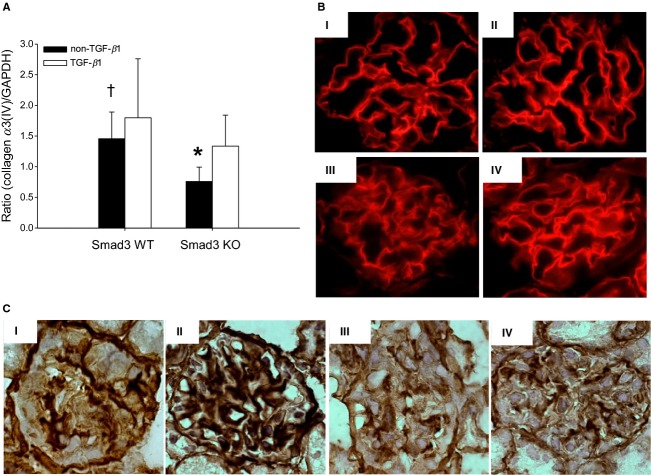
Transforming growth factor (TGF)-β1 has a pivotal role in the pathogenesis of progressive kidney diseases that are characterized by fibrosis. The main intracellular signaling pathway of TGF-β1 is the Smad system, where Smad2 and Smad3 play a central role in transcriptional regulation of target genes involved in extracellular matrix (ECM) metabolism. This study analyzes the hypothesis that blockade of Smad3 attenuates the development of TGF-β1-driven renal fibrosis. This was examined in vivo in a transgenic model of TGF-β1-induced chronic kidney disease with Smad3 or without Smad3 expression and in vitro in mesangial cells and glomerular endothelial cells with Smad2/3 inhibitors or Smad3-knockdown. Electron microscopy was used for evaluation of morphological changes, real-time polymerase chain reaction for detection of RNA expression, and immunohistochemistry for localization of ECM components. Matrix metalloproteinase (MMP) level was assessed by gelatin zymography electrophoresis and located by in situ zymography. The results show TGF-β1-induced mesangial matrix expansion, tubulointerstitial fibrosis, and tubular basement membrane thickening that are attenuated by Smad3 deletion, whereas TGF-β1-induced glomerular basement membrane thickening is not shown. The amount and distribution profile of MMP-2 may suggest a role of the enzyme herein. We conclude that Smad3 targeting is not exclusively beneficial as Smad3 has diverse transcriptional regulatory effects in different cell types in the kidney.
转化生长因子(TGF)-β1在以纤维化为特征的进行性肾脏疾病的发病机制中起关键作用。TGF-β1的主要细胞内信号通路是Smad系统,其中Smad2和Smad3在参与细胞外基质(ECM)代谢的靶基因的转录调控中起核心作用。本研究分析了阻断Smad3可减轻TGF-β1驱动的肾纤维化发展这一假说。在体内,利用TGF-β1诱导的慢性肾脏病转基因模型,分别研究有或无Smad3表达的情况;在体外,利用Smad2/3抑制剂或敲低Smad3的方法,分别在系膜细胞和肾小球内皮细胞中进行研究。采用电子显微镜评估形态学变化,实时聚合酶链反应检测RNA表达,免疫组织化学定位ECM成分。通过明胶酶谱电泳评估基质金属蛋白酶(MMP)水平,并通过原位酶谱法进行定位。结果显示,TGF-β1诱导的系膜基质扩张、肾小管间质纤维化和肾小管基底膜增厚,在缺失Smad3后得到减轻,而TGF-β1诱导的肾小球基底膜增厚未得到显示。MMP-2的量和分布情况可能提示该酶在其中发挥了作用。我们得出结论,靶向Smad3并非完全有益,因为Smad3在肾脏的不同细胞类型中具有多种转录调控作用。