Quan Vanessa, Hulth Anette, Kok Gerdalize, Blumberg Lucille
Division of Public Health Surveillance and Response, National Institute for Communicable Diseases (NICD) of the National Health Laboratory Service, Private Bag X4, Sandringham 2131, Gauteng, South Africa.
Malar J. 2014 Apr 21;13:151. doi: 10.1186/1475-2875-13-151.
Surveillance with timely follow-up of diagnosed cases is a key component of the malaria elimination strategy in South Africa. The strategy requires each malaria case to be reported within 24 hours, and a case should be followed up within 48 hours. However, reporting delays are common in rural parts of the country.
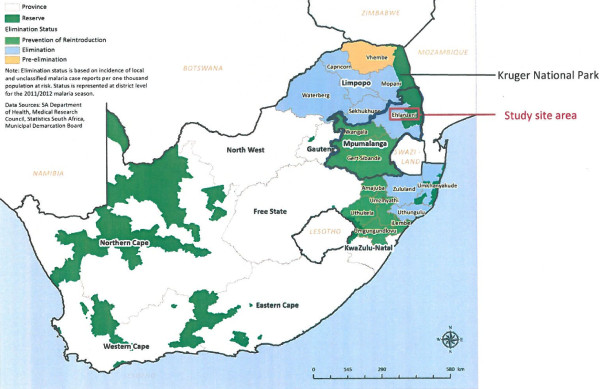
A technical framework was implemented and for eight months a nurse was hired to use a smartphone to report malaria cases to the provincial malaria control programme, from selected primary health care clinics in a rural, malaria-endemic area in South Africa. In addition, a short text message (SMS) notification was sent to the local malaria case investigator for each positive case. The objective was to assess whether reporting over the smartphone led to timelier notification and follow-up of the cases. An evaluation on the simplicity, flexibility, stability, acceptability, and usability of the framework was conducted.
Using mobile reporting, 18 of 23 cases had basic information entered into the provincial malaria information system within 24 hours. For the study period, the complete case information was entered two to three weeks earlier with the mobile reporting than from other clinics. A major improvement was seen in the number of positive cases being followed up within 48 hours. In 2011/2012, only one case out of 22 reported from the same study clinics was followed up within this timeframe. During the study period in 2012/2013, 15 cases out of 23 were followed up within two days. For the other clinics in the area, only a small improvement was seen between the two periods, in the proportion of cases that was followed up within 48 hours.
SMS notification for each diagnosed malaria case improved the timeliness of data transmission, was acceptable to users and was technically feasible in this rural area. For the malaria case investigations, time to follow-up improved compared to other clinics. Although malaria case numbers in the study were small, the results of the qualitative and quantitative evaluations are convincing and consideration should be given to larger-scale use within the national malaria control programme.
对确诊病例进行监测并及时跟进是南非疟疾消除战略的关键组成部分。该战略要求每个疟疾病例在24小时内上报,且病例应在48小时内得到跟进。然而,在该国农村地区,报告延迟现象很常见。
实施了一个技术框架,在八个月的时间里,雇佣一名护士使用智能手机从南非一个疟疾流行的农村地区选定的初级保健诊所向省级疟疾控制项目报告疟疾病例。此外,每例阳性病例都会向当地疟疾病例调查员发送一条简短的短信通知。目的是评估通过智能手机报告是否能使病例得到更及时的通知和跟进。对该框架的简易性、灵活性、稳定性、可接受性和可用性进行了评估。
通过移动报告,23例病例中有18例在24小时内将基本信息录入省级疟疾信息系统。在研究期间,与其他诊所相比,通过移动报告录入完整病例信息的时间提前了两到三周。在48小时内得到跟进的阳性病例数量有了显著改善。在2011/2012年,同一研究诊所报告的22例病例中只有1例在这个时间范围内得到了跟进。在2012/2013年的研究期间,23例中有15例在两天内得到了跟进。对于该地区的其他诊所,在这两个时期内,48小时内得到跟进的病例比例仅有小幅改善。
对每例确诊疟疾病例进行短信通知提高了数据传输的及时性,用户可以接受,并且在这个农村地区技术上是可行的。对于疟疾病例调查,与其他诊所相比,跟进时间有所改善。尽管研究中的疟疾病例数量较少,但定性和定量评估的结果令人信服,应考虑在国家疟疾控制项目中大规模使用。