Malaria Programme, Clinton Health Access Initiative, Pretoria, South Africa.
Department of Health, Malaria and Other Vector Borne Diseases, Pretoria, South Africa.
Malar J. 2019 Feb 21;18(1):45. doi: 10.1186/s12936-019-2683-4.
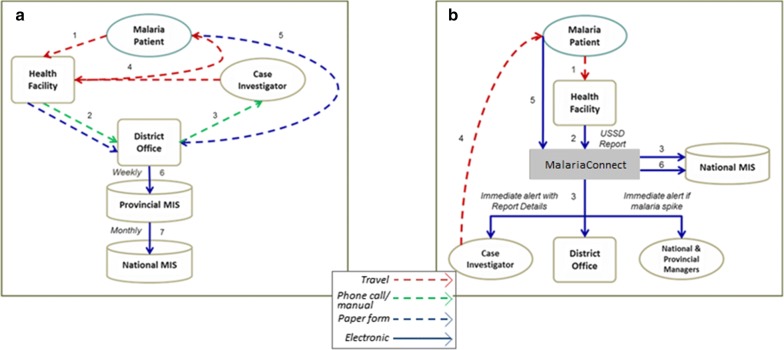
As surveillance is a key strategy for malaria elimination in South Africa, ensuring strong surveillance systems is a National Department of Health priority. Historically, real time tracking of case trends and reporting within 24 h-a requirement in South Africa's National surveillance guidelines-has not been possible. To enhance surveillance and response efficiency, a mobile surveillance tool, MalariaConnect, was developed using Unstructured Supplementary Service Data (USSD) technology. It was rolled out in health facilities in malaria endemic areas of South Africa to provide 24-h reporting of malaria cases.
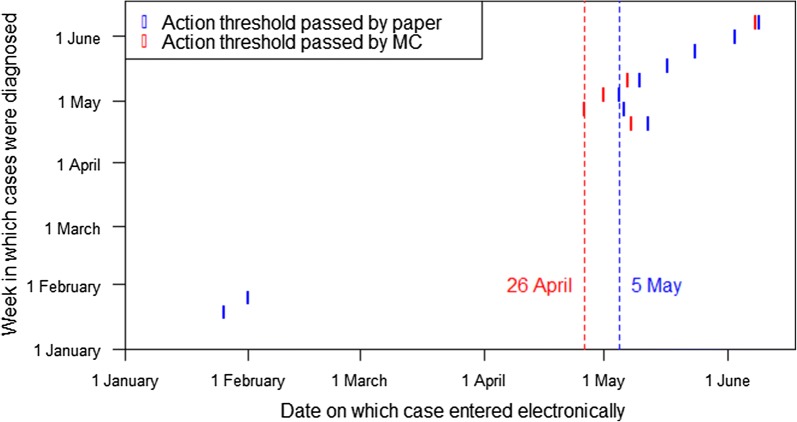
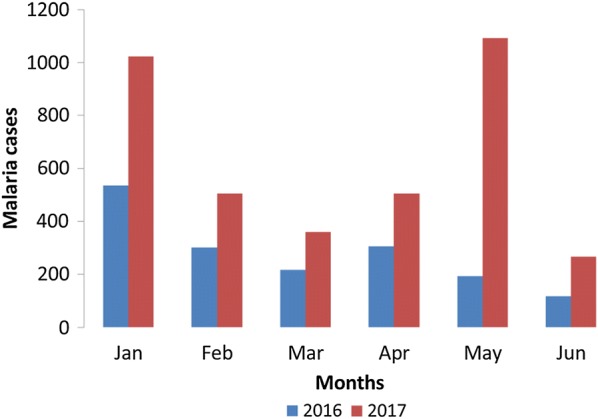
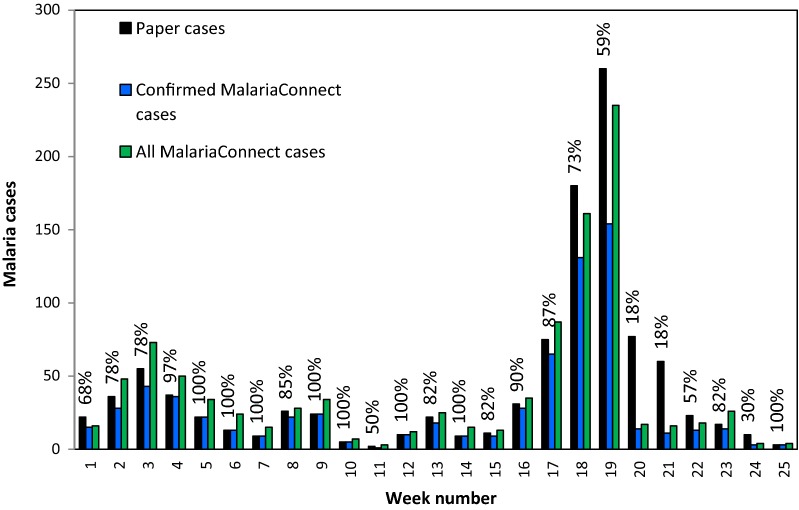
To evaluate the efficiency of the mobile tool to detect an outbreak data were extracted from the paper based and MalariaConnect reporting systems in Bushbuckridge from 1 January to 18 June 2017. These data were subject to time series analyses to determine if MalariaConnect provided sufficient data reliably to detect increasing case trends reported through the paper system. The Chi squared test was used to determine goodness of fit between the following indicator data generated using MalariaConnect and paper reporting systems: timeliness, completeness, and precision.
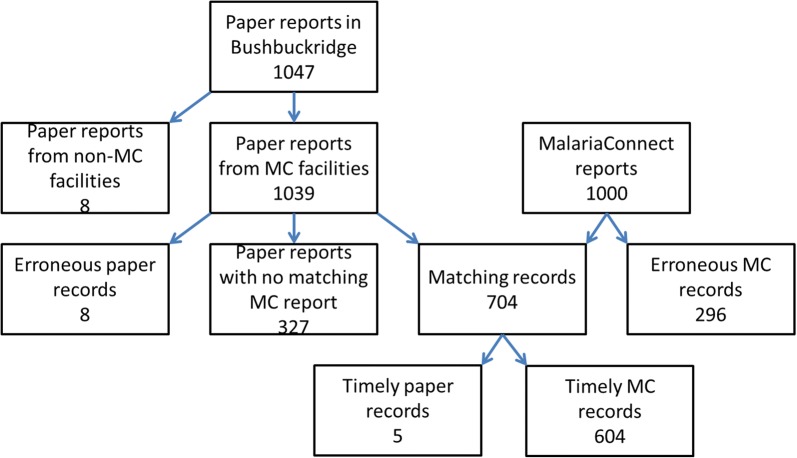
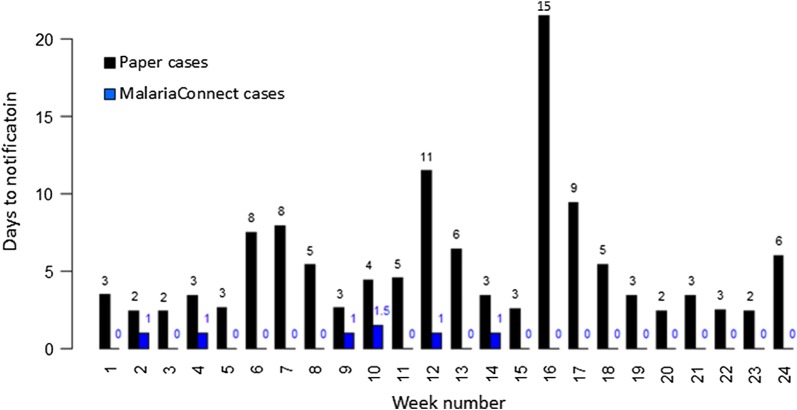
MalariaConnect adequately tracked case trends reported through the paper system. Timeliness of reporting increased significantly using MalariaConnect with 0.63 days to notification compared to 5.65 days using the paper-system (p < 0.05). The completeness of reporting was significantly higher for the paper system (100% completion; p < 0.05), compared to confirmed MalariaConnect cases (61%). There was a moderate association between data precision and the reporting system (p < 0.05). MalariaConnect provided an effective way of reliably and accurately identifying the onset of the malaria outbreak in Bushbuckridge.
Timeliness significantly improved using MalariaConnect and in a malaria elimination setting, can be used to markedly improve case investigation and response activities within the recommended 72-h period. Although data completeness and precision were lower compared to paper reporting, MalariaConnect data can be used to trigger outbreak responses.
由于监测是南非消除疟疾的关键策略,因此确保建立强大的监测系统是南非卫生部的当务之急。从历史上看,实时跟踪病例趋势并在 24 小时内报告——这是南非国家监测指南的要求——是不可能的。为了提高监测和应对效率,使用非结构化补充服务数据 (USSD) 技术开发了一个移动监测工具,称为 MalariaConnect。它在南非疟疾流行地区的卫生机构中推出,以提供 24 小时报告疟疾病例。
为了评估该移动工具检测暴发的效率,从 2017 年 1 月 1 日至 6 月 18 日,从布须克卢夫德的纸质和 MalariaConnect 报告系统中提取数据。对这些数据进行时间序列分析,以确定 MalariaConnect 是否提供了足够的数据来可靠地检测通过纸质系统报告的病例趋势增加。使用卡方检验来确定使用 MalariaConnect 和纸质报告系统生成的以下指标数据的拟合优度:及时性、完整性和准确性。
MalariaConnect 能够充分跟踪通过纸质系统报告的病例趋势。使用 MalariaConnect 报告的及时性显著提高,通知时间从使用纸质系统的 5.65 天减少到 0.63 天(p<0.05)。纸质系统的报告完整性显著更高(100%完成;p<0.05),而经证实的 MalariaConnect 病例为 61%。数据精度与报告系统之间存在中度关联(p<0.05)。MalariaConnect 提供了一种可靠且准确地识别布须克卢夫德疟疾暴发的有效方法。
使用 MalariaConnect 显著提高了及时性,在消除疟疾的环境中,可以明显改善建议的 72 小时内的病例调查和应对活动。尽管与纸质报告相比,数据完整性和准确性较低,但 MalariaConnect 数据可用于触发暴发应对。