Dirin Dmitry N, Dreyfuss Sébastien, Bodnarchuk Maryna I, Nedelcu Georgian, Papagiorgis Paris, Itskos Grigorios, Kovalenko Maksym V
Institute of Inorganic Chemistry, Department of Chemistry and Applied Bioscience, ETH Zürich , CH-8093 Zürich, Switzerland.
J Am Chem Soc. 2014 May 7;136(18):6550-3. doi: 10.1021/ja5006288. Epub 2014 Apr 22.
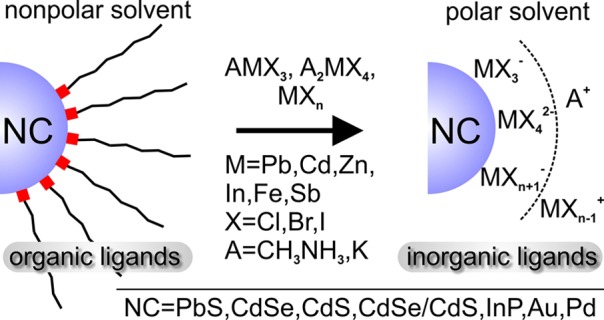
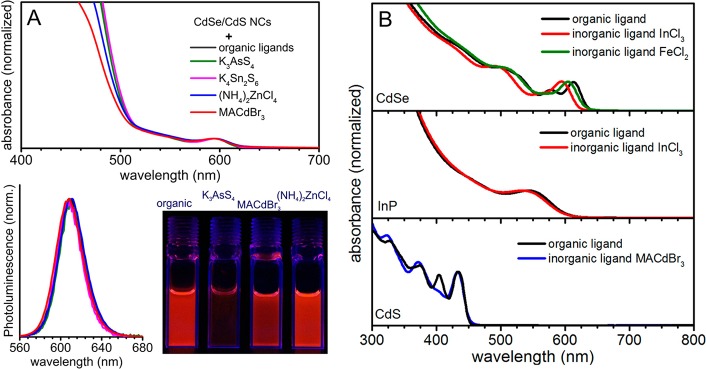
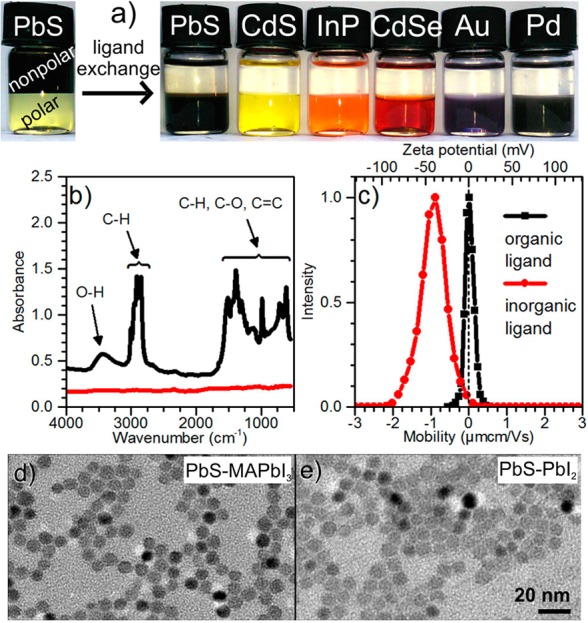
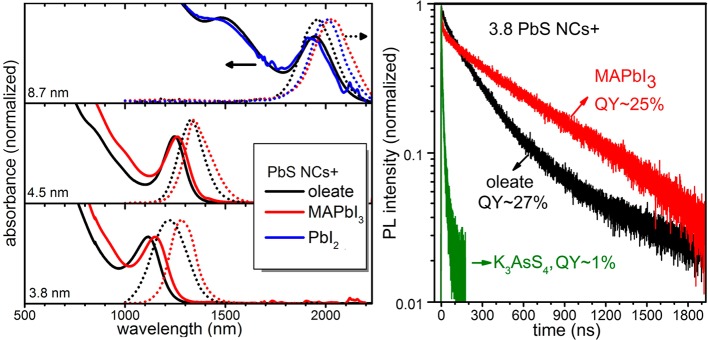
Lead halide perovskites (CH3NH3PbX3, where X = I, Br) and other metal halide complexes (MX(n), where M = Pb, Cd, In, Zn, Fe, Bi, Sb) have been studied as inorganic capping ligands for colloidal nanocrystals. We present the methodology for the surface functionalization via ligand-exchange reactions and the effect on the optical properties of IV-VI, II-VI, and III-V semiconductor nanocrystals. In particular, we show that the Lewis acid-base properties of the solvents, in addition to the solvent dielectric constant, must be properly adjusted for successful ligand exchange and colloidal stability. High luminescence quantum efficiencies of 20-30% for near-infrared emitting CH3NH3PbI3-functionalized PbS nanocrystals and 50-65% for red-emitting CH3NH3CdBr3- and (NH4)2ZnCl4-capped CdSe/CdS nanocrystals point to highly efficient electronic passivation of the nanocrystal surface.
卤化铅钙钛矿(CH3NH3PbX3,其中X = I、Br)以及其他金属卤化物配合物(MX(n),其中M = Pb、Cd、In、Zn、Fe、Bi、Sb)已被研究用作胶体纳米晶体的无机封端配体。我们介绍了通过配体交换反应进行表面功能化的方法以及对IV-VI、II-VI和III-V族半导体纳米晶体光学性质的影响。特别是,我们表明,除了溶剂介电常数外,溶剂的路易斯酸碱性质也必须进行适当调整,以实现成功的配体交换和胶体稳定性。对于近红外发射的CH3NH3PbI3功能化的PbS纳米晶体,发光量子效率高达20-30%;对于红色发射的CH3NH3CdBr3和(NH4)2ZnCl4封端的CdSe/CdS纳米晶体,发光量子效率为50-65%,这表明纳米晶体表面具有高效的电子钝化作用。