Chavan Randhir, Panneerselvam Swati, Adhana Parul, Narendran Nirodhini, Yang Yit
Eye Infirmary, New Cross Hospital, Royal Wolverhampton Hospitals NHS Trust Wolverhampton, West Midlands, UK.
Eye Infirmary, New Cross Hospital, Royal Wolverhampton Hospitals NHS Trust Wolverhampton, West Midlands, UK ; Faculty of Life and Health Sciences, Aston University, Birmingham, UK.
Clin Ophthalmol. 2014 Apr 8;8:717-23. doi: 10.2147/OPTH.S60763. eCollection 2014.
The aim of this study was to describe bilateral visual outcomes and the effect of incomplete follow-up after 3 years of ranibizumab therapy for neovascular age-related macular degeneration. Secondarily, the demands on service provision over a 3-year period were described.
Data on visual acuity, hospital visits, and injections were collected over 36 months on consecutive patients commencing treatment over a 9-month period. Visual outcome was determined for 1) all patients, using last observation carried forward for missed visits due to early discontinuation and 2) only those patients completing full 36-month follow-up.
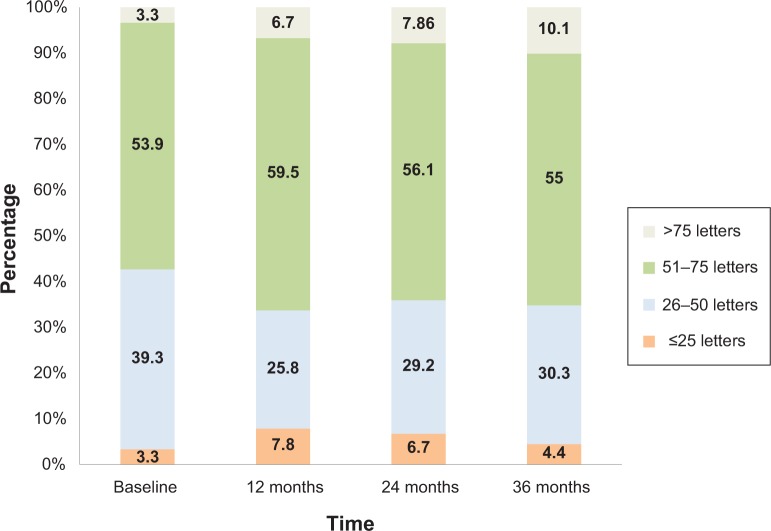
Over 3 years, 120 patients cumulatively attended hospital for 1,823 noninjection visits and 1,365 injection visits. A visual acuity loss of <15 letters (L) was experienced by 78.2% of patients. For all patients (n=120), there was a mean loss of 1.68 L using last observation carried forward for missing values. Excluding five patients who died and 30 who discontinued follow-up, mean gain was 1.47 L. In bilateral cases, final acuity was on average 9 L better in second eyes compared to first eyes. Also, 91% of better-seeing eyes continued to be the better-seeing eye.
We have demonstrated our approach to describing the long-term service provision and visual outcomes of ranibizumab therapy for neovascular age-related macular degeneration in a consecutive cohort of patients. Although there was a heavy burden with very frequent injections and clinic visits, patients can expect a good level of visual stability and a very high chance of maintaining their better-seeing eye for up to 3 years.
本研究旨在描述雷珠单抗治疗新生血管性年龄相关性黄斑变性3年后的双侧视力结果以及不完全随访的影响。其次,描述了3年期间的服务需求。
收集了连续9个月开始治疗的患者在36个月内的视力、医院就诊和注射数据。对1)所有患者,采用末次观察值向前结转法处理因早期停药而漏诊的情况,以及2)仅对完成36个月完整随访的患者确定视力结果。
3年期间,120例患者累计住院进行了1823次非注射就诊和1365次注射就诊。78.2%的患者视力下降<15个字母(L)。对于所有患者(n = 120),采用末次观察值向前结转法处理缺失值后,平均视力下降1.68 L。排除5例死亡患者和30例停止随访的患者后,平均视力提高1.47 L。在双侧病例中,与第一只眼相比,第二只眼的最终视力平均高9 L。此外,91%视力较好的眼睛仍然保持较好的视力。
我们展示了在连续队列患者中描述雷珠单抗治疗新生血管性年龄相关性黄斑变性的长期服务提供和视力结果的方法。尽管频繁注射和门诊就诊负担沉重,但患者在长达3年的时间里有望保持良好的视力稳定性,并且有很高的几率保持视力较好的眼睛。