Institute of Immunology, Medical Faculty 'Carl Gustav Carus', TU Dresden, Dresden, Germany.
Institute of Immunology, Medical Faculty 'Carl Gustav Carus', TU Dresden, Dresden, Germany; Helmholtz Zentrum Dresden-Rossendorf, Institute of Radiopharmaceutical Cancer Research, Department of Radioimmunology, Dresden, Germany.
PLoS One. 2014 Apr 21;9(4):e95517. doi: 10.1371/journal.pone.0095517. eCollection 2014.
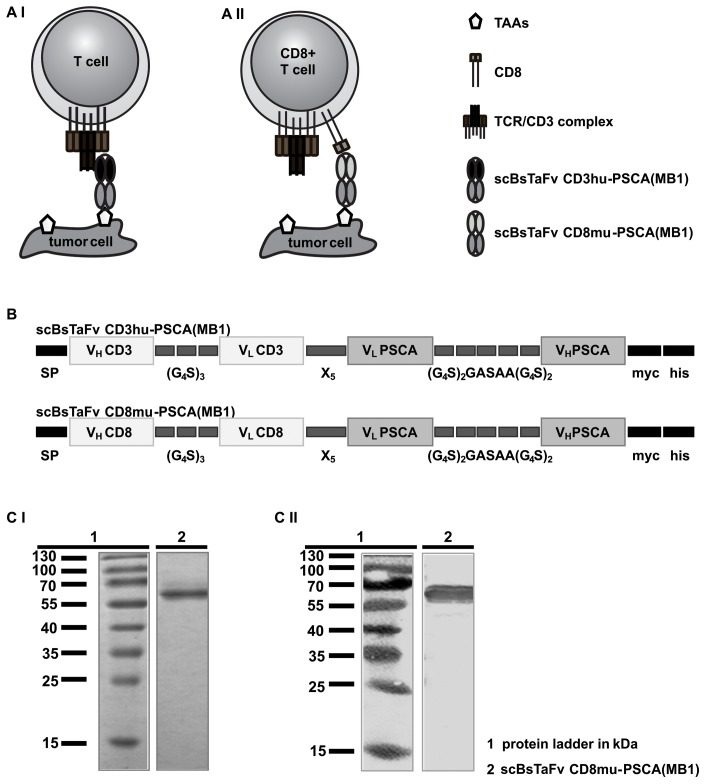
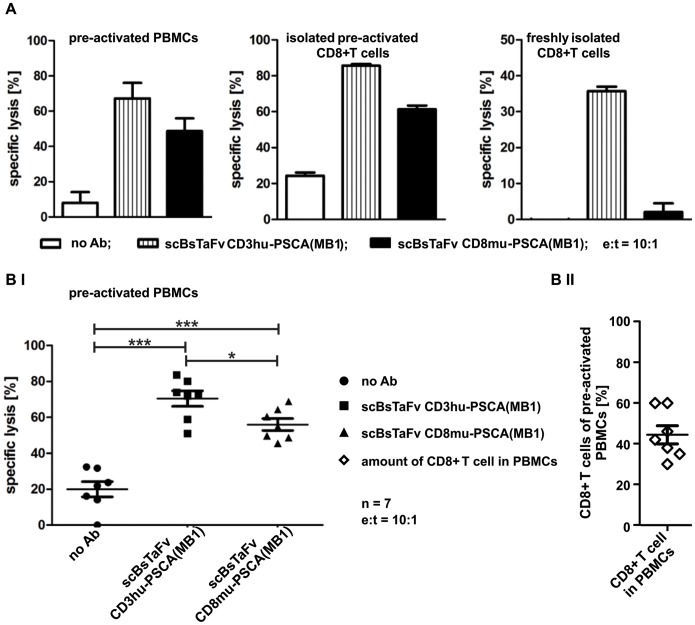
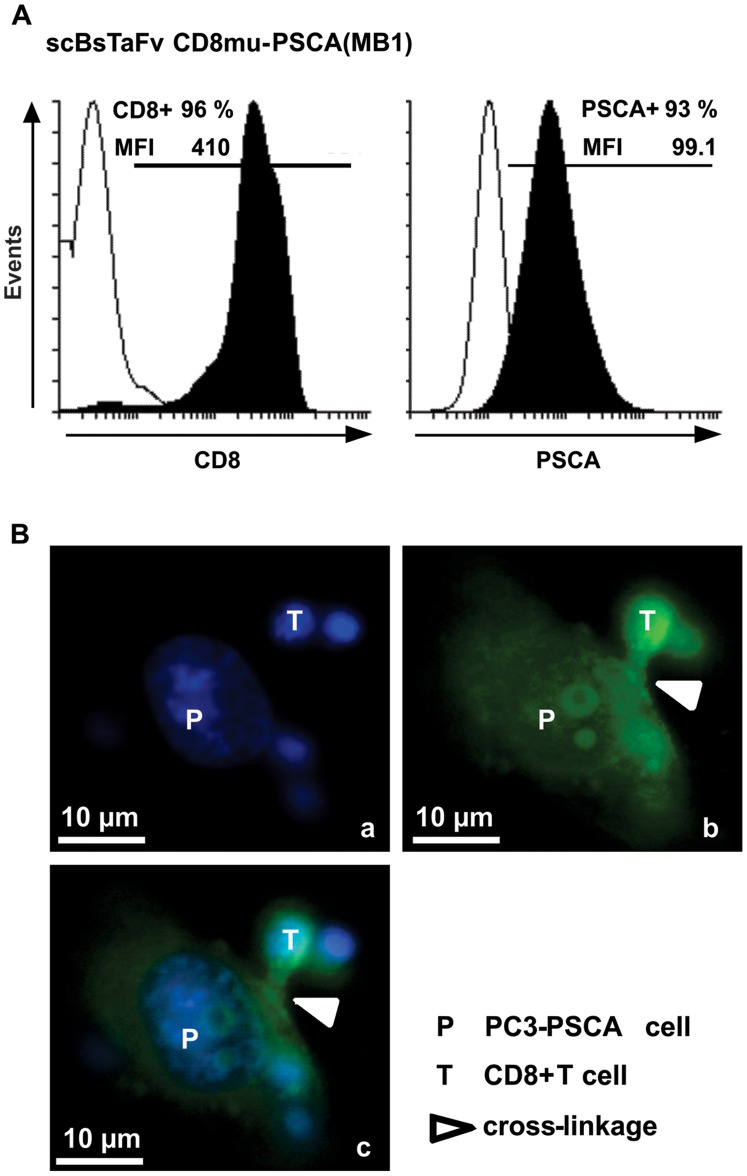
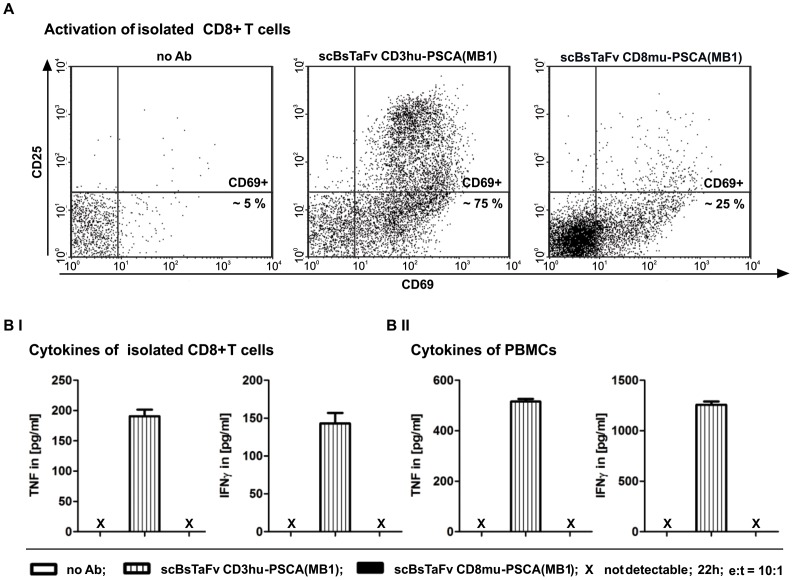
There is currently growing interest in retargeting of effector T cells to tumor cells via bispecific antibodies (bsAbs). Usually, bsAbs are directed on the one hand to the CD3 complex of T cells and on the other hand to a molecule expressed on the surface of the target cell. A bsAb-mediated cross-linkage via CD3 leads to an activation of CD8+ T cells and consequently to killing of the target cells. In parallel, CD4+ T cells including TH1, TH2, TH17 cells and even regulatory T cells (Tregs) will be activated as well. Cytokines produced by CD4+ T cells can contribute to severe side effects e. g. life-threatening cytokine storms and, thinking of the immunosupressive function of Tregs, can even be counterproductive. Therefore, we asked whether or not it is feasible to limit retargeting to CD8+ T cells e. g. via targeting of the co-receptor CD8 instead of CD3. In order to test for proof of concept, a novel bsAb with specificity for CD8 and a tumor-associated surface antigen was constructed. Interestingly, we found that pre-activated (but not freshly isolated) CD8+ T cells can be retargeted via CD8-engaging bsAbs leading to an efficient lysis of target cells.
目前,人们对通过双特异性抗体(bsAb)将效应 T 细胞重新靶向肿瘤细胞的兴趣日益浓厚。通常,bsAb 一方面针对 T 细胞的 CD3 复合物,另一方面针对靶细胞表面表达的分子。通过 CD3 介导的 bsAb 交联导致 CD8+T 细胞的激活,进而导致靶细胞的杀伤。同时,CD4+T 细胞(包括 TH1、TH2、TH17 细胞甚至调节性 T 细胞(Tregs))也会被激活。CD4+T 细胞产生的细胞因子可导致严重的副作用,例如危及生命的细胞因子风暴,并且考虑到 Tregs 的免疫抑制功能,甚至可能适得其反。因此,我们想知道是否可以通过靶向共受体 CD8 而不是 CD3 来限制重新靶向 CD8+T 细胞,例如。为了验证这一概念,构建了一种针对 CD8 和肿瘤相关表面抗原的新型 bsAb。有趣的是,我们发现,通过 CD8 结合 bsAb 可以重新靶向预先激活(但不是新鲜分离)的 CD8+T 细胞,从而有效裂解靶细胞。