University of Pittsburgh School of Medicine, Pittsburgh, PA, USA.
Janssen Biotherapeutics, The Janssen Pharmaceutical Companies of Johnson & Johnson, Spring House, PA, USA.
Br J Cancer. 2021 Mar;124(6):1037-1048. doi: 10.1038/s41416-020-01225-5. Epub 2021 Jan 19.
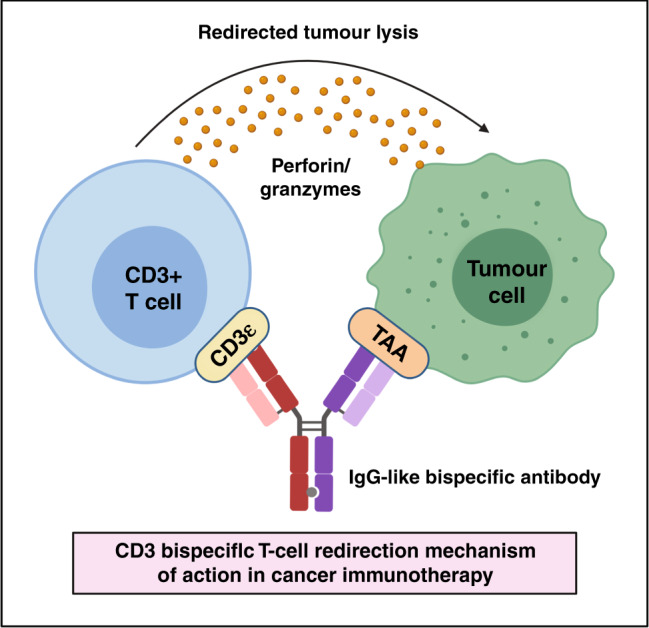
The development of bispecific antibodies that redirect the cytotoxic activity of CD3+ T cells to tumours is a promising immunotherapeutic strategy for the treatment of haematological malignancies and solid cancers. Since the landmark FDA approval at the end of 2014 of the anti-CD3 × anti-CD19 bispecific antibody blinatumomab (Blincyto) for the treatment of relapsed/refractory B-cell acute lymphoblastic leukaemia, ~100 clinical trials investigating the safety and efficacy of CD3+ bispecific T-cell redirectors for cancer have been initiated. However, despite early success, numerous challenges pertaining to CD3+ T-cell redirection in the context of cancer exist, including the recruitment of counterproductive CD3+ T-cell subsets, the release of systemic cytokines, the expansion of immune checkpoint molecules, the presence of an immunosuppressive tumour microenvironment, tumour antigen loss/escape, on-target off-tumour toxicity and suboptimal potency. The aim of the present review is to discuss novel approaches to overcome the key challenges associated with CD3+ bispecific T-cell redirection in order to achieve an optimal balance of anti-tumour activity and safety.
双特异性抗体可将 CD3+T 细胞的细胞毒性活性重新导向肿瘤,这是一种很有前途的免疫治疗策略,可用于治疗血液系统恶性肿瘤和实体瘤。自 2014 年底 FDA 批准抗 CD3 抗体×抗 CD19 双特异性抗体blinatumomab(blinatumomab)用于治疗复发性/难治性 B 细胞急性淋巴细胞白血病以来,已经启动了约 100 项临床试验,以研究 CD3+双特异性 T 细胞重定向剂在癌症治疗中的安全性和疗效。然而,尽管早期取得了成功,但在癌症背景下,CD3+T 细胞重定向仍然存在许多挑战,包括募集产生不良反应的 CD3+T 细胞亚群、全身性细胞因子的释放、免疫检查点分子的扩增、存在免疫抑制性肿瘤微环境、肿瘤抗原丢失/逃逸、肿瘤相关毒性和效力不足等。本综述旨在讨论克服与 CD3+双特异性 T 细胞重定向相关的关键挑战的新方法,以实现抗肿瘤活性和安全性的最佳平衡。