Department of Toxicology, Nutrition and Toxicology Research Institute Maastricht (NUTRIM), Maastricht University, Maastricht, The Netherlands; Top Institute Food and Nutrition, Wageningen, The Netherlands.
Department of Pediatric Pulmonology, School for Public Health and Primary Care (CAPHRI), Maastricht University Medical Center (MUMC), Maastricht, The Netherlands.
PLoS One. 2014 Apr 21;9(4):e95668. doi: 10.1371/journal.pone.0095668. eCollection 2014.
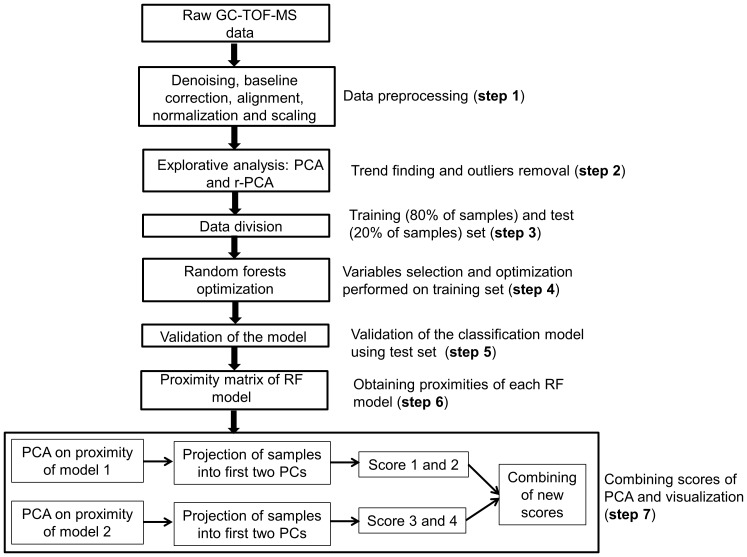
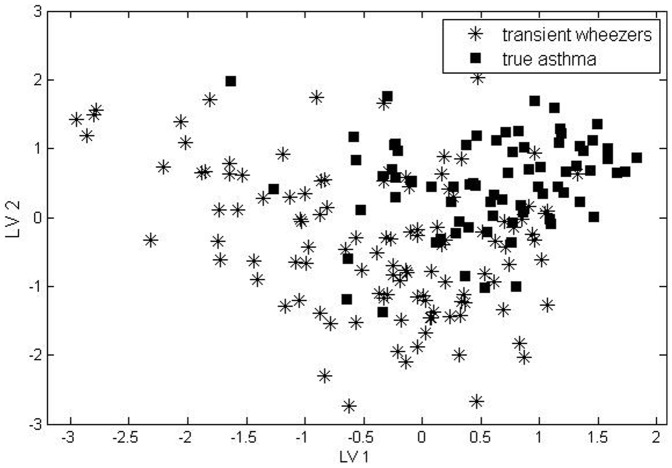
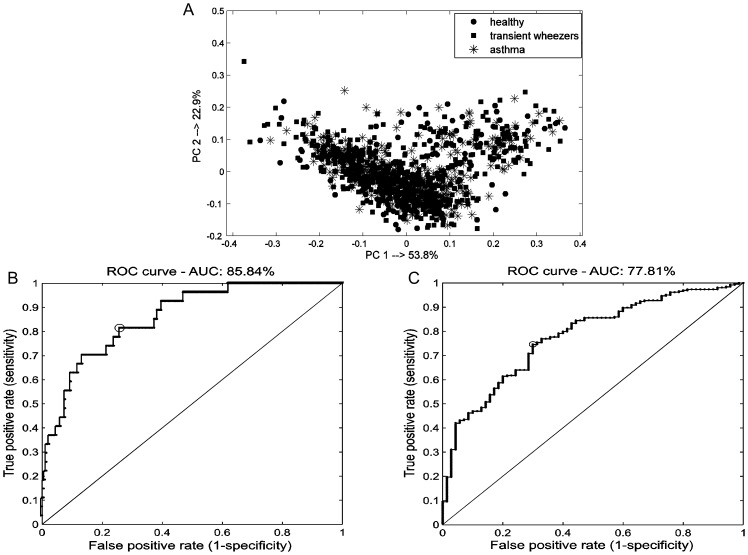
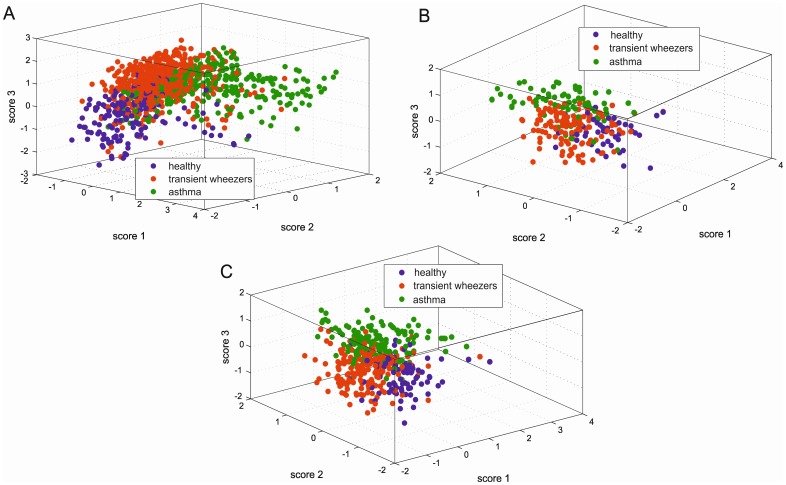
Wheezing is one of the most common respiratory symptoms in preschool children under six years old. Currently, no tests are available that predict at early stage who will develop asthma and who will be a transient wheezer. Diagnostic tests of asthma are reliable in adults but the same tests are difficult to use in children, because they are invasive and require active cooperation of the patient. A non-invasive alternative is needed for children. Volatile Organic Compounds (VOCs) excreted in breath could yield such non-invasive and patient-friendly diagnostic. The aim of this study was to identify VOCs in the breath of preschool children (inclusion at age 2-4 years) that indicate preclinical asthma. For that purpose we analyzed the total array of exhaled VOCs with Gas Chromatography time of flight Mass Spectrometry of 252 children between 2 and 6 years of age. Breath samples were collected at multiple time points of each child. Each breath-o-gram contained between 300 and 500 VOCs; in total 3256 different compounds were identified across all samples. Using two multivariate methods, Random Forests and dissimilarity Partial Least Squares Discriminant Analysis, we were able to select a set of 17 VOCs which discriminated preschool asthmatic children from transient wheezing children. The correct prediction rate was equal to 80% in an independent test set. These VOCs are related to oxidative stress caused by inflammation in the lungs and consequently lipid peroxidation. In conclusion, we showed that VOCs in the exhaled breath predict the subsequent development of asthma which might guide early treatment.
喘息是 6 岁以下学龄前儿童最常见的呼吸道症状之一。目前,没有可以早期预测哪些儿童会发展为哮喘,哪些儿童只是短暂性喘息的检测手段。哮喘的诊断测试在成人中是可靠的,但同样的测试在儿童中很难使用,因为它们具有侵入性,需要患者的积极配合。儿童需要一种非侵入性的替代方法。呼气中排出的挥发性有机化合物(VOCs)可能提供这种非侵入性且适合患者的诊断方法。本研究的目的是确定学龄前儿童(纳入年龄为 2-4 岁)呼吸中指示临床前哮喘的 VOCs。为此,我们使用气相色谱飞行时间质谱分析了 252 名 2 至 6 岁儿童的呼出 VOC 总谱。在每个孩子的多个时间点收集呼吸样本。每个呼吸图谱包含 300 到 500 种 VOC;总共在所有样本中鉴定出 3256 种不同的化合物。使用两种多元方法,随机森林和差异偏最小二乘判别分析,我们能够选择一组 17 种 VOC,这些 VOC 可以区分学龄前哮喘儿童和短暂性喘息儿童。在独立测试集中,正确预测率等于 80%。这些 VOC 与肺部炎症引起的氧化应激有关,因此与脂质过氧化有关。总之,我们表明,呼气中的 VOC 可以预测随后的哮喘发展,这可能指导早期治疗。