Department of Nutrition and Food Hygiene, School of Public Health, China Medical University, No. 92 Beier Road, Heping District, Shenyang 110001, Liaoning, China.
Department of Orthopedics, Shengjing Hospital, China Medical University, No. 36 Sanhao Street, Sanhao District, Shenyang 110004, Liaoning, China.
Int J Mol Sci. 2014 Apr 22;15(4):6925-40. doi: 10.3390/ijms15046925.
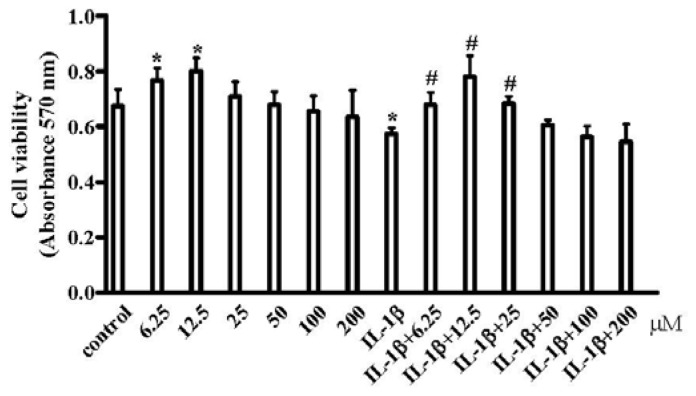
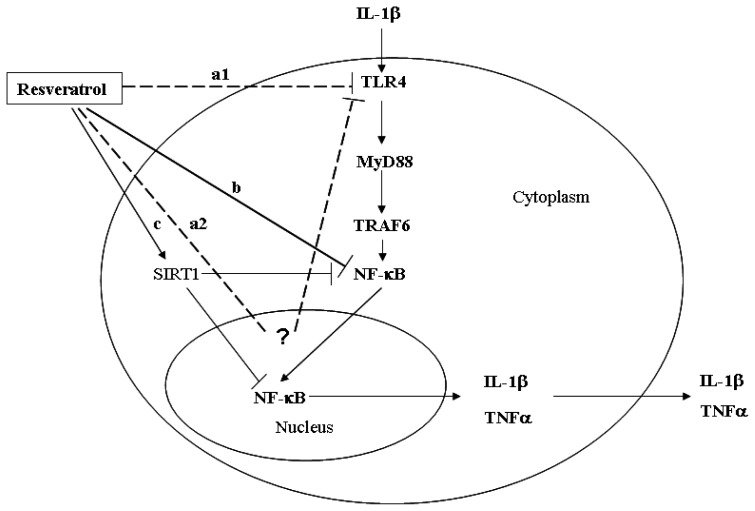
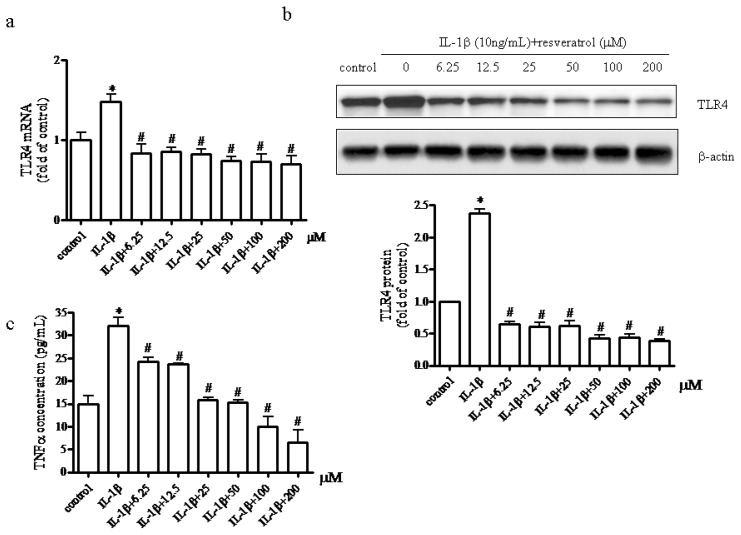
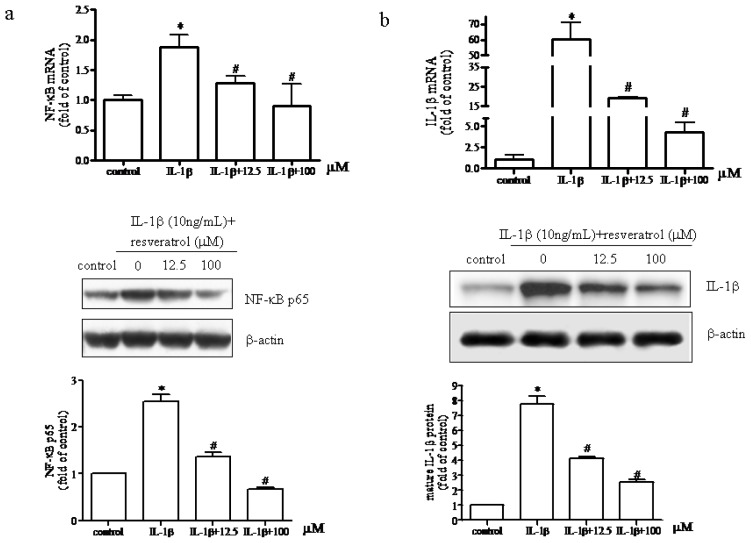
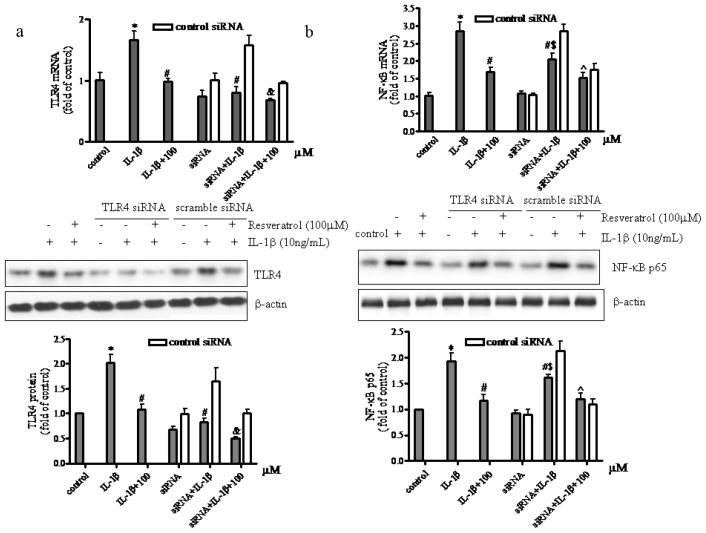
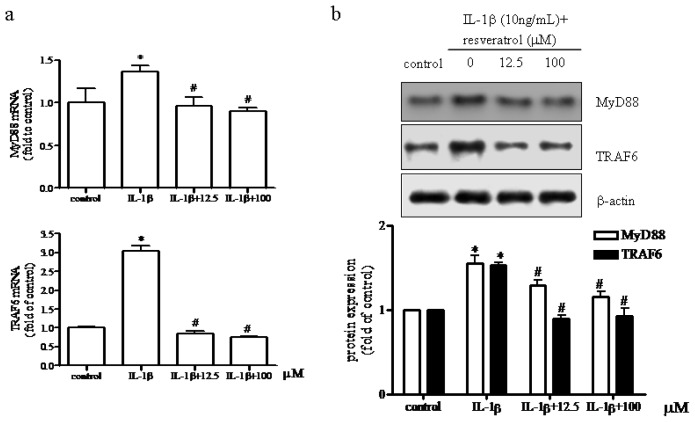
Resveratrol is a natural polyphenolic compound that prevents inflammation in chondrocytes and animal models of osteoarthritis (OA) via yet to be defined mechanisms. The purpose of this study was to determine whether the protective effect of resveratrol on IL-1β-induced human articular chondrocytes was associated with the TLR4/MyD88/NF-кB signaling pathway by incubating human articular chondrocytes (harvested from osteoarthritis patients) with IL-1β before treatment with resveratrol. Cell viability was evaluated using the MTT (3-(4,5-dimethylthiazol-2-yl)-2,5-diphenyltetrazolium bromide) assay and TNFα levels in culture supernatants were measured by ELISA(Enzymelinked immunosorbent assay). The levels of TLR4 and its downstream signaling targets (MyD88 and TRAF6) and IL-1β were assessed by measuring the levels of mRNA and protein expression by real-time RT-PCR and western blot analysis, respectively, in addition to assessing NF-кB activation. In addition, TLR4 siRNA was used to block TLR4 expression in chondrocytes further demonstrating that resveratrol prevented IL-1β-mediated inflammation by TLR4 inhibition. We found that resveratrol prevented IL-1β-induced reduction in cell viability. Stimulation of chondrocytes with IL-1β caused a significant up-regulation of TLR4 and its downstream targets MyD88 and TRAF6 resulting in NF-кB activation associated with the synthesis of IL-1β and TNFα. These IL-1β-induced inflammatory responses were all effectively reversed by resveratrol. Furthermore, activation of NF-кB in chondrocytes treated with TLR4 siRNA was significantly attenuated, but not abolished, and exposure to resveratrol further reduced NF-кB translocation. These data suggested that resveratrol prevented IL-1β-induced inflammation in human articular chondrocytes at least in part by inhibiting the TLR4/MyD88/NF-кB signaling pathway suggesting that resveratrol has the potential to be used as a nutritional supplement to counteract OA symptoms.
白藜芦醇是一种天然多酚化合物,通过尚未明确的机制,可防止软骨细胞炎症和骨关节炎(OA)的动物模型炎症。本研究的目的是通过在使用白藜芦醇治疗之前用 IL-1β 孵育人关节软骨细胞(从 OA 患者中收获),确定白藜芦醇对 IL-1β 诱导的人关节软骨细胞的保护作用是否与 TLR4/MyD88/NF-κB 信号通路有关。通过 MTT(3-(4,5-二甲基噻唑-2-基)-2,5-二苯基四氮唑溴盐)测定法评估细胞活力,并通过 ELISA(酶联免疫吸附测定)测量培养上清液中的 TNFα 水平。通过实时 RT-PCR 和 Western blot 分析分别测量 TLR4 及其下游信号靶标(MyD88 和 TRAF6)和 IL-1β 的水平,评估 mRNA 和蛋白质表达水平,此外还评估 NF-κB 激活。此外,使用 TLR4 siRNA 阻断软骨细胞中的 TLR4 表达,进一步证明白藜芦醇通过 TLR4 抑制防止 IL-1β 介导的炎症。我们发现白藜芦醇可防止 IL-1β 诱导的细胞活力降低。IL-1β 刺激软骨细胞导致 TLR4 及其下游靶标 MyD88 和 TRAF6 的显着上调,导致 NF-κB 激活与 IL-1β 和 TNFα 的合成相关。这些 IL-1β 诱导的炎症反应均被白藜芦醇有效逆转。此外,用 TLR4 siRNA 处理的软骨细胞中 NF-κB 的激活显着减弱,但未被消除,并且暴露于白藜芦醇进一步降低了 NF-κB 易位。这些数据表明,白藜芦醇通过抑制 TLR4/MyD88/NF-κB 信号通路,至少部分防止了人关节软骨细胞中 IL-1β 诱导的炎症,表明白藜芦醇具有作为营养补充剂用于对抗 OA 症状的潜力。