Cho Hyong-Ho, Cargnin Francesca, Kim Yujin, Lee Bora, Kwon Ryuk-Jun, Nam Heejin, Shen Rongkun, Barnes Anthony P, Lee Jae W, Lee Seunghee, Lee Soo-Kyung
Pediatric Neuroscience Research Program, Papé Family Pediatric Research Institute, Department of Pediatrics, Portland, Oregon, United States of America; Department of Otolaryngology-Head and Neck Surgery, Chonnam National University Medical School, Gwangju, Korea.
Pediatric Neuroscience Research Program, Papé Family Pediatric Research Institute, Department of Pediatrics, Portland, Oregon, United States of America.
PLoS Genet. 2014 Apr 24;10(4):e1004280. doi: 10.1371/journal.pgen.1004280. eCollection 2014 Apr.
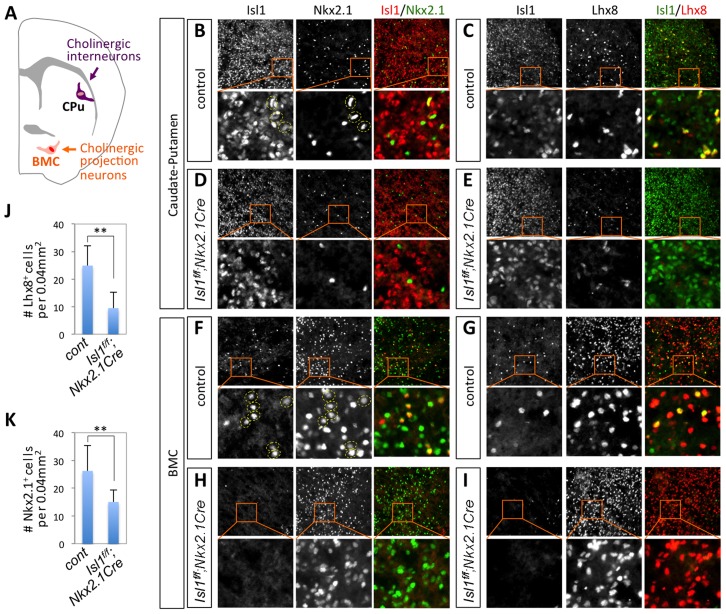
The establishment of correct neurotransmitter characteristics is an essential step of neuronal fate specification in CNS development. However, very little is known about how a battery of genes involved in the determination of a specific type of chemical-driven neurotransmission is coordinately regulated during vertebrate development. Here, we investigated the gene regulatory networks that specify the cholinergic neuronal fates in the spinal cord and forebrain, specifically, spinal motor neurons (MNs) and forebrain cholinergic neurons (FCNs). Conditional inactivation of Isl1, a LIM homeodomain factor expressed in both differentiating MNs and FCNs, led to a drastic loss of cholinergic neurons in the developing spinal cord and forebrain. We found that Isl1 forms two related, but distinct types of complexes, the Isl1-Lhx3-hexamer in MNs and the Isl1-Lhx8-hexamer in FCNs. Interestingly, our genome-wide ChIP-seq analysis revealed that the Isl1-Lhx3-hexamer binds to a suite of cholinergic pathway genes encoding the core constituents of the cholinergic neurotransmission system, such as acetylcholine synthesizing enzymes and transporters. Consistently, the Isl1-Lhx3-hexamer directly coordinated upregulation of cholinergic pathways genes in embryonic spinal cord. Similarly, in the developing forebrain, the Isl1-Lhx8-hexamer was recruited to the cholinergic gene battery and promoted cholinergic gene expression. Furthermore, the expression of the Isl1-Lhx8-complex enabled the acquisition of cholinergic fate in embryonic stem cell-derived neurons. Together, our studies show a shared molecular mechanism that determines the cholinergic neuronal fate in the spinal cord and forebrain, and uncover an important gene regulatory mechanism that directs a specific neurotransmitter identity in vertebrate CNS development.
建立正确的神经递质特征是中枢神经系统发育中神经元命运特化的关键步骤。然而,在脊椎动物发育过程中,参与特定类型化学驱动神经传递决定的一系列基因是如何协同调控的,我们却知之甚少。在此,我们研究了脊髓和前脑(具体为脊髓运动神经元和前脑胆碱能神经元)中指定胆碱能神经元命运的基因调控网络。Isl1是一种在分化中的运动神经元和胆碱能神经元中均有表达的LIM同源结构域因子,其条件性失活导致发育中的脊髓和前脑胆碱能神经元大量缺失。我们发现Isl1形成了两种相关但不同的复合物,即运动神经元中的Isl1-Lhx3六聚体和胆碱能神经元中的Isl1-Lhx8六聚体。有趣的是,我们的全基因组ChIP-seq分析表明,Isl1-Lhx3六聚体与一系列编码胆碱能神经传递系统核心成分的胆碱能通路基因结合,如乙酰胆碱合成酶和转运体。一致的是,Isl1-Lhx3六聚体直接协同上调胚胎脊髓中胆碱能通路基因的表达。同样,在发育中的前脑,Isl1-Lhx8六聚体被募集到胆碱能基因簇并促进胆碱能基因表达。此外,Isl1-Lhx8复合物的表达使胚胎干细胞衍生的神经元获得胆碱能命运。总之,我们的研究揭示了一种共同的分子机制,该机制决定了脊髓和前脑胆碱能神经元的命运,并揭示了一种重要的基因调控机制,该机制在脊椎动物中枢神经系统发育中指导特定的神经递质身份。