Hoebert Joëlle M, van Dijk Liset, Mantel-Teeuwisse Aukje K, Leufkens Hubert Gm, Laing Richard O
Division of Pharmacoepidemiology and Clinical Pharmacology, Utrecht Institute for Pharmaceutical Sciences (UIPS), Utrecht, the Netherlands.
Netherlands Institute for Health Services Research (NIVEL), Utrecht, the Netherlands.
J Pharm Policy Pract. 2013 Jul 10;6:5. doi: 10.1186/2052-3211-6-5. eCollection 2013.
Continuous provision of appropriate medicines of assured quality, in adequate quantities, and at reasonable prices is a concern for all national governments. A national medicines policy (NMP) developed in a collaborative fashion identifies strategies needed to meet these objectives and provides a comprehensive framework to develop all components of a national pharmaceutical sector. To meet the health needs of the population, there is a general need for medicine policies based on universal principles, but nevertheless adapted to the national situation. This review aims to provide a quantitative and qualitative (describing the historical development) study of the development process and evolution of NMPs.
The number of NMPs and their current status has been obtained from the results of the assessment of WHO Level I indicators. The policy formulation process is examined in more detail with case studies from four countries: Sri Lanka, Australia, former Yugoslav Republic of Macedonia and South Africa.
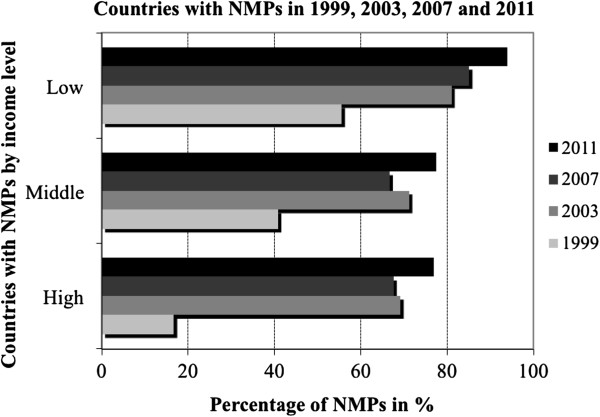
The number of NMPs worldwide has increased in the last 25 years with the highest proportional increase in the last 5-10 years in high-income countries. Higher income countries seem to have more NMP implementation plans available and have updated their NMP more recently. The four case studies show that the development of a NMP is a complex process that is country specific. In addition, it demonstrates that an appropriate political window is needed for the policy to be passed (for South Africa and the FYR Macedonia, a major political event acted as a trigger for initiating the policy development). Policy-making does not stop with the official adoption of a policy but should create mechanisms for implementation and monitoring. The NMPs of the FYR Macedonia and Australia provide indicators for monitoring.
To date, not all countries have a NMP since political pressure by national experts or non-governmental organizations is generally needed to establish a NMP. Case studies in four countries showed that the policy process is just as important as the policy document since the process must create a mechanism by which all stakeholders are brought together and a sense of collective ownership of the final policy may be achieved.
持续提供质量有保证、数量充足且价格合理的药品是所有国家政府关注的问题。以协作方式制定的国家药品政策(NMP)确定了实现这些目标所需的战略,并为发展国家制药部门的所有组成部分提供了一个全面的框架。为满足民众的健康需求,普遍需要基于普遍原则但又适应国情的药品政策。本综述旨在对国家药品政策的制定过程和演变进行定量和定性(描述历史发展)研究。
国家药品政策的数量及其现状已从世界卫生组织一级指标评估结果中获取。通过对四个国家(斯里兰卡、澳大利亚、前南斯拉夫的马其顿共和国和南非)的案例研究,更详细地考察了政策制定过程。
在过去25年里,全球国家药品政策的数量有所增加,在过去5至10年中,高收入国家的增长比例最高。高收入国家似乎有更多的国家药品政策实施计划,并且最近更新了其国家药品政策。这四个案例研究表明,国家药品政策的制定是一个复杂的、因国家而异的过程。此外,这表明政策的通过需要一个合适的政治时机(对于南非和前南斯拉夫的马其顿共和国而言,一个重大政治事件成为启动政策制定的触发因素)。政策制定并非随着政策的正式通过而停止,而是应建立实施和监测机制。前南斯拉夫的马其顿共和国和澳大利亚的国家药品政策提供了监测指标。
迄今为止,并非所有国家都有国家药品政策,因为通常需要国家专家或非政府组织的政治压力才能制定国家药品政策。四个国家的案例研究表明,政策制定过程与政策文件同样重要,因为该过程必须建立一种机制,使所有利益相关者汇聚在一起,并实现对最终政策的集体归属感。