Authors' Affiliations: Department of Neurosurgery, Massachusetts General Hospital, Harvard Medical School, Boston Massachusetts.
Cancer Immunol Res. 2014 Apr;2(4):295-300. doi: 10.1158/2326-6066.CIR-14-0015.
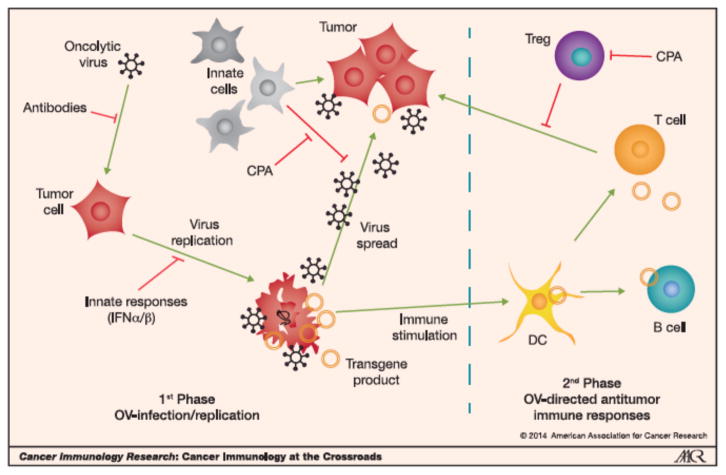
Oncolytic viruses (OV) selectively replicate and kill cancer cells and spread within the tumor, while not harming normal tissue. In addition to this direct oncolytic activity, OVs are also very effective at inducing immune responses to themselves and to the infected tumor cells. OVs encompass a broad diversity of DNA and RNA viruses that are naturally cancer selective or can be genetically engineered. OVs provide a diverse platform for immunotherapy; they act as in situ vaccines and can be armed with immunomodulatory transgenes or combined with other immunotherapies. However, the interactions of OVs with the immune system may affect therapeutic outcomes in opposing fashions: negatively by limiting virus replication and/or spread, or positively by inducing antitumor immune responses. Many aspects of the OV-tumor/host interaction are important in delineating the effectiveness of therapy: (i) innate immune responses and the degree of inflammation induced; (ii) types of virus-induced cell death; (iii) inherent tumor physiology, such as infiltrating and resident immune cells, vascularity/hypoxia, lymphatics, and stromal architecture; and (iv) tumor cell phenotype, including alterations in IFN signaling, oncogenic pathways, cell surface immune markers [MHC, costimulatory, and natural killer (NK) receptors], and the expression of immunosuppressive factors. Recent clinical trials with a variety of OVs, especially those expressing granulocyte macrophage colony-stimulating factor (GM-CSF), have demonstrated efficacy and induction of antitumor immune responses in the absence of significant toxicity. Manipulating the balance between antivirus and antitumor responses, often involving overlapping immune pathways, will be critical to the clinical success of OVs.
溶瘤病毒(OV)选择性复制并杀伤癌细胞,并在肿瘤内传播,同时不会对正常组织造成伤害。除了这种直接的溶瘤活性外,OV 还非常有效地诱导针对自身和感染肿瘤细胞的免疫反应。OV 包含广泛的 DNA 和 RNA 病毒,这些病毒天然具有肿瘤选择性,或者可以通过基因工程进行改造。OV 为免疫疗法提供了多样化的平台;它们充当原位疫苗,并且可以携带免疫调节转基因,或者与其他免疫疗法结合使用。然而,OV 与免疫系统的相互作用可能会以相反的方式影响治疗效果:通过限制病毒复制和/或传播产生负面影响,或者通过诱导抗肿瘤免疫反应产生积极影响。OV-肿瘤/宿主相互作用的许多方面对于阐明治疗效果都很重要:(i)先天免疫反应和诱导的炎症程度;(ii)病毒诱导的细胞死亡类型;(iii)固有肿瘤生理学,如浸润和常驻免疫细胞、血管/缺氧、淋巴管和基质结构;以及(iv)肿瘤细胞表型,包括 IFN 信号、致癌途径、细胞表面免疫标志物 [MHC、共刺激和自然杀伤 (NK) 受体] 和免疫抑制因子的表达的改变。最近的临床试验使用了多种 OV,特别是表达粒细胞巨噬细胞集落刺激因子(GM-CSF)的 OV,证明了它们在没有明显毒性的情况下具有疗效并诱导抗肿瘤免疫反应。操纵抗病毒和抗肿瘤反应之间的平衡,通常涉及重叠的免疫途径,对于 OV 的临床成功至关重要。