Kamau Edwin, Alemayehu Saba, Feghali Karla C, Juma Dennis W, Blackstone George M, Marion William R, Obare Peter, Ogutu Bernhards, Ockenhouse Christian F
Walter Reed Army Institute of Research, Military Malaria Research Program, Malaria Vaccine Branch, 503 Robert Grant Ave, Silver Spring, Maryland, USA.
Malar J. 2014 Apr 25;13:158. doi: 10.1186/1475-2875-13-158.
Microscopy and antigen detecting rapid diagnostic tests are the diagnostic tests of choice in management of clinical malaria. However, due to their limitations, the need to utilize more sensitive methods such as real-time PCR (qPCR) is evident as more studies are now utilizing molecular methods in detection of malaria. Some of the challenges that continue to limit the widespread utilization of qPCR include lack of assay standardization, assay variability, risk of contamination, and the need for cold-chain. Lyophilization of molecular assays can overcome some of these limitations and potentially enable widespread qPCR utilization.
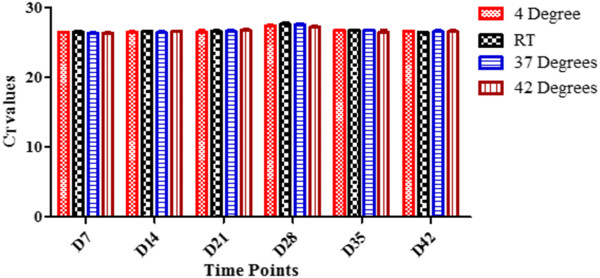
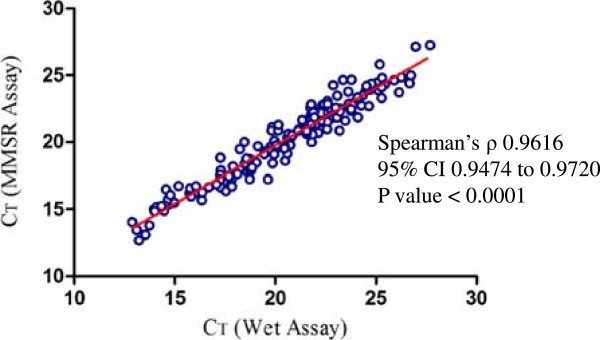
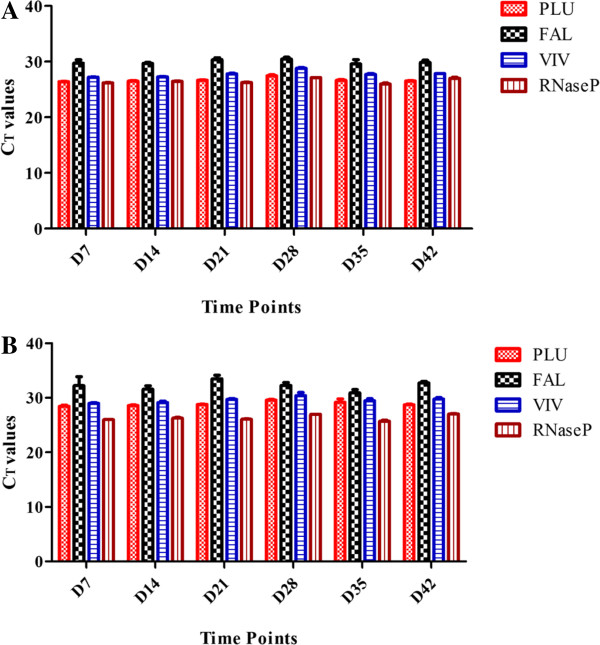
A recently published multiplex malaria qPCR assay was lyophilized by freezing drying into Sample-Ready™ format (MMSR). MMSR assay contained all the required reagents for qPCR including primers and probes, requiring only the addition of water and sample to perform qPCR. The performance of the MMSR assay was compared to the non-freeze dried, "wet" assay. Stability studies were done by maintaining the MMSR assays at four different ambient temperatures of 4°C, room temperature (RT), 37°C and 42°C over a period of 42 days, tested at seven-day intervals. Plasmodium falciparum and Plasmodium vivax DNAs were used for analysis of the MMSR assay either as single or mixed parasites, at two different concentrations. The CT values and the standard deviations (SD) were used in the analysis of the assay performance.
The limit of detection for the MMSR assay was 0.244 parasites/μL for Plasmodium spp. (PLU) and P. falciparum (FAL) assay targets compared to "wet" assay which was 0.39 and 3.13 parasites/μL for PLU and FAL assay targets, respectively. The MMSR assay performed with high efficiencies similar to those of the "wet" assay and was stable at 37°C for 42 days, with estimated shelf-life of 5 months. When used to analyse field clinical samples, MMSR assay performed with 100% sensitivity and specificity compared to the "wet" assay.
The MMSR assay has the same robust performance characteristics as the "wet" assay and is highly stable. Availability of MMSR assay allows flexibility and provides an option in choosing assay for malaria diagnostics depending on the application, needs and budget.
显微镜检查和抗原检测快速诊断试验是临床疟疾管理中的首选诊断方法。然而,由于其局限性,随着越来越多的研究采用分子方法检测疟疾,显然需要使用更敏感的方法,如实时光聚合酶链反应(qPCR)。继续限制qPCR广泛应用的一些挑战包括缺乏检测标准化、检测变异性、污染风险以及对冷链的需求。分子检测的冻干可以克服其中一些局限性,并有可能使qPCR得到广泛应用。
将最近发表的多重疟疾qPCR检测方法通过冷冻干燥制成样品即用型(MMSR)。MMSR检测包含qPCR所需的所有试剂,包括引物和探针,进行qPCR时仅需加入水和样品。将MMSR检测的性能与未冻干的“湿”检测进行比较。通过在42天内将MMSR检测在4°C、室温(RT)、37°C和42°C这四个不同环境温度下保存,并每隔七天进行测试,来进行稳定性研究。恶性疟原虫和间日疟原虫DNA以单一或混合寄生虫的形式,在两种不同浓度下用于MMSR检测的分析。CT值和标准差(SD)用于分析检测性能。
与“湿”检测相比,MMSR检测对疟原虫属(PLU)和恶性疟原虫(FAL)检测靶点的检测限分别为0.244个寄生虫/μL,而“湿”检测对PLU和FAL检测靶点的检测限分别为0.39和3.13个寄生虫/μL。MMSR检测的效率与“湿”检测相似,在37°C下可稳定保存42天,估计保质期为5个月。当用于分析现场临床样本时,与“湿”检测相比,MMSR检测的灵敏度和特异性均为100%。
MMSR检测具有与“湿”检测相同的强大性能特征,且高度稳定。MMSR检测的可用性提供了灵活性,并根据应用、需求和预算为疟疾诊断检测的选择提供了一种选择。