Fischer Wolfgang, Breithaupt Ute, Kern Beate, Smith Stella I, Spicher Carolin, Haas Rainer
Max von Pettenkofer-Institut für Hygiene und Medizinische Mikrobiologie, Ludwig-Maximilians-Universität, D-80336 Munich, Germany.
BMC Genomics. 2014 Apr 27;15:310. doi: 10.1186/1471-2164-15-310.
The human gastric pathogen Helicobacter pylori is a paradigm for chronic bacterial infections. Its persistence in the stomach mucosa is facilitated by several mechanisms of immune evasion and immune modulation, but also by an unusual genetic variability which might account for the capability to adapt to changing environmental conditions during long-term colonization. This variability is reflected by the fact that almost each infected individual is colonized by a genetically unique strain. Strain-specific genes are dispersed throughout the genome, but clusters of genes organized as genomic islands may also collectively be present or absent.
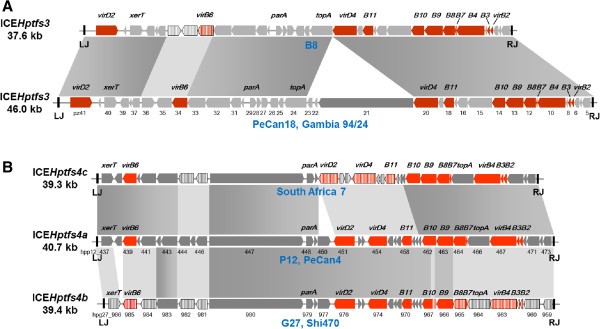
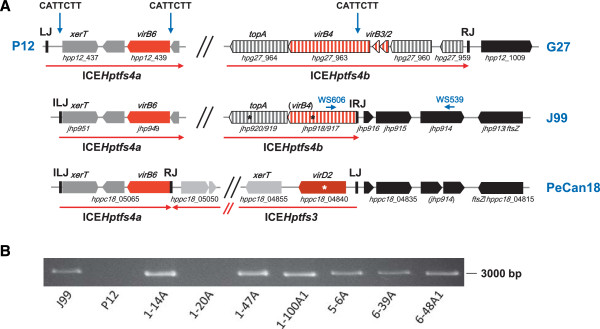
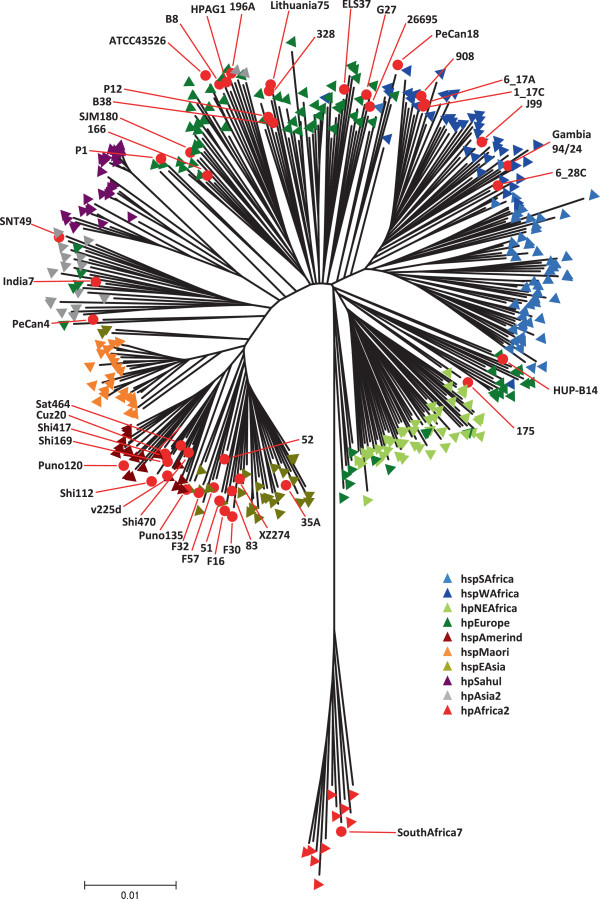
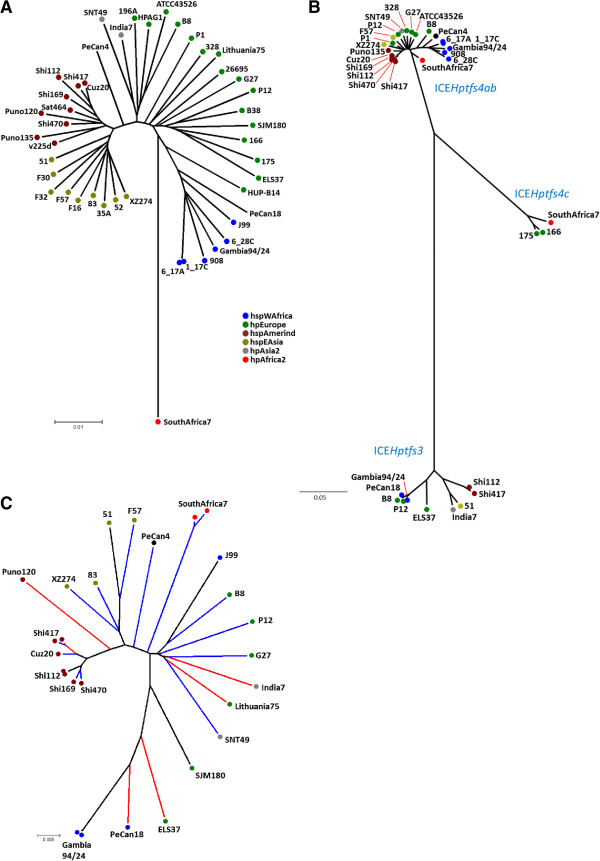
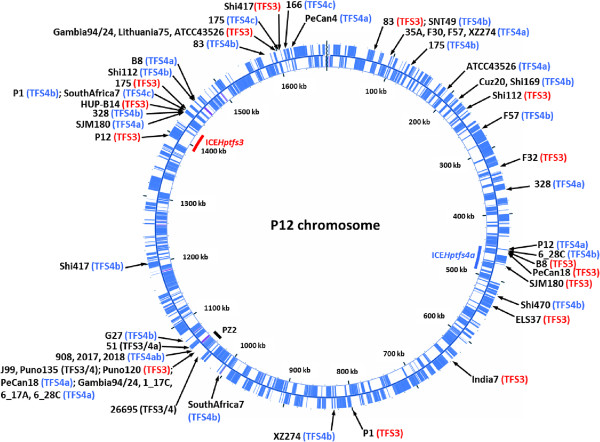
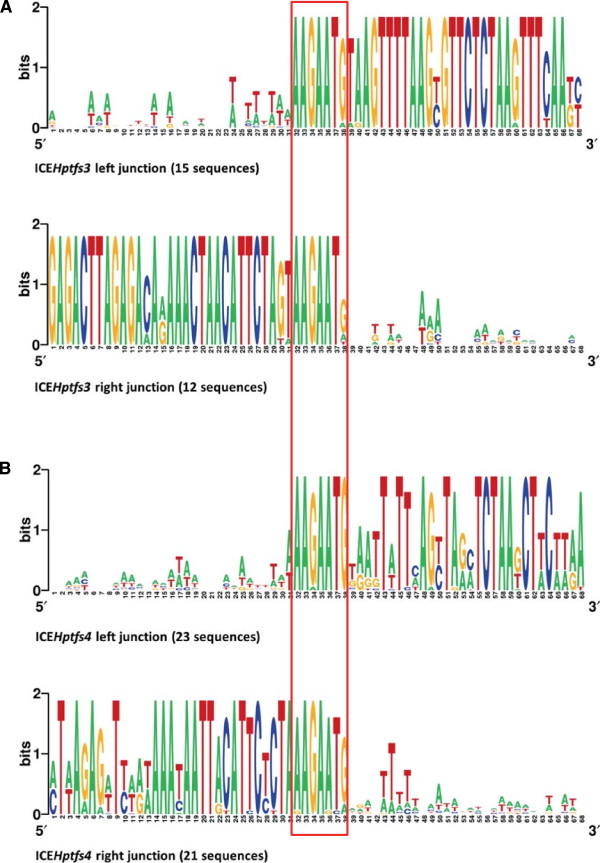
We have comparatively analysed such clusters, which are commonly termed plasticity zones, in a high number of H. pylori strains of varying geographical origin. We show that these regions contain fixed gene sets, rather than being true regions of genome plasticity, but two different types and several subtypes with partly diverging gene content can be distinguished. Their genetic diversity is incongruent with variations in the rest of the genome, suggesting that they are subject to horizontal gene transfer within H. pylori populations. We identified 40 distinct integration sites in 45 genome sequences, with a conserved heptanucleotide motif that seems to be the minimal requirement for integration.
The significant number of possible integration sites, together with the requirement for a short conserved integration motif and the high level of gene conservation, indicates that these elements are best described as integrating conjugative elements (ICEs) with an intermediate integration site specificity.
人类胃部病原体幽门螺杆菌是慢性细菌感染的一个范例。它在胃黏膜中的持续存在得益于多种免疫逃避和免疫调节机制,也得益于其异常的遗传变异性,这种变异性可能解释了它在长期定植过程中适应不断变化的环境条件的能力。这种变异性体现在几乎每个受感染个体都被一种基因独特的菌株定植这一事实上。菌株特异性基因分散在整个基因组中,但作为基因组岛组织的基因簇也可能共同存在或不存在。
我们对大量来自不同地理区域的幽门螺杆菌菌株中通常称为可塑性区的此类基因簇进行了比较分析。我们表明,这些区域包含固定的基因集,而不是真正的基因组可塑性区域,但可以区分出两种不同类型和几种亚型,其基因内容部分不同。它们的遗传多样性与基因组其余部分的变异不一致,这表明它们在幽门螺杆菌群体中受到水平基因转移的影响。我们在45个基因组序列中确定了40个不同的整合位点,带有一个保守的七核苷酸基序,这似乎是整合的最低要求。
大量可能的整合位点,加上对短保守整合基序的要求和高水平的基因保守性,表明这些元件最好被描述为具有中等整合位点特异性的整合接合元件(ICEs)。