Sangoro Onyango, Lweitojera Dickson, Simfukwe Emmanuel, Ngonyani Hassan, Mbeyela Edgar, Lugiko Daniel, Kihonda Japhet, Maia Marta, Moore Sarah
Ifakara Health Institute, Box 74, Bagamoyo, Tanzania.
Malar J. 2014 Apr 26;13:159. doi: 10.1186/1475-2875-13-159.
Before topical repellents can be employed as interventions against arthropod bites, their efficacy must be established. Currently, laboratory or field tests, using human volunteers, are the main methods used for assessing the efficacy of topical repellents. However, laboratory tests are not representative of real life conditions under which repellents are used and field-testing potentially exposes human volunteers to disease. There is, therefore, a need to develop methods to test efficacy of repellents under real life conditions while minimizing volunteer exposure to disease.
A lotion-based, 15% N, N-Diethyl-3-methylbenzamide (DEET) repellent and 15% DEET in ethanol were compared to a placebo lotion in a 200 sq m (10 m × 20 m) semi-field system (SFS) against laboratory-reared Anopheles arabiensis mosquitoes and in full field settings against wild malaria vectors and nuisance-biting mosquitoes. The average percentage protection against biting mosquitoes over four hours in the SFS and field setting was determined. A Poisson regression model was then used to determine relative risk of being bitten when wearing either of these repellents compared to the placebo.
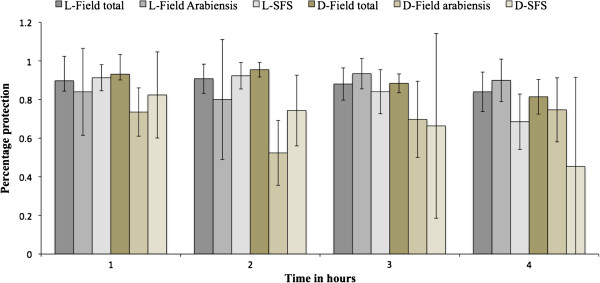
Average percentage protection of the lotion-based 15% DEET repellent after four hours of mosquito collection was 82.13% (95% CI 75.94-88.82) in the semi-field experiments and 85.10% (95% CI 78.97-91.70) in the field experiments. Average percentage protection of 15% DEET in ethanol after four hours was 71.29% (CI 61.77-82.28) in the semi-field system and 88.24% (84.45-92.20) in the field.
Semi-field evaluation results were comparable to full-field evaluations, indicating that such systems could be satisfactorily used in measuring efficacy of topically applied mosquito repellents, thereby avoiding risks of exposure to mosquito-borne pathogens, associated with field testing.
在将局部用驱虫剂用作预防节肢动物叮咬的干预措施之前,必须确定其有效性。目前,使用人类志愿者进行的实验室或现场测试是评估局部用驱虫剂有效性的主要方法。然而,实验室测试不能代表使用驱虫剂的实际生活条件,而现场测试可能会使人类志愿者接触疾病。因此,需要开发在实际生活条件下测试驱虫剂有效性的方法,同时尽量减少志愿者接触疾病的风险。
在一个200平方米(10米×20米)的半野外系统(SFS)中,将一种基于乳液的15%N,N-二乙基-3-甲基苯甲酰胺(避蚊胺)驱虫剂和15%乙醇中的避蚊胺与一种安慰剂乳液进行比较,以对抗实验室饲养的阿拉伯按蚊,并在全野外环境中对抗野生疟疾传播媒介和骚扰性叮咬蚊子。确定了在SFS和野外环境中四小时内对叮咬蚊子的平均防护百分比。然后使用泊松回归模型来确定与安慰剂相比,使用这两种驱虫剂中的任何一种时被叮咬的相对风险。
在半野外实验中,基于乳液的15%避蚊胺驱虫剂在捕蚊四小时后的平均防护百分比为82.13%(95%置信区间75.94 - 88.82),在野外实验中为85.10%(95%置信区间78.97 - 91.70)。乙醇中15%避蚊胺在四小时后的平均防护百分比在半野外系统中为71.29%(置信区间61.77 - 82.28),在野外为88.24%(84.45 - 92.20)。
半野外评估结果与全野外评估结果相当,表明此类系统可令人满意地用于测量局部应用的驱蚊剂的功效,从而避免与现场测试相关的接触蚊媒病原体的风险。