Gorina Marta, Limonero Joaquín T, Peñart Xavier, Jiménez Jordi, Gassó Javier
Universitat Autónoma de Barcelona, Bellaterra, Cerdanyola del Vallès, Barcelona, España.
Universitat Autónoma de Barcelona, Bellaterra, Cerdanyola del Vallès, Barcelona, España; Grupo de Investigación en Estrés y Salud (GIES), Universitat Autónoma de Barcelona, Bellaterra, Cerdanyola del Vallès, Barcelona, España.
Aten Primaria. 2014 Jun-Jul;46(6):276-82. doi: 10.1016/j.aprim.2013.07.011. Epub 2014 Apr 24.
To determine the level of satisfaction of users that receive home health care through two different models of primary health care: integrated model and dispensaries model.
cross-sectional, observational study.
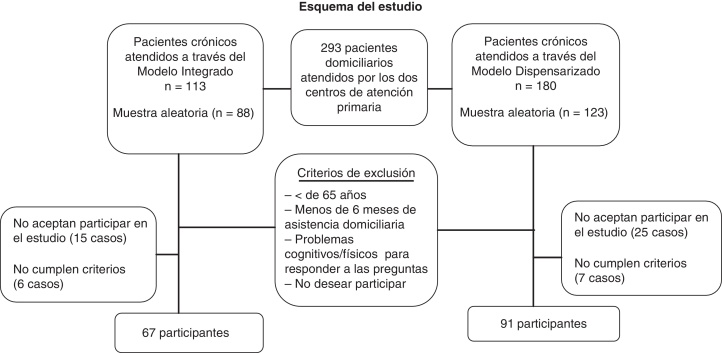
Two primary care centers in the province of Barcelona.
The questionnaire was administered to 158 chronic patients over 65 years old, of whom 67 were receiving health care from the integrated model, and 91 from the dispensaries model.
The Evaluation of Satisfaction with Home Health Care (SATISFAD12) questionnaire was, together with other complementary questions about service satisfaction of home health care, as well as social demographic questions (age, sex, disease, etc).
The patients of the dispensaries model showed more satisfaction than the users receiving care from the integrated model. There was a greater healthcare continuity for those patients from the dispensaries model, and a lower percentage of hospitalizations during the last year. The satisfaction of the users from both models was not associated to gender, the health perception,or independence of the
The user satisfaction rate of the home care by primary health care seems to depend of the typical characteristics of each organisational model. The dispensaries model shows a higher rate of satisfaction or perceived quality of care in all the aspects analysed. More studies are neede to extrapolate these results to other primary care centers belonging to other institutions.
通过两种不同的初级卫生保健模式(综合模式和药房模式)确定接受家庭医疗保健的用户的满意度水平。
横断面观察性研究。
巴塞罗那省的两个初级保健中心。
对158名65岁以上的慢性病患者进行问卷调查,其中67人接受综合模式的医疗保健,91人接受药房模式的医疗保健。
家庭医疗保健满意度评估(SATISFAD12)问卷,以及其他关于家庭医疗保健服务满意度的补充问题,以及社会人口统计学问题(年龄、性别、疾病等)。
药房模式的患者比接受综合模式护理的用户表现出更高的满意度。药房模式的患者有更高的医疗连续性,并且去年的住院率更低。两种模式的用户满意度与性别、健康认知或独立性无关。
初级卫生保健家庭护理的用户满意度似乎取决于每个组织模式的典型特征。在所有分析的方面,药房模式显示出更高的满意度或护理质量感知率。需要更多研究将这些结果推广到属于其他机构的其他初级保健中心。