Kane Heidi S, Dunkel Schetter Christine, Glynn Laura M, Hobel Calvin J, Sandman Curt A
Department of Psychology, University of California Los Angeles, 1285 Franz Hall Box 951563, Los Angeles, CA 90095-1563, USA.
Department of Psychology, University of California Los Angeles, 1285 Franz Hall Box 951563, Los Angeles, CA 90095-1563, USA.
Biol Psychol. 2014 Jul;100:13-9. doi: 10.1016/j.biopsycho.2014.04.003. Epub 2014 Apr 21.
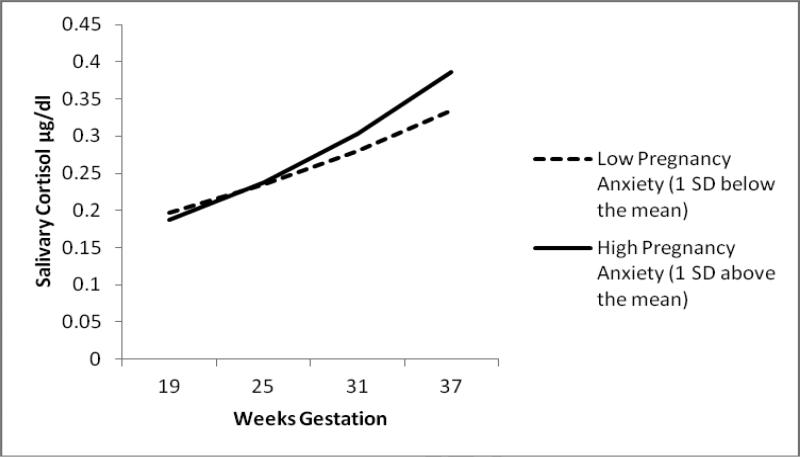
Pregnancy anxiety is a potent predictor of adverse birth and infant outcomes. The goal of the current study was to examine one potential mechanism whereby these effects may occur by testing associations between pregnancy anxiety and maternal salivary cortisol on 4 occasions during pregnancy in a sample of 448 women. Higher mean levels of pregnancy anxiety over the course of pregnancy predicted steeper increases in cortisol trajectories compared to lower pregnancy anxiety. Significant differences between cortisol trajectories emerged between 30 and 31 weeks of gestation. Results remained significant when adjusted for state anxiety and perceived stress. Neither changes in pregnancy anxiety over gestation, nor pregnancy anxiety specific to only a particular time in pregnancy predicted cortisol. These findings provide support for one way in which pregnancy anxiety may influence maternal physiology and contribute to a growing literature on the complex biological pathways linking pregnancy anxiety to birth and infant outcomes.
孕期焦虑是不良分娩和婴儿结局的有力预测指标。本研究的目的是通过在448名女性样本的孕期4个时间点测试孕期焦虑与母体唾液皮质醇之间的关联,来检验这些影响可能发生的一种潜在机制。与较低的孕期焦虑相比,孕期平均焦虑水平较高预示着皮质醇轨迹上升更为陡峭。在妊娠30至31周时,皮质醇轨迹出现了显著差异。在对状态焦虑和感知压力进行调整后,结果仍然显著。孕期焦虑随孕周的变化以及仅在孕期特定时间出现的孕期焦虑均不能预测皮质醇。这些发现为孕期焦虑可能影响母体生理的一种方式提供了支持,并为将孕期焦虑与分娩及婴儿结局联系起来的复杂生物学途径的不断增多的文献做出了贡献。