Eskenazi Brenda, Quirós-Alcalá Lesliam, Lipsitt Jonah M, Wu Lemuel D, Kruger Philip, Ntimbane Tzundzukani, Nawn John Burns, Bornman M S Riana, Seto Edmund
Center for Environmental Research and Children's Health (CERCH), School of Public Health, University of California, 1995 University Ave, Suite 265, Berkeley, CA 94704, USA.
Malaria Control Programme, Limpopo Department of Health, Voortrekker Street, Tzaneen, Limpopo 0850, South Africa.
Environ Int. 2014 Jul;68:219-26. doi: 10.1016/j.envint.2014.03.003.
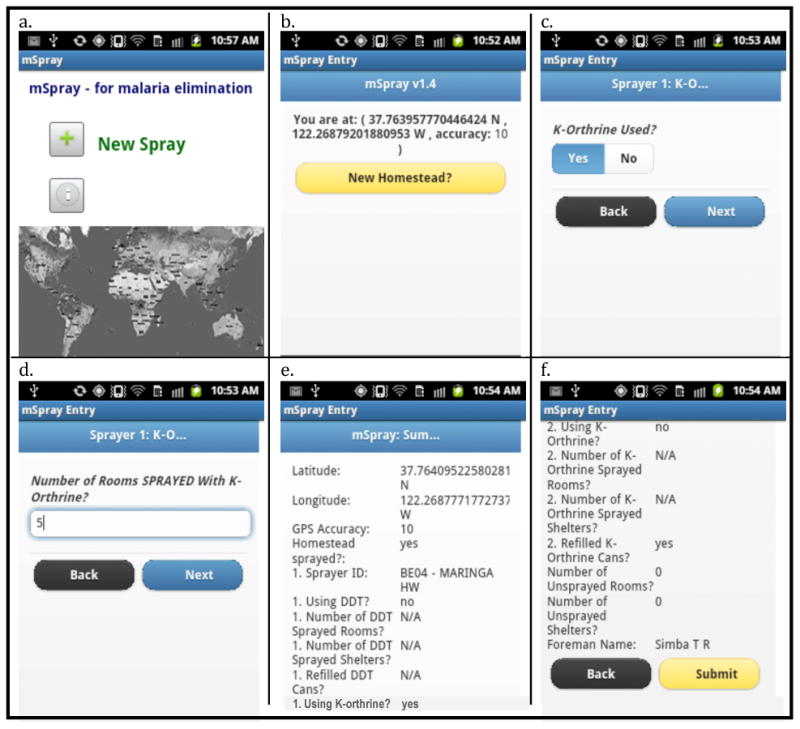
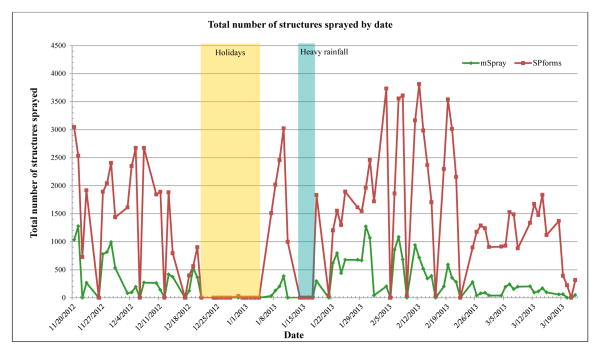
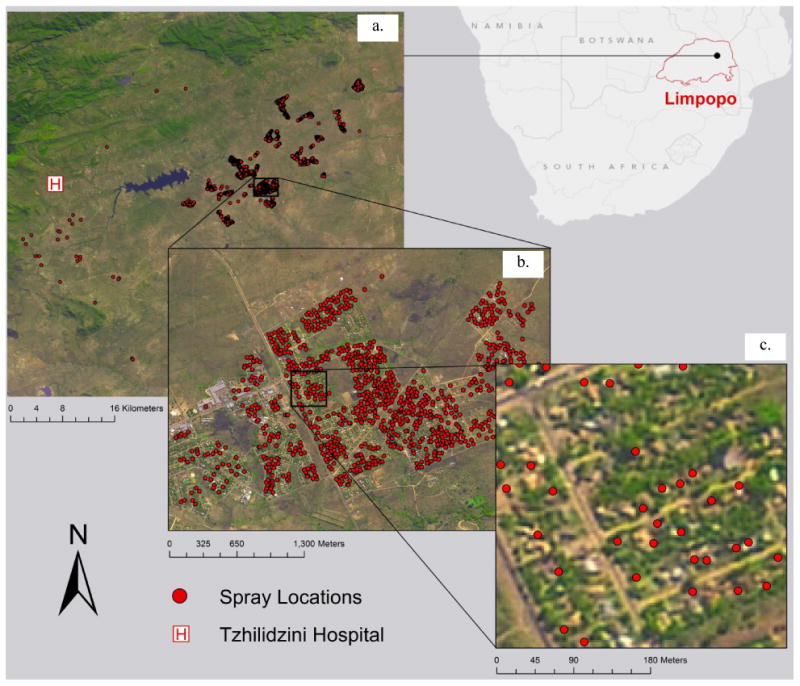
Recent estimates indicate that malaria has led to over half a million deaths worldwide, mostly to African children. Indoor residual spraying (IRS) of insecticides is one of the primary vector control interventions. However, current reporting systems do not obtain precise location of IRS events in relation to malaria cases, which poses challenges for effective and efficient malaria control. This information is also critical to avoid unnecessary human exposure to IRS insecticides. We developed and piloted a mobile-based application (mSpray) to collect comprehensive information on IRS spray events. We assessed the utility, acceptability and feasibility of using mSpray to gather improved homestead- and chemical-level IRS coverage data. We installed mSpray on 10 cell phones with data bundles, and pilot tested it with 13 users in Limpopo, South Africa. Users completed basic information (number of rooms/shelters sprayed; chemical used, etc.) on spray events. Upon submission, this information as well as geographic positioning system coordinates and time/date stamp were uploaded to a Google Drive Spreadsheet to be viewed in real time. We administered questionnaires, conducted focus groups, and interviewed key informants to evaluate the utility of the app. The low-cost, cell phone-based "mSpray" app was learned quickly by users, well accepted and preferred to the current paper-based method. We recorded 2865 entries (99.1% had a GPS accuracy of 20 m or less) and identified areas of improvement including increased battery life. We also identified a number of logistic and user problems (e.g., cost of cell phones and cellular bundles, battery life, obtaining accurate GPS measures, user errors, etc.) that would need to be overcome before full deployment. Use of cell phone technology could increase the efficiency of IRS malaria control efforts by mapping spray events in relation to malaria cases, resulting in more judicious use of chemicals that are potentially harmful to humans and the environment.
近期估计表明,疟疾已在全球导致超过50万人死亡,其中大多数是非洲儿童。室内滞留喷洒杀虫剂是主要的病媒控制干预措施之一。然而,当前的报告系统无法获取室内滞留喷洒事件相对于疟疾病例的精确位置,这给有效且高效地控制疟疾带来了挑战。该信息对于避免人类不必要地接触室内滞留喷洒杀虫剂也至关重要。我们开发并试点了一款基于移动设备的应用程序(mSpray),以收集有关室内滞留喷洒事件的全面信息。我们评估了使用mSpray收集改进后的家庭层面和化学品层面室内滞留喷洒覆盖数据的效用、可接受性和可行性。我们在10部配备了数据套餐的手机上安装了mSpray,并在南非林波波省对13名用户进行了试点测试。用户填写了有关喷洒事件的基本信息(喷洒的房间/庇护所数量;使用的化学品等)。提交后,这些信息以及地理定位系统坐标和时间/日期戳会上传到谷歌文档电子表格中以便实时查看。我们发放了问卷、开展了焦点小组讨论并采访了关键信息提供者,以评估该应用程序的效用。这款低成本的、基于手机的“mSpray”应用程序用户很快就能学会,广受接受,且比当前基于纸张的方法更受青睐。我们记录了2865条记录(99.1%的记录GPS精度在20米或以内),并确定了需要改进的方面,包括延长电池续航时间。我们还发现了一些后勤和用户问题(例如手机和手机套餐的成本、电池续航时间、获取精确的GPS测量值、用户错误等),在全面部署之前需要克服这些问题。使用手机技术可以通过绘制与疟疾病例相关的喷洒事件地图,提高室内滞留喷洒疟疾控制工作的效率,从而更明智地使用可能对人类和环境有害的化学品。