Yang Yanyan, Kim Seung Cheol, Yu Tao, Yi Young-Su, Rhee Man Hee, Sung Gi-Ho, Yoo Byong Chul, Cho Jae Youl
Department of Genetic Engineering, Sungkyunkwan University, Suwon 440-746, Republic of Korea.
Division of Gynecologic Oncology Department of Obstetrics and Gynecology, Ewha Womans University Mokdong Hospital College of Medicine, Ewha Womans University, Seoul 158-710, Republic of Korea.
Mediators Inflamm. 2014;2014:352371. doi: 10.1155/2014/352371. Epub 2014 Mar 20.
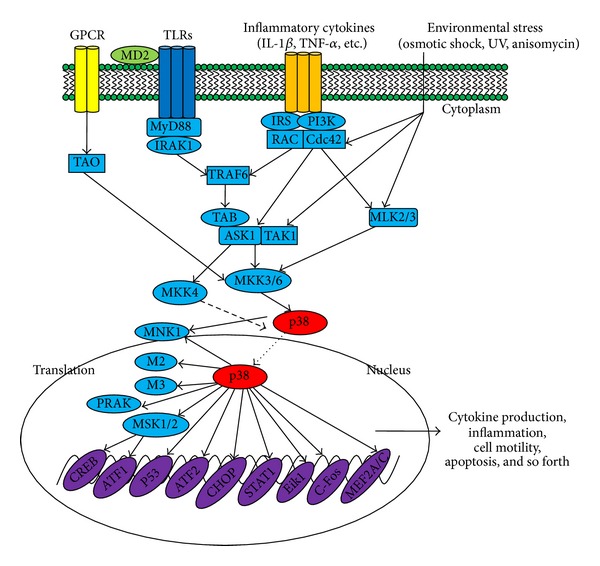
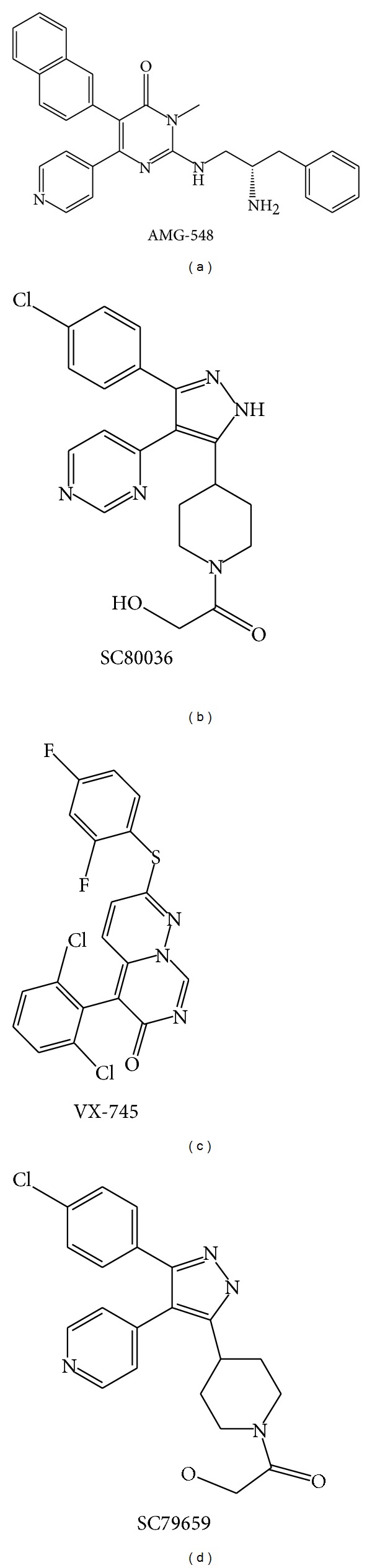
Inflammation is a natural host defensive process that is largely regulated by macrophages during the innate immune response. Mitogen-activated protein kinases (MAPKs) are proline-directed serine and threonine protein kinases that regulate many physiological and pathophysiological cell responses. p38 MAPKs are key MAPKs involved in the production of inflammatory mediators, including tumor necrosis factor-α (TNF-α) and cyclooxygenase-2 (COX-2). p38 MAPK signaling plays an essential role in regulating cellular processes, especially inflammation. In this paper, we summarize the characteristics of p38 signaling in macrophage-mediated inflammation. In addition, we discuss the potential of using inhibitors targeting p38 expression in macrophages to treat inflammatory diseases.
炎症是一种天然的宿主防御过程,在固有免疫反应期间主要由巨噬细胞调节。丝裂原活化蛋白激酶(MAPKs)是脯氨酸定向的丝氨酸和苏氨酸蛋白激酶,可调节许多生理和病理生理细胞反应。p38 MAPKs是参与炎症介质产生的关键MAPKs,包括肿瘤坏死因子-α(TNF-α)和环氧化酶-2(COX-2)。p38 MAPK信号传导在调节细胞过程,尤其是炎症中起重要作用。在本文中,我们总结了巨噬细胞介导的炎症中p38信号传导的特征。此外,我们讨论了使用靶向巨噬细胞中p38表达的抑制剂治疗炎症性疾病的潜力。