Department of Forest Sciences, Centre for Applied Conservation Research, University of British Columbia 2424 Main Mall, Vancouver, British Columbia, V6T 1Z4, Canada.
School of Biological Sciences, University of Queensland St Lucia, Queensland, 4072, Australia.
Ecol Evol. 2014 Apr;4(7):1102-16. doi: 10.1002/ece3.1009. Epub 2014 Mar 6.
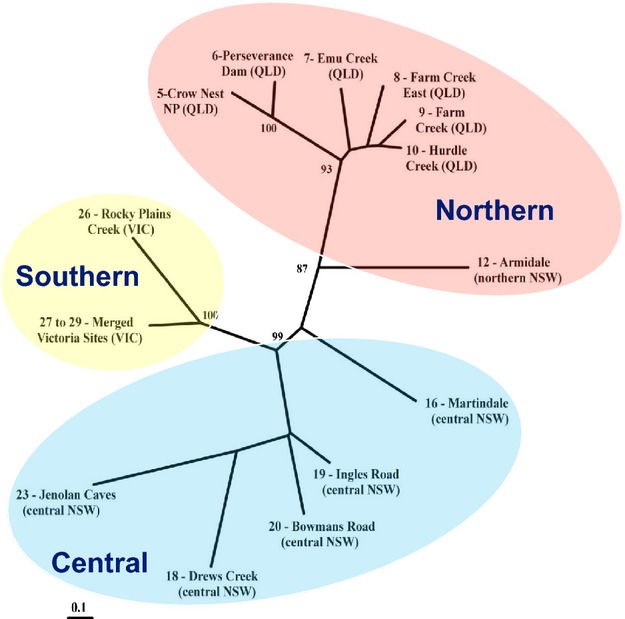
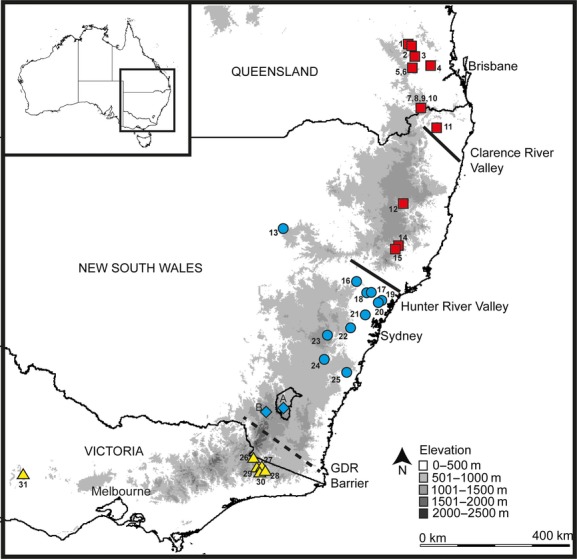
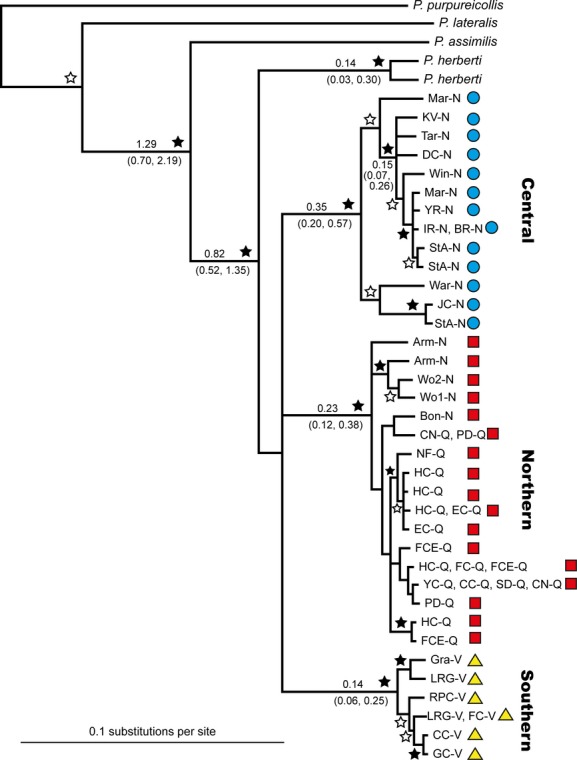
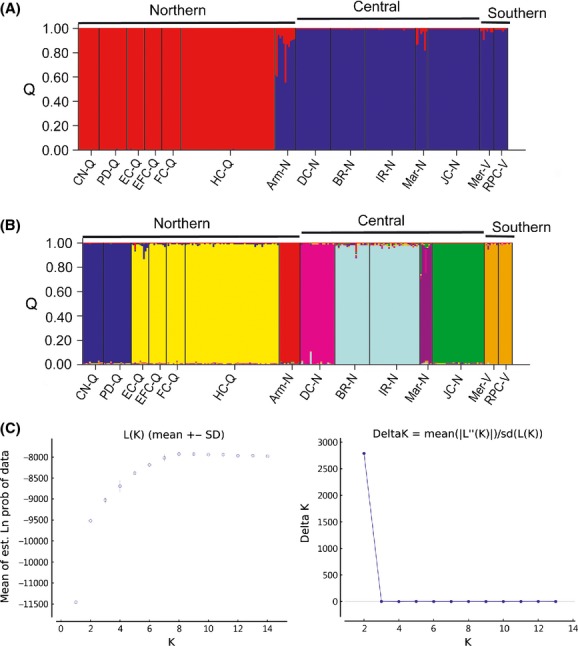
Mesic southeastern Australia represents the continent's ancestral biome and is highly biodiverse, yet its phylogeographic history remains poorly understood. Here, we examine mitochondrial DNA (mtDNA) control region and microsatellite diversity in the brush-tailed rock-wallaby (Petrogale penicillata;n = 279 from 31 sites), to assess historic evolutionary and biogeographic processes in southeastern Australia. Our results (mtDNA, microsatellites) confirmed three geographically discrete and genetically divergent lineages within brush-tailed rock-wallabies, whose divergence appears to date to the mid-Pleistocene. These three lineages had been hypothesized previously but data were limited. While the Northern and Central lineages were separated by a known biogeographic barrier (Hunter Valley), the boundary between the Central and Southern lineages was not. We propose that during particularly cool glacial cycles, the high peaks of the Great Dividing Range and the narrow adjacent coastal plain resulted in a more significant north-south barrier for mesic taxa in southeastern Australia than has been previously appreciated. Similarly, located phylogeographic breaks in codistributed species highlight the importance of these regions in shaping the distribution of biodiversity in southeastern Australia and suggest the existence of three major refuge areas during the Pleistocene. Substructuring within the northern lineage also suggests the occurrence of multiple local refugia during some glacial cycles. Within the three major lineages, most brush-tailed rock-wallaby populations were locally highly structured, indicating limited dispersal by both sexes. The three identified lineages represent evolutionarily significant units and should be managed to maximize the retention of genetic diversity within this threatened species.
澳大利亚东南部的湿润亚热带地区代表了该大陆的原始生物区系,生物多样性非常丰富,但人们对其系统地理学历史仍知之甚少。在这里,我们研究了刷尾岩袋鼠(Petrogale penicillata)的线粒体 DNA(mtDNA)控制区和微卫星多样性(n=来自 31 个地点的 279 个个体),以评估澳大利亚东南部的历史进化和生物地理过程。我们的结果(mtDNA、微卫星)证实了刷尾岩袋鼠存在三个地理上离散且遗传上分化的谱系,其分化似乎可以追溯到更新世中期。这三个谱系以前曾被假设过,但数据有限。虽然北部和中部谱系被一个已知的生物地理屏障(亨特谷)隔开,但中部和南部谱系之间的边界没有。我们提出,在特别寒冷的冰川循环期间,大分水岭的高峰和狭窄的相邻沿海平原对澳大利亚东南部的湿润分类群形成了比以前认为的更显著的南北屏障。同样,在共存物种中出现的位于地理上的断裂突显了这些地区在塑造澳大利亚东南部生物多样性分布方面的重要性,并表明在更新世期间存在三个主要避难所区域。北部谱系内的亚结构也表明,在某些冰川循环中,存在多个局部避难所。在这三个主要谱系中,大多数刷尾岩袋鼠种群在当地高度结构化,表明两性的扩散能力有限。这三个确定的谱系代表了具有进化意义的单位,应加以管理,以最大限度地保留该受威胁物种的遗传多样性。