Division of Ecology and Evolution, Research School of Biology, Australian National University, Acton, ACT 2601, Australia.
Australian Museum Research Institute, Australian Museum, 1 William Street, Sydney, New South Wales 2010, Australia.
Genes (Basel). 2020 Jan 31;11(2):154. doi: 10.3390/genes11020154.
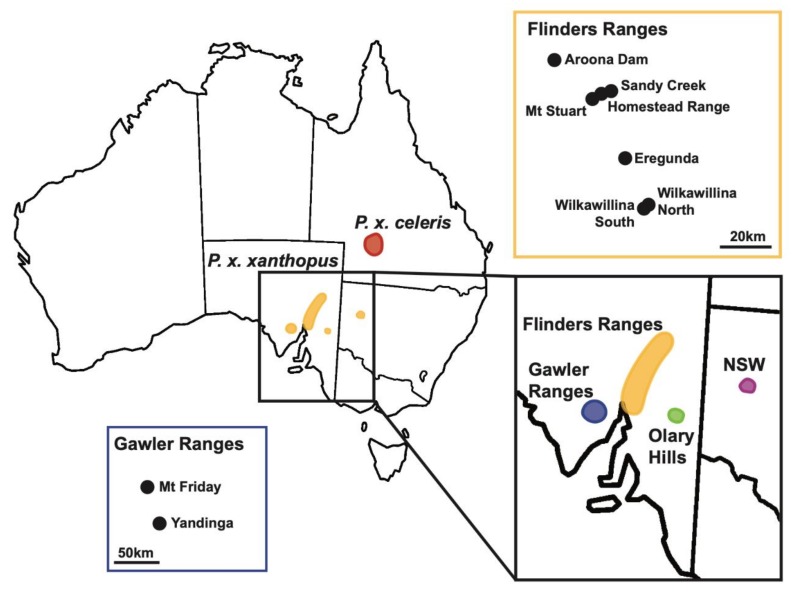
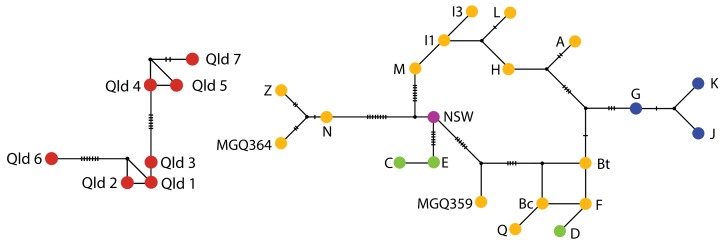
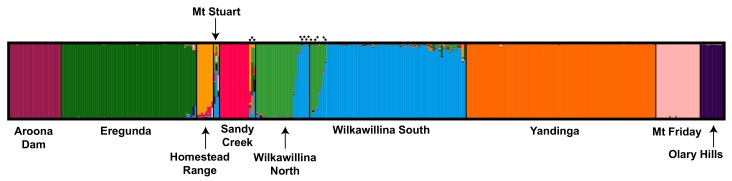
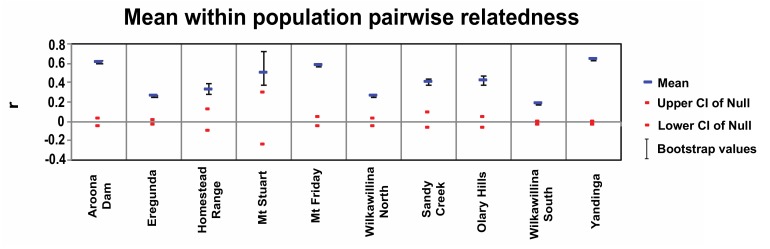
Little genetic research has been undertaken on mammals across the vast expanse of the arid biome in Australia, despite continuing species decline and need for conservation management. Here, we evaluate the contemporary and historical genetic connectivity of the yellow-footed rock-wallaby, , a threatened macropodid which inhabits rocky outcrops across the disconnected mountain range systems of the southern arid biome. We use 17 microsatellite loci together with mitochondrial control region data to determine the genetic diversity of populations and the evolutionary processes shaping contemporary population dynamics on which to base conservation recommendations. Our results indicate the highly fragmented populations have reduced diversity and limited contemporary gene flow, with most populations having been through population bottlenecks. Despite limited contemporary gene flow, the phylogeographic relationships of the mitochondrial control region indicate a lack of structure and suggests greater historical connectivity. This is an emerging outcome for mammals across this arid region. On the basis of our results, we recommend augmentation of populations of , mixing populations from disjunct mountain range systems to reduce the chance of continued diversity loss and inbreeding depression, and therefore maximize the potential for populations to adapt and survive into the future.
尽管澳大利亚干旱生物群落地域辽阔,但在哺乳动物方面的遗传研究很少,尽管物种不断减少,需要进行保护管理。在这里,我们评估了黄足岩袋鼠的当代和历史遗传连通性,黄足岩袋鼠是一种受威胁的有袋目动物,栖息在澳大利亚南部干旱生物群落分离的山脉系统的岩石露头中。我们使用 17 个微卫星基因座和线粒体控制区数据来确定种群的遗传多样性以及塑造当代种群动态的进化过程,为保护建议提供依据。我们的结果表明,高度碎片化的种群多样性降低,当代基因流有限,大多数种群都经历了种群瓶颈。尽管当代基因流有限,但线粒体控制区的系统地理学关系表明不存在结构,表明存在更大的历史连通性。这是该干旱地区哺乳动物的一个新兴结果。基于我们的研究结果,我们建议增加黄足岩袋鼠的种群数量,混合来自分离山脉系统的种群,以降低持续多样性丧失和近交衰退的风险,并最大限度地提高种群适应和未来生存的潜力。