Sainathan Sandeep, Wu Leester D, Andaz Shahriyour
Department of Surgery, Bronx-Lebanon Hospital Center, Bronx, New York 10457, USA.
Department of Radiation Oncology, South Nassau Communities Hospital, Oceanside, New York 11572, USA.
Lung India. 2014 Apr;31(2):158-60. doi: 10.4103/0970-2113.129854.
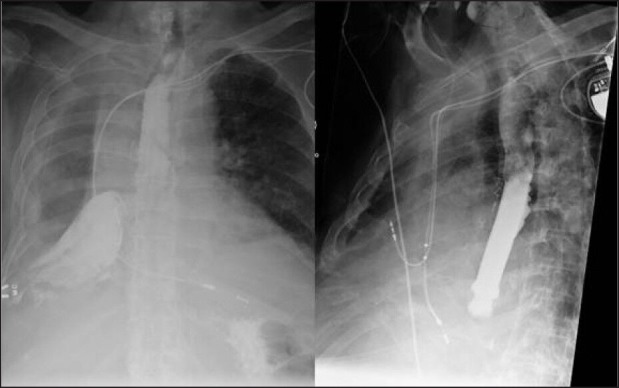
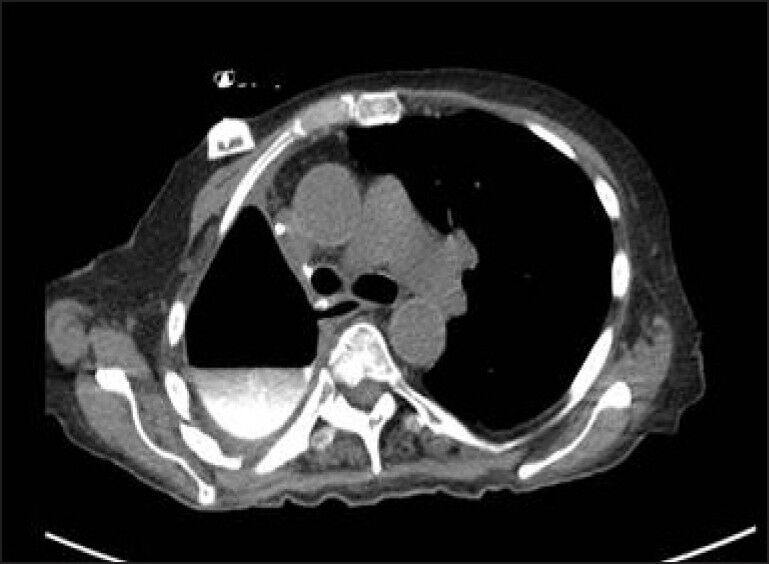
Stereotactic body radiation therapy (SBRT) is a novel form of external beam radiation therapy. It is used to treat early and locally recurrent nonsmall cell lung cancer (NSLC) in medically inoperable patients. It uses high dose, hypofractionated radiotherapy, with targeting of the tumor by precise spatial localization, thus minimizing injury to surrounding tissues. It can be safely used to ablate NSLC in both central and peripheral locations. We present two cases of delayed esophageal perforation after SBRT for locally recurrent central NSLC. The perforations occurred several months after the therapy. They were treated with covered esophageal stents, with mortality, due to the perforation in one of the patients. SBRT should be judiciously used to ablate centrally located NSLC and patients who develop episodes of esophagitis during or after SBRT, need to be closely followed with endoscopy to look for esophageal ulcerations. These ulcers should be closely followed for healing as these may degenerate into full thickness perforations several months after SBRT.
立体定向体部放射治疗(SBRT)是一种新型的外照射放射治疗形式。它用于治疗医学上无法手术的早期和局部复发性非小细胞肺癌(NSLC)患者。它采用高剂量、低分割放疗,通过精确的空间定位靶向肿瘤,从而将对周围组织的损伤降至最低。它可安全用于消融中央型和周围型NSLC。我们报告了两例因SBRT治疗局部复发性中央型NSLC后发生延迟性食管穿孔的病例。穿孔发生在治疗后数月。患者接受了覆膜食管支架治疗,其中一名患者因穿孔死亡。应谨慎使用SBRT消融中央型NSLC,并且在SBRT期间或之后发生食管炎的患者,需要密切进行内镜检查以寻找食管溃疡。应密切观察这些溃疡的愈合情况,因为在SBRT后数月它们可能恶化为全层穿孔。