Parker Margaret G, Ouyang Fengxiu, Pearson Colleen, Gillman Matthew W, Belfort Mandy B, Hong Xiumei, Wang Guoying, Heffner Linda, Zuckerman Barry, Wang Xiaobin
Department of Pediatrics, Boston Medical Center, Boston University School of Medicine, Boston, USA.
BMC Pregnancy Childbirth. 2014 Apr 30;14:153. doi: 10.1186/1471-2393-14-153.
To evaluate the association between prepregnancy body mass index (BMI) is associated with early vs. late and medically-induced vs. spontaneous preterm birth (PTB) subtypes.
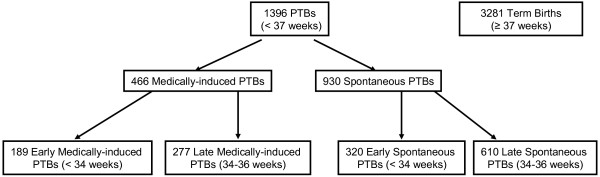
Using data from the Boston Birth Cohort, we examined associations of prepregnancy BMI with 189 early (<34 completed weeks) and 277 late (34-36 completed weeks) medically-induced PTBs and 320 early and 610 late spontaneous PTBs vs. 3281 term births (37-44 weeks) in multinomial regression. To assess for mediation by important pregnancy complications, we performed sequential models with and without hypertensive disorders of pregnancy, chorioamnionitis, and gestational diabetes.
Prevalence of prepregnancy obesity (BMI ≥ 30.0 kg/m2) was 28% among mothers with medically-induced PTBs, 18% among mothers with spontaneous PTBs, and 18% among mothers with term births (p = <0.001). After adjustment for demographic and known risk factors for PTB, prepregnancy obesity was associated with higher odds of both early [OR 1.78 (1.19, 2.66)] and late [OR 1.49 (1.09, 2.04)] medically-induced PTB. These effect estimates were attenuated with inclusion of hypertensive disorders of pregnancy and gestational diabetes. For spontaneous deliveries, prepregnancy obesity was associated with decreased odds of PTB (0.76 [0.58, 0.98]) and underweight was nearly associated with increased odds of PTB (1.46 [0.99, 2.16]).
Prepregnancy obesity is associated with higher risk of medically-induced, but not spontaneous PTB. Hypertensive disorders of pregnancy and gestational diabetes appear to partially explain the association between prepregnancy obesity and early and late medically-induced PTB.
评估孕前体重指数(BMI)与早产的早晚以及医源性早产与自发性早产亚型之间的关联。
利用波士顿出生队列的数据,我们在多项回归分析中研究了孕前BMI与189例早期(<34足周)和277例晚期(34 - 36足周)医源性早产以及320例早期和610例晚期自发性早产与3281例足月产(37 - 44周)之间的关联。为了评估重要妊娠并发症的中介作用,我们进行了包含和不包含妊娠高血压疾病、绒毛膜羊膜炎和妊娠期糖尿病的序贯模型分析。
医源性早产母亲中孕前肥胖(BMI≥30.0kg/m²)的患病率为28%,自发性早产母亲中为18%,足月产母亲中为18%(p<0.001)。在调整了人口统计学和已知的早产风险因素后,孕前肥胖与早期[比值比(OR)1.78(1.19,2.66)]和晚期[OR 1.49(1.09,2.04)]医源性早产的较高几率相关。纳入妊娠高血压疾病和妊娠期糖尿病后,这些效应估计值减弱。对于自然分娩,孕前肥胖与早产几率降低相关(0.76[0.58,0.98]),而体重过轻几乎与早产几率增加相关(1.46[0.99,2.16])。
孕前肥胖与医源性早产风险较高相关,但与自发性早产无关。妊娠高血压疾病和妊娠期糖尿病似乎部分解释了孕前肥胖与早期和晚期医源性早产之间的关联。