Mussolino Claudio, Alzubi Jamal, Fine Eli J, Morbitzer Robert, Cradick Thomas J, Lahaye Thomas, Bao Gang, Cathomen Toni
Institute for Cell and Gene Therapy, University Medical Center Freiburg, 79106 Freiburg, Germany Center for Chronic Immunodeficiency, University Medical Center Freiburg, 79108 Freiburg, Germany Institute of Experimental Hematology, Hannover Medical School, 30625 Hannover, Germany.
Department of Biomedical Engineering, Georgia Institute of Technology and Emory University, Atlanta, GA 30332, USA.
Nucleic Acids Res. 2014 Jun;42(10):6762-73. doi: 10.1093/nar/gku305. Epub 2014 May 3.
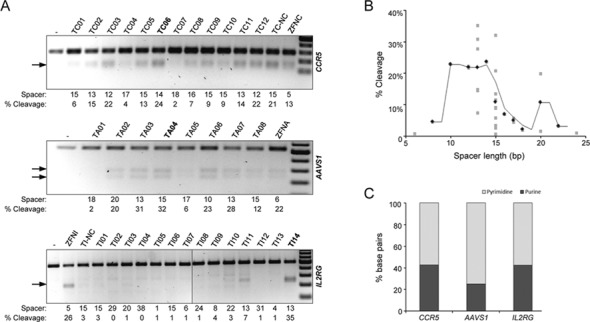
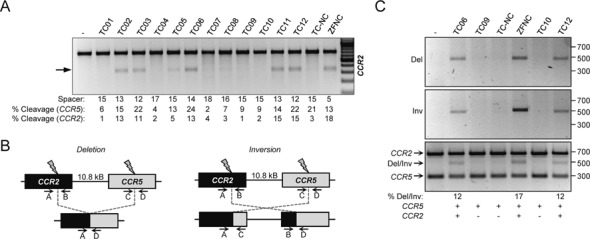
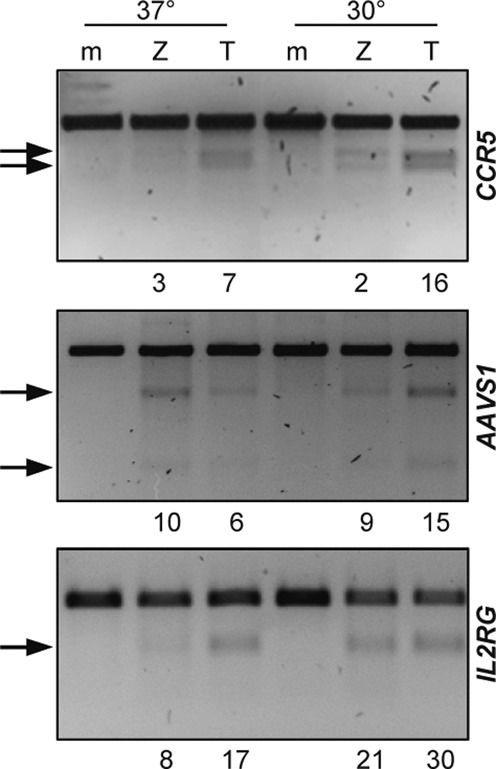
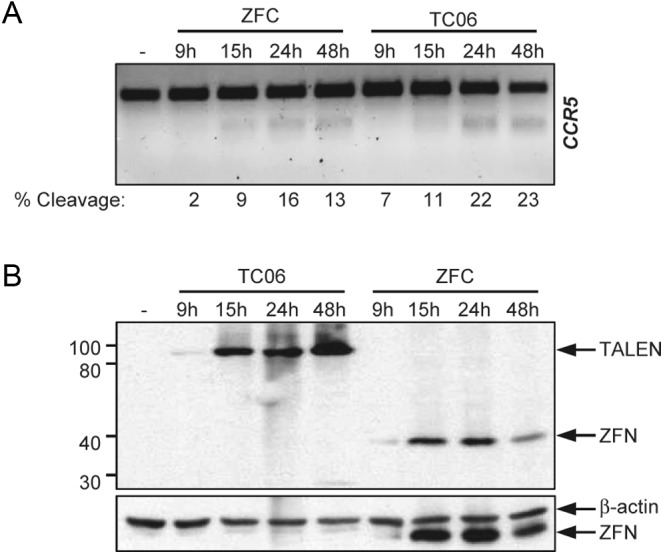
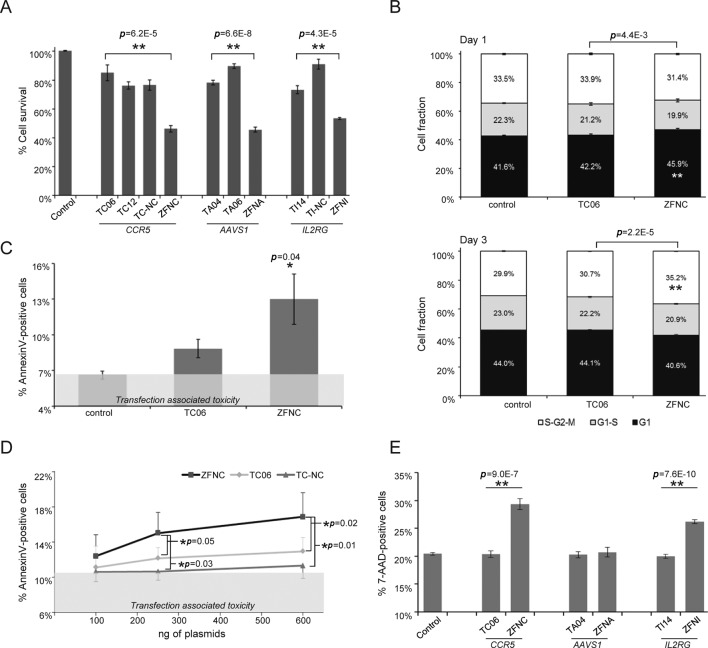
Designer nucleases have been successfully employed to modify the genomes of various model organisms and human cell types. While the specificity of zinc-finger nucleases (ZFNs) and RNA-guided endonucleases has been assessed to some extent, little data are available for transcription activator-like effector-based nucleases (TALENs). Here, we have engineered TALEN pairs targeting three human loci (CCR5, AAVS1 and IL2RG) and performed a detailed analysis of their activity, toxicity and specificity. The TALENs showed comparable activity to benchmark ZFNs, with allelic gene disruption frequencies of 15-30% in human cells. Notably, TALEN expression was overall marked by a low cytotoxicity and the absence of cell cycle aberrations. Bioinformatics-based analysis of designer nuclease specificity confirmed partly substantial off-target activity of ZFNs targeting CCR5 and AAVS1 at six known and five novel sites, respectively. In contrast, only marginal off-target cleavage activity was detected at four out of 49 predicted off-target sites for CCR5- and AAVS1-specific TALENs. The rational design of a CCR5-specific TALEN pair decreased off-target activity at the closely related CCR2 locus considerably, consistent with fewer genomic rearrangements between the two loci. In conclusion, our results link nuclease-associated toxicity to off-target cleavage activity and corroborate TALENs as a highly specific platform for future clinical translation.
设计核酸酶已成功用于修饰各种模式生物和人类细胞类型的基因组。虽然锌指核酸酶(ZFNs)和RNA引导的核酸内切酶的特异性已在一定程度上得到评估,但关于基于转录激活因子样效应物的核酸酶(TALENs)的数据却很少。在此,我们构建了靶向三个人类基因座(CCR5、AAVS1和IL2RG)的TALEN对,并对其活性、毒性和特异性进行了详细分析。TALENs表现出与基准ZFNs相当的活性,在人类细胞中的等位基因破坏频率为15 - 30%。值得注意的是,TALEN表达总体上具有低细胞毒性且不存在细胞周期异常的特点。基于生物信息学对设计核酸酶特异性的分析证实,靶向CCR5和AAVS1的ZFNs分别在六个已知位点和五个新位点存在部分显著的脱靶活性。相比之下,在CCR5和AAVS1特异性TALENs的49个预测脱靶位点中,仅在4个位点检测到边缘性的脱靶切割活性。合理设计的CCR5特异性TALEN对显著降低了在密切相关的CCR2基因座的脱靶活性,这与两个基因座之间较少的基因组重排一致。总之,我们的结果将核酸酶相关毒性与脱靶切割活性联系起来,并证实TALENs是未来临床转化的高度特异性平台。