1] Centre for Tumour Biology Barts Cancer Institute-a Cancer Research UK Centre of Excellence, Queen Mary, University of London, London EC1M 6BQ, UK [2] Institute for Bioengineering of Catalonia, 08028 Barcelona, Spain.
Institute for Bioengineering of Catalonia, 08028 Barcelona, Spain.
Nat Mater. 2014 Jun;13(6):631-7. doi: 10.1038/nmat3960. Epub 2014 May 4.
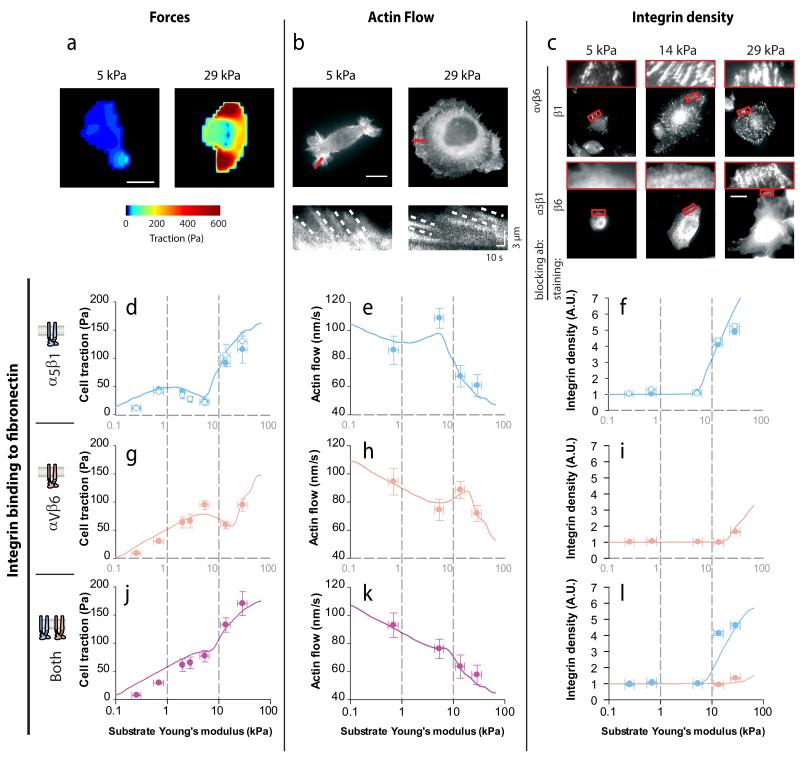
Tissue rigidity regulates processes in development, cancer and wound healing. However, how cells detect rigidity, and thereby modulate their behaviour, remains unknown. Here, we show that sensing and adaptation to matrix rigidity in breast myoepithelial cells is determined by the bond dynamics of different integrin types. Cell binding to fibronectin through either α5β1 integrins (constitutively expressed) or αvβ6 integrins (selectively expressed in cancer and development) adapts force generation, actin flow and integrin recruitment to rigidities associated with healthy or malignant tissue, respectively. In vitro experiments and theoretical modelling further demonstrate that this behaviour is explained by the different binding and unbinding rates of both integrin types to fibronectin. Moreover, rigidity sensing through differences in integrin bond dynamics applies both when integrins bind separately and when they compete for binding to fibronectin.
组织硬度调节着发育、癌症和伤口愈合等过程。然而,细胞如何感知硬度并相应地调节其行为仍然未知。在这里,我们发现,乳腺肌上皮细胞对基质硬度的感知和适应取决于不同整合素类型的键动力学。细胞通过α5β1 整联蛋白(持续表达)或αvβ6 整联蛋白(在癌症和发育中选择性表达)与纤连蛋白结合,分别将力的产生、肌动蛋白流和整联蛋白募集适应于与健康组织或恶性组织相关的硬度。体外实验和理论建模进一步表明,这种行为是由两种整联蛋白类型与纤连蛋白的结合和脱结合速率不同所解释的。此外,通过整合素键动力学的差异进行的硬度感知,既适用于整合素单独结合的情况,也适用于它们竞争与纤连蛋白结合的情况。