• 文献检索
  • 文档翻译
  • 深度研究
  • 学术资讯
  • Suppr Zotero 插件Zotero 插件
  • 邀请有礼
  • 套餐&价格
  • 历史记录
应用&插件
Suppr Zotero 插件Zotero 插件浏览器插件Mac 客户端Windows 客户端微信小程序
定价
高级版会员购买积分包购买API积分包
服务
文献检索文档翻译深度研究API 文档MCP 服务
关于我们
关于 Suppr公司介绍联系我们用户协议隐私条款
关注我们

Suppr 超能文献

核心技术专利:CN118964589B侵权必究
粤ICP备2023148730 号-1Suppr @ 2026

文献检索

告别复杂PubMed语法,用中文像聊天一样搜索,搜遍4000万医学文献。AI智能推荐,让科研检索更轻松。

立即免费搜索

文件翻译

保留排版,准确专业,支持PDF/Word/PPT等文件格式,支持 12+语言互译。

免费翻译文档

深度研究

AI帮你快速写综述,25分钟生成高质量综述,智能提取关键信息,辅助科研写作。

立即免费体验

我难以置信,但我最好对此做点什么:患者对在线心脏年龄风险计算器的体验。

I don't believe it, but i'd better do something about it: patient experiences of online heart age risk calculators.

作者信息

Bonner Carissa, Jansen Jesse, Newell Ben R, Irwig Les, Glasziou Paul, Doust Jenny, Dhillon Haryana, McCaffery Kirsten

机构信息

Screening and Test Evaluation Program (STEP), Sydney School of Public Health, The University of Sydney, Sydney, Australia.

出版信息

J Med Internet Res. 2014 May 5;16(5):e120. doi: 10.2196/jmir.3190.

DOI:10.2196/jmir.3190
PMID:24797339
原文链接:https://pmc.ncbi.nlm.nih.gov/articles/PMC4026572/
Abstract

BACKGROUND

Health risk calculators are widely available on the Internet, including cardiovascular disease (CVD) risk calculators that estimate the probability of a heart attack, stroke, or death over a 5- or 10-year period. Some calculators convert this probability to "heart age", where a heart age older than current age indicates modifiable risk factors. These calculators may impact patient decision making about CVD risk management with or without clinician involvement, but little is known about how patients use them. Previous studies have not investigated patient understanding of heart age compared to 5-year percentage risk, or the best way to present heart age.

OBJECTIVE

This study aimed to investigate patient experiences and understanding of online heart age calculators that use different verbal, numerical, and graphical formats, based on 5- and 10-year Framingham risk equations used in clinical practice guidelines around the world.

METHODS

General practitioners in New South Wales, Australia, recruited 26 patients with CVD/lifestyle risk factors who were not taking cholesterol or blood pressure-lowering medication in 2012. Participants were asked to "think aloud" while using two heart age calculators in random order, with semi-structured interviews before and after. Transcribed audio recordings were coded and a framework analysis method was used.

RESULTS

Risk factor questions were often misinterpreted, reducing the accuracy of the calculators. Participants perceived older heart age as confronting and younger heart age as positive but unrealistic. Unexpected or contradictory results (eg, low percentage risk but older heart age) led participants to question the credibility of the calculators. Reasons to discredit the results included the absence of relevant lifestyle questions and impact of corporate sponsorship. However, the calculators prompted participants to consider lifestyle changes irrespective of whether they received younger, same, or older heart age results.

CONCLUSIONS

Online heart age calculators can be misunderstood and disregarded if they produce unexpected or contradictory results, but they may still motivate lifestyle changes. Future research should investigate both the benefits and harms of communicating risk in this way, and how to increase the reliability and credibility of online health risk calculators.

摘要

背景

健康风险计算器在互联网上广泛可得,包括心血管疾病(CVD)风险计算器,可估算5年或10年内心脏病发作、中风或死亡的概率。一些计算器将此概率转换为“心脏年龄”,心脏年龄大于实际年龄表明存在可改变的风险因素。这些计算器可能会影响患者在有无临床医生参与情况下对CVD风险管理的决策,但对于患者如何使用它们却知之甚少。先前的研究尚未调查患者对心脏年龄与5年风险百分比的理解,以及呈现心脏年龄的最佳方式。

目的

本研究旨在基于全球临床实践指南中使用的5年和10年弗明汉风险方程,调查患者对使用不同语言、数字和图形格式的在线心脏年龄计算器的体验和理解。

方法

2012年,澳大利亚新南威尔士州的全科医生招募了26名有CVD/生活方式风险因素且未服用胆固醇或降压药物的患者。参与者被要求按随机顺序使用两个心脏年龄计算器时“边想边说”,前后进行半结构化访谈。对转录的音频记录进行编码,并采用框架分析方法。

结果

风险因素问题常被误解,降低了计算器的准确性。参与者认为心脏年龄较大令人不安,而心脏年龄较小则是积极的但不现实。意外或矛盾的结果(如低风险百分比但心脏年龄较大)导致参与者质疑计算器的可信度。质疑结果的原因包括缺乏相关生活方式问题以及企业赞助的影响。然而,这些计算器促使参与者考虑生活方式的改变,无论他们得到的心脏年龄结果是更年轻、相同还是更老。

结论

如果在线心脏年龄计算器产生意外或矛盾的结果,可能会被误解和忽视,但它们仍可能促使生活方式的改变。未来的研究应调查以这种方式传达风险的益处和危害,以及如何提高在线健康风险计算器的可靠性和可信度。
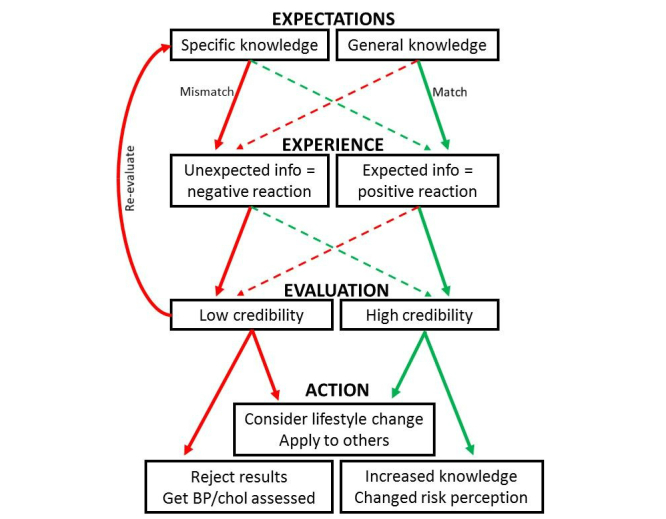
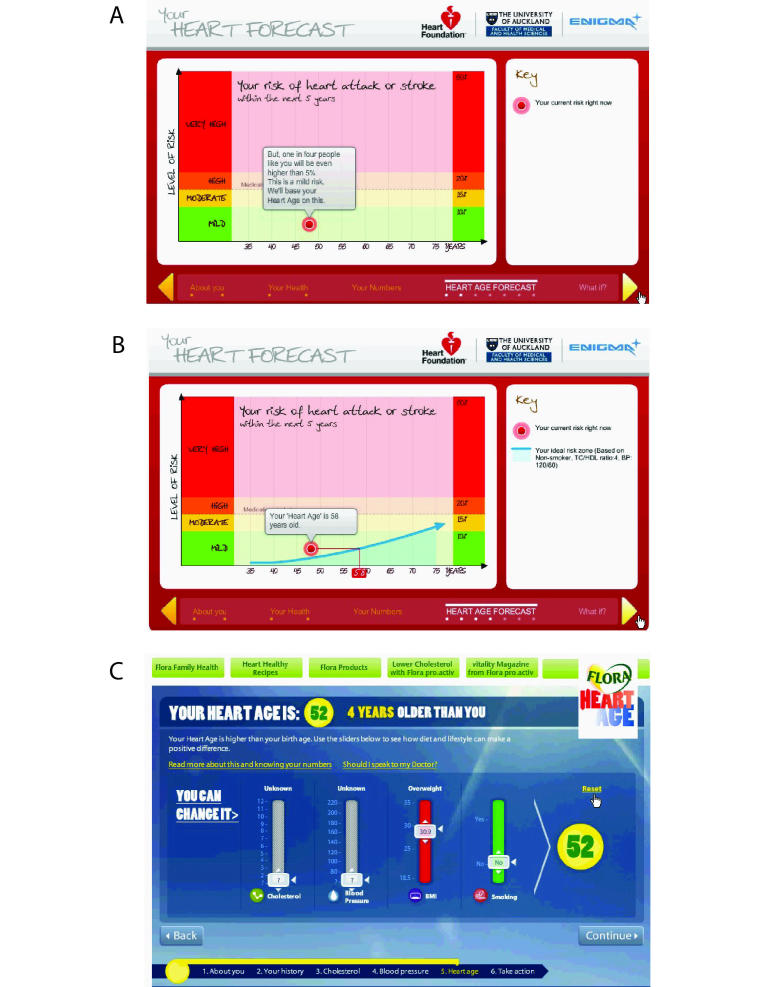
https://cdn.ncbi.nlm.nih.gov/pmc/blobs/8960/4026572/bc3d155aafee/jmir_v16i5e120_fig2.jpg
https://cdn.ncbi.nlm.nih.gov/pmc/blobs/8960/4026572/b85c1ecaadc4/jmir_v16i5e120_fig1.jpg
https://cdn.ncbi.nlm.nih.gov/pmc/blobs/8960/4026572/bc3d155aafee/jmir_v16i5e120_fig2.jpg
https://cdn.ncbi.nlm.nih.gov/pmc/blobs/8960/4026572/b85c1ecaadc4/jmir_v16i5e120_fig1.jpg
https://cdn.ncbi.nlm.nih.gov/pmc/blobs/8960/4026572/bc3d155aafee/jmir_v16i5e120_fig2.jpg

相似文献

1
I don't believe it, but i'd better do something about it: patient experiences of online heart age risk calculators.我难以置信,但我最好对此做点什么:患者对在线心脏年龄风险计算器的体验。
J Med Internet Res. 2014 May 5;16(5):e120. doi: 10.2196/jmir.3190.
2
Heuristics and biases in cardiovascular disease prevention: How can we improve communication about risk, benefits and harms?心血管疾病预防中的启发式偏差:我们如何改进风险、获益和危害的沟通?
Patient Educ Couns. 2018 May;101(5):843-853. doi: 10.1016/j.pec.2017.12.003. Epub 2017 Dec 11.
3
Is the "Heart Age" Concept Helpful or Harmful Compared to Absolute Cardiovascular Disease Risk? An Experimental Study.与绝对心血管疾病风险相比,“心脏年龄”概念是有益还是有害?一项实验研究。
Med Decis Making. 2015 Nov;35(8):967-78. doi: 10.1177/0272989X15597224. Epub 2015 Aug 6.
4
Clinical Validity, Understandability, and Actionability of Online Cardiovascular Disease Risk Calculators: Systematic Review.在线心血管疾病风险计算器的临床有效性、可理解性及可操作性:系统评价
J Med Internet Res. 2018 Feb 1;20(2):e29. doi: 10.2196/jmir.8538.
5
Should heart age calculators be used alongside absolute cardiovascular disease risk assessment?心脏年龄计算器是否应与绝对心血管疾病风险评估一起使用?
BMC Cardiovasc Disord. 2018 Feb 7;18(1):19. doi: 10.1186/s12872-018-0760-1.
6
"They are saying it's high, but I think it's quite low": exploring cardiovascular disease risk communication in NHS health checks through video-stimulated recall interviews with patients - a qualitative study.“他们说这个数值很高,但我觉得挺低的”:通过对患者进行视频刺激回忆访谈探索英国国家医疗服务体系健康检查中的心血管疾病风险沟通——一项定性研究
BMC Prim Care. 2024 Apr 23;25(1):126. doi: 10.1186/s12875-024-02357-w.
7
Shared decision-making about cardiovascular disease medication in older people: a qualitative study of patient experiences in general practice.老年人心血管疾病药物治疗的共同决策:一般实践中患者体验的定性研究。
BMJ Open. 2019 Mar 20;9(3):e026342. doi: 10.1136/bmjopen-2018-026342.
8
Experiences of a National Web-Based Heart Age Calculator for Cardiovascular Disease Prevention: User Characteristics, Heart Age Results, and Behavior Change Survey.基于网络的全国性心脏年龄计算器在心血管疾病预防中的应用体验:用户特征、心脏年龄结果和行为改变调查。
J Med Internet Res. 2020 Aug 7;22(8):e19028. doi: 10.2196/19028.
9
"First-hit" heart attack risk calculators on the world wide web: implications for laypersons and healthcare practitioners.万维网上的“首次发作”心脏病发作风险计算器:对外行和医疗从业者的影响。
Int J Med Inform. 2008 Jun;77(6):405-12. doi: 10.1016/j.ijmedinf.2007.08.001. Epub 2007 Oct 1.
10
The 'lottery' of cardiovascular risk estimation with Internet-based risk calculators.基于互联网的风险计算器进行心血管风险评估的“彩票”。
J Med Syst. 2018 Mar 2;42(4):68. doi: 10.1007/s10916-018-0925-6.

引用本文的文献

1
The Heart Health Yarning Tool: Co-Designing a Shared Decision-Making Tool With Aboriginal and Torres Strait Islander People for Cardiovascular Disease Prevention and Risk Management.心脏健康预警工具:与原住民和托雷斯海峡岛民共同设计一个用于心血管疾病预防和风险管理的共享决策工具。
Health Expect. 2025 Aug;28(4):e70387. doi: 10.1111/hex.70387.
2
Usefulness of Atherogenic Indices for Predicting High Values of Avoidable Lost Life Years Heart Age in 139,634 Spanish Workers.致动脉粥样硬化指数对预测139634名西班牙工人中可避免的生命损失年数和心脏年龄高值的有用性。
Diagnostics (Basel). 2024 Oct 26;14(21):2388. doi: 10.3390/diagnostics14212388.
3

本文引用的文献

1
General practitioners' use of different cardiovascular risk assessment strategies: a qualitative study.全科医生使用不同心血管风险评估策略的情况:一项定性研究。
Med J Aust. 2013 Oct 7;199(7):485-9. doi: 10.5694/mja13.10133.
2
Belief in numbers: When and why women disbelieve tailored breast cancer risk statistics.相信数字:女性何时以及为何不相信量身定制的乳腺癌风险统计数据。
Patient Educ Couns. 2013 Aug;92(2):253-9. doi: 10.1016/j.pec.2013.03.016. Epub 2013 Apr 24.
3
Agreement among cardiovascular disease risk calculators.心血管疾病风险计算器的一致性。
Codesigning a Digital Type 2 Diabetes Risk Communication Tool in Singapore: Qualitative Participatory Action Research Approach.
在新加坡共同设计数字 2 型糖尿病风险沟通工具:定性参与式行动研究方法。
JMIR Form Res. 2024 Nov 5;8:e50456. doi: 10.2196/50456.
4
"They are saying it's high, but I think it's quite low": exploring cardiovascular disease risk communication in NHS health checks through video-stimulated recall interviews with patients - a qualitative study.“他们说这个数值很高,但我觉得挺低的”:通过对患者进行视频刺激回忆访谈探索英国国家医疗服务体系健康检查中的心血管疾病风险沟通——一项定性研究
BMC Prim Care. 2024 Apr 23;25(1):126. doi: 10.1186/s12875-024-02357-w.
5
Communicating the results of risk-based breast cancer screening through visualizations of risk: a participatory design approach.基于风险的乳腺癌筛查结果通过风险可视化呈现:一种参与式设计方法。
BMC Med Inform Decis Mak. 2024 Mar 18;24(1):78. doi: 10.1186/s12911-024-02483-6.
6
Implementing patient decision aids into general practice clinical decision support systems: Feasibility study in cardiovascular disease prevention.将患者决策辅助工具纳入全科医疗临床决策支持系统:心血管疾病预防的可行性研究
PEC Innov. 2023 Feb 21;2:100140. doi: 10.1016/j.pecinn.2023.100140. eCollection 2023 Dec.
7
Testing Explanations for Skepticism of Personalized Risk Information.测试对个人风险信息持怀疑态度的原因。
Med Decis Making. 2023 May;43(4):430-444. doi: 10.1177/0272989X231162824. Epub 2023 Apr 2.
8
The Impact and Perception of England's Web-Based Heart Age Test of Cardiovascular Disease Risk: Mixed Methods Study.英国基于网络的心血管疾病风险心脏年龄测试的影响与认知:混合方法研究
JMIR Cardio. 2023 Feb 6;7:e39097. doi: 10.2196/39097.
9
Cardiovascular risk communication strategies in primary prevention. A systematic review with narrative synthesis.心血管疾病初级预防中的风险沟通策略。系统评价与叙述性综合。
J Adv Nurs. 2022 Oct;78(10):3116-3140. doi: 10.1111/jan.15327. Epub 2022 Jun 19.
10
The Impact of Health Literacy-Sensitive Design and Heart Age in a Cardiovascular Disease Prevention Decision Aid: Randomized Controlled Trial and End-User Testing.健康素养敏感设计与心脏年龄在心血管疾病预防决策辅助工具中的影响:随机对照试验与终端用户测试
JMIR Cardio. 2022 Apr 15;6(1):e34142. doi: 10.2196/34142.
Circulation. 2013 May 14;127(19):1948-56. doi: 10.1161/CIRCULATIONAHA.112.000412. Epub 2013 Apr 10.
4
Cardiovascular risk age: concepts and practicalities.心血管风险年龄:概念与实践。
Heart. 2012 Jun;98(12):941-6. doi: 10.1136/heartjnl-2011-301478.
5
Effectiveness of personalized and interactive health risk calculators: a randomized trial.个性化互动式健康风险计算器的效果:一项随机试验。
Med Decis Making. 2012 Jul-Aug;32(4):594-605. doi: 10.1177/0272989X11431736. Epub 2012 Jan 12.
6
Risk estimates from an online risk calculator are more believable and recalled better when expressed as integers.当以整数形式表示时,在线风险计算器得出的风险估计值更可信且记忆效果更好。
J Med Internet Res. 2011 Sep 7;13(3):e54. doi: 10.2196/jmir.1656.
7
Cool but counterproductive: interactive, Web-based risk communications can backfire.冷静但适得其反:基于网络的交互式风险沟通可能会适得其反。
J Med Internet Res. 2011 Aug 25;13(3):e60. doi: 10.2196/jmir.1665.
8
Using alternative statistical formats for presenting risks and risk reductions.使用替代统计格式来呈现风险和风险降低情况。
Cochrane Database Syst Rev. 2011 Mar 16;2011(3):CD006776. doi: 10.1002/14651858.CD006776.pub2.
9
Does Your Heart Forecast help practitioner understanding and confidence with cardiovascular disease risk communication?“你的心脏预测”是否有助于从业者理解心血管疾病风险并在沟通中增强信心?
J Prim Health Care. 2011 Mar 1;3(1):4-9.
10
'Your Heart Forecast': a new approach for describing and communicating cardiovascular risk?“你的心脏预测”:一种描述和传达心血管风险的新方法?
Heart. 2010 May;96(9):708-13. doi: 10.1136/hrt.2009.191320.