Li Jiangmei, Zhang Lunfeng, Gao Zhen, Kang Hua, Rong Guohua, Zhang Xu, Chen Chang
National Laboratory of Biomacromolecules, Institute of Biophysics, Chinese Academy of Sciences, Beijing, 100101, China.
Protein Cell. 2014 Jun;5(6):457-68. doi: 10.1007/s13238-014-0055-y. Epub 2014 May 7.
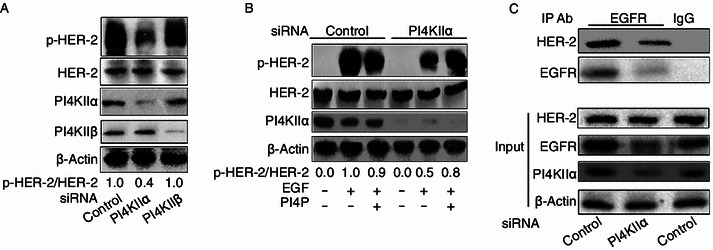
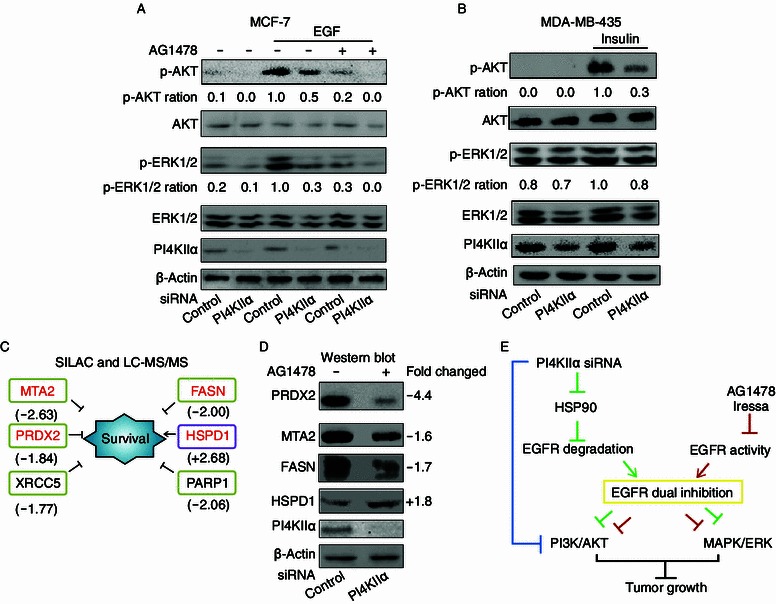
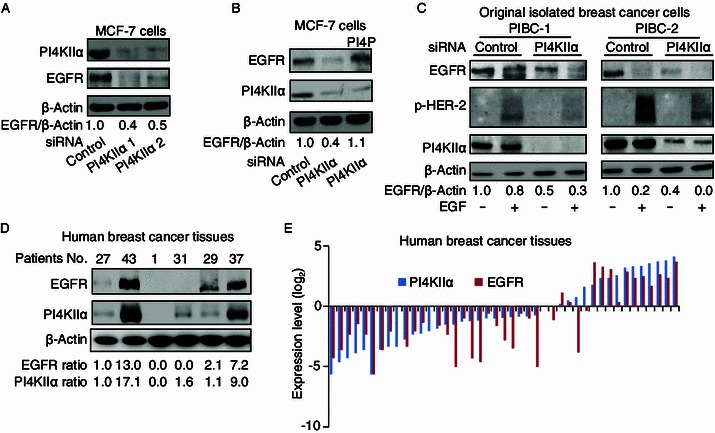
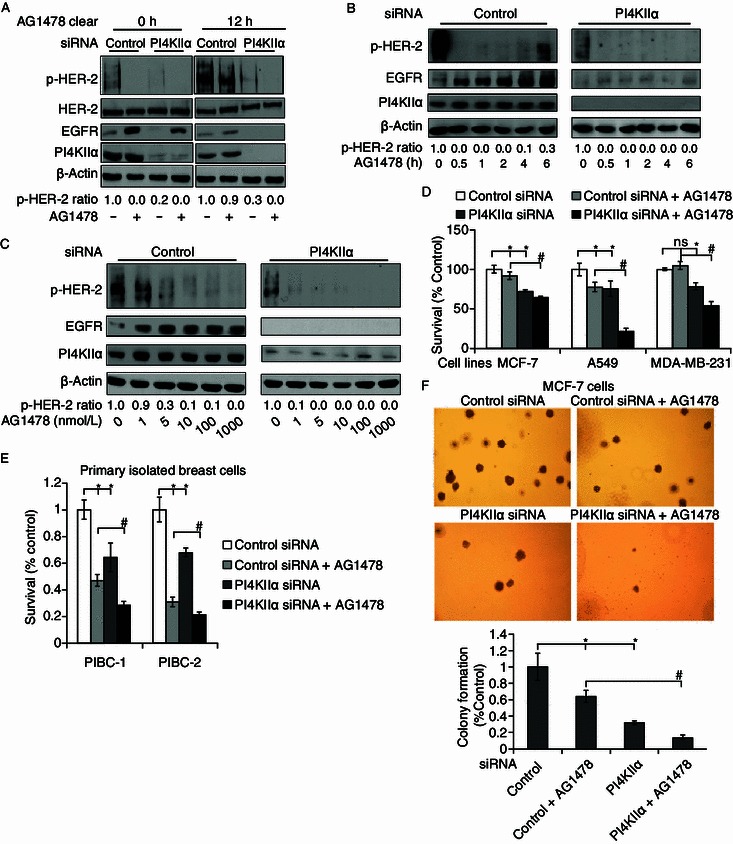
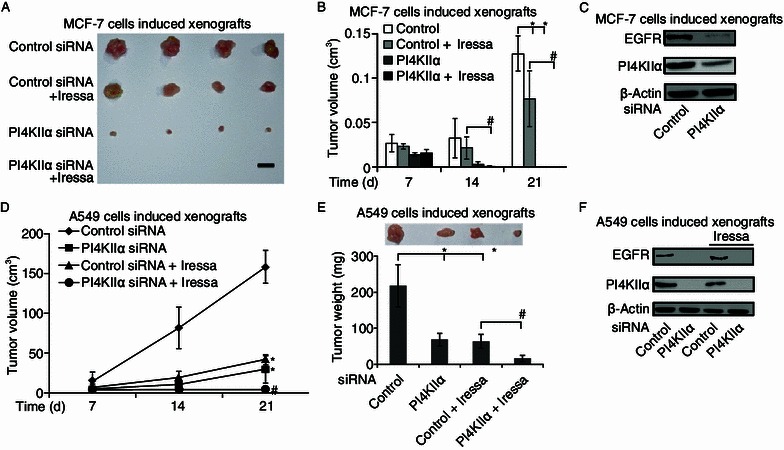
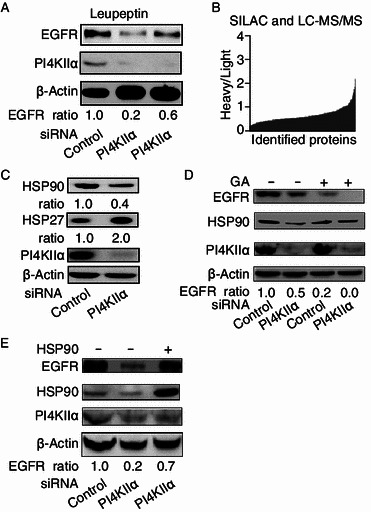
Our previous studies indicate that phosphatidylinositol 4-kinase IIα can promote the growth of multi-malignant tumors via HER-2/PI3K and MAPK pathways. However, the molecular mechanisms of this pathway and its potential for clinical application remain unknown. In this study, we found that PI4KIIα could be an ideal combinatorial target for EGFR treatment via regulating EGFR degradation. Results showed that PI4KIIα knockdown reduced EGFR protein level, and the expression of PI4KIIα shows a strong correlation with EGFR in human breast cancer tissues (r = 0.77, P < 0.01). PI4KIIα knockdown greatly prolonged the effects and decreased the effective dosage of AG-1478, a specific inhibitor of EGFR. In addition, it significantly enhanced AG1478-induced inhibition of tumor cell survival and strengthened the effect of the EGFR-targeting anti-cancer drug Iressa in xenograft tumor models. Mechanistically, we found that PI4KIIα suppression increased EGFR ligand-independent degradation. Quantitative proteomic analysis by stable isotope labeling with amino acids in cell culture (SILAC) and LC-MS/MS suggested that HSP90 mediated the effect of PI4KIIα on EGFR. Furthermore, we found that combined inhibition of PI4KIIα and EGFR suppressed both PI3K/AKT and MAPK/ERK pathways, and resulted in downregulation of multiple oncogenes like PRDX2, FASN, MTA2, ultimately leading to suppression of tumor growth. Therefore, we conclude that combined inhibition of PI4KIIα and EGFR exerts a multiple anti-tumor effect. Dual inhibition of EGFR at protein and activity level via combinatorial blocking of PI4KIIα presents a novel strategy to combat EGFR-dependent tumors.
我们之前的研究表明,磷脂酰肌醇4-激酶IIα可通过HER-2/PI3K和MAPK信号通路促进多种恶性肿瘤的生长。然而,该信号通路的分子机制及其临床应用潜力仍不清楚。在本研究中,我们发现PI4KIIα可能是通过调节表皮生长因子受体(EGFR)降解而成为EGFR治疗的理想联合靶点。结果显示,敲低PI4KIIα可降低EGFR蛋白水平,且PI4KIIα的表达与人乳腺癌组织中的EGFR呈强相关性(r = 0.77,P < 0.01)。敲低PI4KIIα可显著延长AG-1478(一种EGFR特异性抑制剂)的作用时间并降低其有效剂量。此外,它还显著增强了AG1478诱导的对肿瘤细胞存活的抑制作用,并增强了EGFR靶向抗癌药物易瑞沙在异种移植瘤模型中的效果。机制上,我们发现抑制PI4KIIα可增加EGFR非配体依赖性降解。通过细胞培养中氨基酸稳定同位素标记(SILAC)和液相色谱-串联质谱(LC-MS/MS)进行的定量蛋白质组学分析表明,热休克蛋白90(HSP90)介导了PI4KIIα对EGFR的作用。此外,我们发现联合抑制PI4KIIα和EGFR可同时抑制PI3K/AKT和MAPK/ERK信号通路,并导致多个癌基因如PRDX2、FASN、MTA2的下调,最终导致肿瘤生长受到抑制。因此,我们得出结论,联合抑制PI4KIIα和EGFR可发挥多种抗肿瘤作用。通过联合阻断PI4KIIα在蛋白和活性水平上对EGFR进行双重抑制,为对抗EGFR依赖性肿瘤提供了一种新策略。