Alli-Balogun Ganiyu Olabanji, Gewinner Christina A, Jacobs Ruth, Kriston-Vizi Janos, Waugh Mark G, Minogue Shane
Lipid and Membrane Biology Group, UCL Division of Medicine, Royal Free Campus, University College London, London NW3 2PF, United Kingdom.
UCL Translational Research Office, London W1T 7JA, United Kingdom.
Mol Biol Cell. 2016 Dec 15;27(25):4033-4042. doi: 10.1091/mbc.E16-08-0564. Epub 2016 Oct 26.
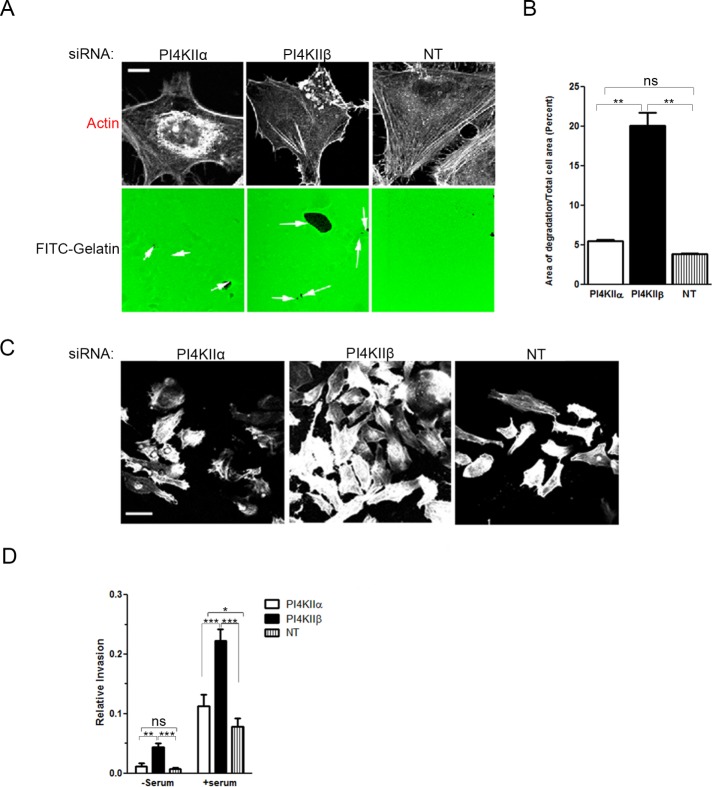
The type II phosphatidylinositol 4-kinase (PI4KII) enzymes synthesize the lipid phosphatidylinositol 4-phosphate (PI(4)P), which has been detected at the Golgi complex and endosomal compartments and recruits clathrin adaptors. Despite common mechanistic similarities between the isoforms, the extent of their redundancy is unclear. We found that depletion of PI4KIIα and PI4KIIβ using small interfering RNA led to actin remodeling. Depletion of PI4KIIβ also induced the formation of invadopodia containing membrane type I matrix metalloproteinase (MT1-MMP). Depletion of PI4KII isoforms also differentially affected trans-Golgi network (TGN) pools of PI(4)P and post-TGN traffic. PI4KIIβ depletion caused increased MT1-MMP trafficking to invasive structures at the plasma membrane and was accompanied by reduced colocalization of MT1-MMP with membranes containing the endosomal markers Rab5 and Rab7 but increased localization with the exocytic Rab8. Depletion of PI4KIIβ was sufficient to confer an aggressive invasive phenotype on minimally invasive HeLa and MCF-7 cell lines. Mining oncogenomic databases revealed that loss of the PI4K2B allele and underexpression of PI4KIIβ mRNA are associated with human cancers. This finding supports the cell data and suggests that PI4KIIβ may be a clinically significant suppressor of invasion. We propose that PI4KIIβ synthesizes a pool of PI(4)P that maintains MT1-MMP traffic in the degradative pathway and suppresses the formation of invadopodia.
II型磷脂酰肌醇4激酶(PI4KII)可合成脂质磷脂酰肌醇4磷酸(PI(4)P),该物质已在高尔基体复合体和内体区室中被检测到,并可募集网格蛋白衔接蛋白。尽管各亚型之间在机制上有共同的相似之处,但其冗余程度尚不清楚。我们发现,使用小分子干扰RNA耗尽PI4KIIα和PI4KIIβ会导致肌动蛋白重塑。耗尽PI4KIIβ还会诱导含有膜型I基质金属蛋白酶(MT1-MMP)的侵袭性伪足形成。耗尽PI4KII亚型也会对PI(4)P的反式高尔基体网络(TGN)池和TGN后运输产生不同影响。耗尽PI4KIIβ会导致MT1-MMP向质膜侵袭结构的运输增加,并伴随着MT1-MMP与含有内体标记物Rab5和Rab7的膜的共定位减少,但与外排性Rab8的定位增加。耗尽PI4KIIβ足以赋予低侵袭性的HeLa和MCF-7细胞系侵袭性增强的表型。挖掘肿瘤基因组数据库发现,PI4K2B等位基因缺失和PI4KIIβ mRNA表达不足与人类癌症有关。这一发现支持了细胞实验数据,并表明PI4KIIβ可能是一种具有临床意义的侵袭抑制因子。我们提出,PI4KIIβ合成了一组PI(4)P,维持MT1-MMP在降解途径中的运输,并抑制侵袭性伪足的形成。