• 文献检索
  • 文档翻译
  • 深度研究
  • 学术资讯
  • Suppr Zotero 插件Zotero 插件
  • 邀请有礼
  • 套餐&价格
  • 历史记录
应用&插件
Suppr Zotero 插件Zotero 插件浏览器插件Mac 客户端Windows 客户端微信小程序
定价
高级版会员购买积分包购买API积分包
服务
文献检索文档翻译深度研究API 文档MCP 服务
关于我们
关于 Suppr公司介绍联系我们用户协议隐私条款
关注我们

Suppr 超能文献

核心技术专利:CN118964589B侵权必究
粤ICP备2023148730 号-1Suppr @ 2026

文献检索

告别复杂PubMed语法,用中文像聊天一样搜索,搜遍4000万医学文献。AI智能推荐,让科研检索更轻松。

立即免费搜索

文件翻译

保留排版,准确专业,支持PDF/Word/PPT等文件格式,支持 12+语言互译。

免费翻译文档

深度研究

AI帮你快速写综述,25分钟生成高质量综述,智能提取关键信息,辅助科研写作。

立即免费体验

在英国手语中,典型发育的失聪儿童和患有自闭症谱系障碍的失聪儿童在理解情感面部表情时是如何运用面部的?

How do typically developing deaf children and deaf children with autism spectrum disorder use the face when comprehending emotional facial expressions in British sign language?

作者信息

Denmark Tanya, Atkinson Joanna, Campbell Ruth, Swettenham John

机构信息

Division of Psychology and Language Science, Department of Developmental Science, University College London, London, UK,

出版信息

J Autism Dev Disord. 2014 Oct;44(10):2584-92. doi: 10.1007/s10803-014-2130-x.

DOI:10.1007/s10803-014-2130-x
PMID:24803370
原文链接:https://pmc.ncbi.nlm.nih.gov/articles/PMC4167441/
Abstract

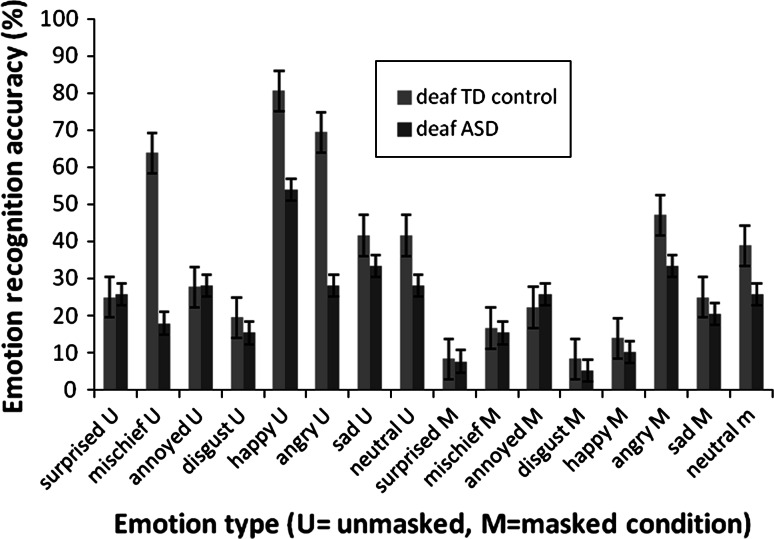
Facial expressions in sign language carry a variety of communicative features. While emotion can modulate a spoken utterance through changes in intonation, duration and intensity, in sign language specific facial expressions presented concurrently with a manual sign perform this function. When deaf adult signers cannot see facial features, their ability to judge emotion in a signed utterance is impaired (Reilly et al. in Sign Lang Stud 75:113-118, 1992). We examined the role of the face in the comprehension of emotion in sign language in a group of typically developing (TD) deaf children and in a group of deaf children with autism spectrum disorder (ASD). We replicated Reilly et al.'s (Sign Lang Stud 75:113-118, 1992) adult results in the TD deaf signing children, confirming the importance of the face in understanding emotion in sign language. The ASD group performed more poorly on the emotion recognition task than the TD children. The deaf children with ASD showed a deficit in emotion recognition during sign language processing analogous to the deficit in vocal emotion recognition that has been observed in hearing children with ASD.

摘要

手语中的面部表情具有多种交际功能。在口语中,情感可以通过语调、时长和强度的变化来调节话语表达,而在手语中,与手部动作同时呈现的特定面部表情则起到这一作用。当成年聋人手语使用者无法看到面部特征时,他们判断手语话语中情感的能力就会受损(赖利等人,《手语研究》第75卷:第113 - 118页,1992年)。我们研究了面部表情在一组发育正常的(TD)聋童和一组患有自闭症谱系障碍(ASD)的聋童对手语情感理解中的作用。我们在TD聋人手语儿童中重现了赖利等人(《手语研究》第75卷:第113 - 118页,1992年)针对成年人的研究结果,证实了面部表情在理解手语情感中的重要性。ASD组在情感识别任务中的表现比TD组儿童更差。患有ASD的聋童在手语处理过程中的情感识别存在缺陷,这与在患有ASD的听力儿童中观察到的语音情感识别缺陷类似。

https://cdn.ncbi.nlm.nih.gov/pmc/blobs/5703/4167441/eb4a2042ca51/10803_2014_2130_Fig3_HTML.jpg
https://cdn.ncbi.nlm.nih.gov/pmc/blobs/5703/4167441/d17591df1e34/10803_2014_2130_Fig1_HTML.jpg
https://cdn.ncbi.nlm.nih.gov/pmc/blobs/5703/4167441/40a60105af01/10803_2014_2130_Fig2_HTML.jpg
https://cdn.ncbi.nlm.nih.gov/pmc/blobs/5703/4167441/eb4a2042ca51/10803_2014_2130_Fig3_HTML.jpg
https://cdn.ncbi.nlm.nih.gov/pmc/blobs/5703/4167441/d17591df1e34/10803_2014_2130_Fig1_HTML.jpg
https://cdn.ncbi.nlm.nih.gov/pmc/blobs/5703/4167441/40a60105af01/10803_2014_2130_Fig2_HTML.jpg
https://cdn.ncbi.nlm.nih.gov/pmc/blobs/5703/4167441/eb4a2042ca51/10803_2014_2130_Fig3_HTML.jpg

相似文献

1
How do typically developing deaf children and deaf children with autism spectrum disorder use the face when comprehending emotional facial expressions in British sign language?在英国手语中,典型发育的失聪儿童和患有自闭症谱系障碍的失聪儿童在理解情感面部表情时是如何运用面部的?
J Autism Dev Disord. 2014 Oct;44(10):2584-92. doi: 10.1007/s10803-014-2130-x.
2
Signing with the Face: Emotional Expression in Narrative Production in Deaf Children with Autism Spectrum Disorder.用脸签名:自闭症谱系障碍聋童叙事创作中的情感表达。
J Autism Dev Disord. 2019 Jan;49(1):294-306. doi: 10.1007/s10803-018-3756-x.
3
Palm reversal errors in native-signing children with autism.患有自闭症的本土手语儿童的手掌反转错误。
J Commun Disord. 2012 Nov-Dec;45(6):439-54. doi: 10.1016/j.jcomdis.2012.08.004. Epub 2012 Aug 25.
4
Sign Language Echolalia in Deaf Children With Autism Spectrum Disorder.自闭症谱系障碍失聪儿童的手语模仿言语
J Speech Lang Hear Res. 2017 Jun 10;60(6):1622-1634. doi: 10.1044/2016_JSLHR-L-16-0292.
5
Evidence for shared deficits in identifying emotions from faces and from voices in autism spectrum disorders and specific language impairment.自闭症谱系障碍和特定语言障碍患者在通过面部和声音识别情绪方面存在共同缺陷的证据。
Int J Lang Commun Disord. 2015 Jul;50(4):452-66. doi: 10.1111/1460-6984.12146. Epub 2015 Jan 14.
6
Relations between language and cognition in native-signing children with autism spectrum disorder.自闭症谱系障碍本土手语儿童的语言与认知关系。
Autism Res. 2016 Dec;9(12):1304-1315. doi: 10.1002/aur.1621. Epub 2016 Mar 3.
7
How sign language expertise can influence the effects of face masks on non-linguistic characteristics.手语专业知识如何影响口罩对面部非语言特征的影响。
Cogn Res Princ Implic. 2022 Jun 23;7(1):53. doi: 10.1186/s41235-022-00405-6.
8
Quantifying Facial Expression Intensity and Signal Use in Deaf Signers.量化聋人手语使用者的面部表情强度和信号使用情况。
J Deaf Stud Deaf Educ. 2019 Oct 1;24(4):346-355. doi: 10.1093/deafed/enz023.
9
Deaf signers outperform hearing non-signers in recognizing happy facial expressions.聋人手语使用者在识别快乐面部表情方面优于听力非手语使用者。
Psychol Res. 2020 Sep;84(6):1485-1494. doi: 10.1007/s00426-019-01160-y. Epub 2019 Mar 13.
10
The role of motion and intensity in deaf children's recognition of real human facial expressions of emotion.运动和强度在聋童识别真实人类情感面部表情中的作用。
Cogn Emot. 2018 Feb;32(1):102-115. doi: 10.1080/02699931.2017.1289894. Epub 2017 Feb 14.

引用本文的文献

1
Preserved but Un-Sustained Responses to Bids for Dyadic Engagement in School-Age Children with Autism.自闭症学龄儿童对二元互动邀请的保留但未持续的反应。
J Autism Dev Disord. 2025 Jan 4. doi: 10.1007/s10803-024-06691-x.
2
Comparison of Diagnostic Profiles of Deaf and Hearing Children with a Diagnosis of Autism.聋童与听障儿童孤独症诊断特征比较。
Int J Environ Res Public Health. 2023 Jan 24;20(3):2143. doi: 10.3390/ijerph20032143.
3
Are palm reversals the pronoun reversals of sign language? Evidence from a fingerspelling task.

本文引用的文献

1
The Interplay between Emotion and Cognition in Autism Spectrum Disorder: Implications for Developmental Theory.自闭症谱系障碍中情绪与认知的相互作用:对发展理论的启示。
Front Integr Neurosci. 2012 Dec 4;6:113. doi: 10.3389/fnint.2012.00113. eCollection 2012.
2
"Who said that?" Matching of low- and high-intensity emotional prosody to facial expressions by adolescents with ASD.“谁说的?”自闭症青少年对低强度和高强度情绪韵律与面部表情的匹配。
J Autism Dev Disord. 2012 Dec;42(12):2546-57. doi: 10.1007/s10803-012-1511-2.
3
Deaf children with autism spectrum disorders.
手掌翻转是手语中的代词翻转吗?来自手指拼写任务的证据。
Front Psychol. 2022 Oct 14;13:953019. doi: 10.3389/fpsyg.2022.953019. eCollection 2022.
4
Inhibitory Control of Emotional Interference in Deaf Children: Evidence From Event-Related Potentials and Event-Related Spectral Perturbation Analysis.聋儿情绪干扰的抑制控制:来自事件相关电位和事件相关频谱扰动分析的证据
Front Psychiatry. 2022 Jun 24;13:897595. doi: 10.3389/fpsyt.2022.897595. eCollection 2022.
5
Signing with the Face: Emotional Expression in Narrative Production in Deaf Children with Autism Spectrum Disorder.用脸签名:自闭症谱系障碍聋童叙事创作中的情感表达。
J Autism Dev Disord. 2019 Jan;49(1):294-306. doi: 10.1007/s10803-018-3756-x.
自闭症谱系障碍的聋童。
J Autism Dev Disord. 2012 Oct;42(10):2027-37. doi: 10.1007/s10803-012-1452-9.
4
Auditory, visual, and auditory-visual perceptions of emotions by young children with hearing loss versus children with normal hearing.听障儿童与正常听力儿童的情绪听觉、视觉和视听感知。
J Speech Lang Hear Res. 2012 Aug;55(4):1148-62. doi: 10.1044/1092-4388(2011/11-0060). Epub 2012 Jan 23.
5
Gaze patterns during identity and emotion judgments in hearing adults and deaf users of American Sign Language.听力正常的成年人与美国手语聋人使用者在进行身份和情感判断时的注视模式。
Perception. 2011;40(5):563-75. doi: 10.1068/p6858.
6
Detecting subtle facial emotion recognition deficits in high-functioning Autism using dynamic stimuli of varying intensities.使用不同强度的动态刺激来检测高功能自闭症患者微妙的面部情绪识别缺陷。
Neuropsychologia. 2010 Jul;48(9):2777-81. doi: 10.1016/j.neuropsychologia.2010.03.008. Epub 2010 Mar 19.
7
Deficits in facial, body movement and vocal emotional processing in autism spectrum disorders.自闭症谱系障碍患者在面部、身体运动和声音情感处理方面存在缺陷。
Psychol Med. 2010 Nov;40(11):1919-29. doi: 10.1017/S0033291709992364. Epub 2010 Jan 27.
8
Can emotion recognition be taught to children with autism spectrum conditions?自闭症谱系障碍儿童能否学会情绪识别?
Philos Trans R Soc Lond B Biol Sci. 2009 Dec 12;364(1535):3567-74. doi: 10.1098/rstb.2009.0191.
9
The development of emotion recognition in individuals with autism.自闭症个体的情绪识别发展。
Child Dev. 2009 Sep-Oct;80(5):1434-47. doi: 10.1111/j.1467-8624.2009.01343.x.
10
Mixed signals: combining linguistic and affective functions of eyebrows in questions in sign language of the Netherlands.混合信号:荷兰手语中疑问句式里眉毛的语言功能与情感功能的结合
Lang Speech. 2009;52(Pt 2-3):315-39. doi: 10.1177/0023830909103177.