Rasi Abbas, Faghihi Alireza, Jalali Mirhadi Aziz, Zamanian Abbas, Ghaffarpour Gholamhossein
Skin and Stem Cell Research Center, Department of Dermatology, Tehran University of Medical Sciences, Tehran, Iran; Department of Dermatology, Rasoul-e Akram Hospital, Iran University of Medical Sciences, Tehran, Iran.
Skin Diseases and Leishmaniasis Research Center, Department of Dermatology, Isfahan University of Medical Sciences, Isfahan, Iran; Department of Dermatology, Rasoul-e Akram Hospital, Iran University of Medical Sciences, Tehran, Iran.
Adv Biomed Res. 2014 Mar 31;3:112. doi: 10.4103/2277-9175.129719. eCollection 2014.
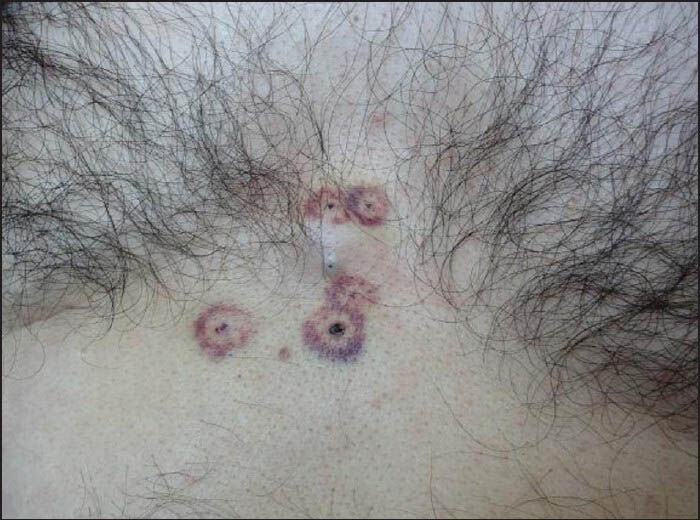
Hirudo medicinalis sucks blood directly through the external mammalian skin. We recently observed a healthy 64-year-old Iranian man, who presented with numerous asymptomatic multilobular oval-to-round well-defined 0.5 to 1.5 cm cystic lesions with central umbilication (central black eschar) over the upper portion of his chest. We made the diagnosis of epidermoid cyst, giant comedone and leech bite on the basis of the constellation of clinical features. The patient was treated with oral ciprofloxacin at a dose of 2 g daily, and 2% topical erythromycin solution. Despite improvement, the evidence of cystic lesions persisted. There was no history of similar lesions in any other family member. There was no history of trauma. The patient was not using any topical or systemic medication. Two weeks before his visit, he had a history of leech therapy under the supervision of a general practitioner. His medical history was significant for leech therapy of the lesions, five days previously. He was followed up for another two weeks and after disappearance of the inflammation, with the patient under local anesthesia, the well-circumscribed mass was completely evacuated with a sharp curette and comedone extractor. The patient was subsequently lost to follow-up.
Considering the efficacy of leeches, it would be favorable to breed a germ-free leech. In Iran, the use of the leeches in surgery, in recent years, has been infrequent. It appears that the positive effects of this ancient remedy may now be explained through scientific methods, promising potentially even more uses of this admirable creature in medicine.
医用水蛭可直接通过哺乳动物的体表皮肤吸血。我们最近观察到一名64岁健康的伊朗男性,其胸部上方出现了许多无症状的多叶椭圆形至圆形、边界清晰、直径0.5至1.5厘米的囊性病变,中央有脐凹(中央黑色焦痂)。根据临床特征组合,我们诊断为表皮样囊肿、巨大黑头粉刺和水蛭叮咬。患者接受了每日2克剂量的口服环丙沙星以及2%的外用红霉素溶液治疗。尽管病情有所改善,但囊性病变的迹象仍然存在。其他家庭成员无类似病变病史。无外伤史。患者未使用任何外用或全身性药物。在就诊前两周,他有在一名全科医生监督下接受水蛭疗法的病史。其病史中值得注意的是五天前对这些病变进行了水蛭疗法。对他进行了另外两周的随访,炎症消退后,在局部麻醉下,用锐利刮匙和黑头粉刺挤压器将边界清晰的肿块完全清除。该患者随后失访。
考虑到水蛭的功效,培育无菌水蛭将是有益的。在伊朗,近年来水蛭在外科手术中的使用并不常见。看来这种古老疗法的积极作用现在可以通过科学方法来解释,有望使这种令人钦佩的生物在医学上有更多潜在用途。