Liu Francesca Diane M, Kenngott Elisabeth E, Schröter Micha F, Kühl Anja, Jennrich Silke, Watzlawick Ralf, Hoffmann Ute, Wolff Thorsten, Norley Stephen, Scheffold Alexander, Stumhofer Jason S, Saris Christiaan J M, Schwab Jan M, Hunter Christopher A, Debes Gudrun F, Hamann Alf
Deutsches Rheuma-Forschungszentrum and Charité-Universitätsmedizin Berlin, Berlin, Germany; Department of Pathobiology, University of Pennsylvania School of Veterinary Medicine, Philadelphia, Pennsylvania, United States of America.
Deutsches Rheuma-Forschungszentrum and Charité-Universitätsmedizin Berlin, Berlin, Germany.
PLoS Pathog. 2014 May 8;10(5):e1004110. doi: 10.1371/journal.ppat.1004110. eCollection 2014 May.
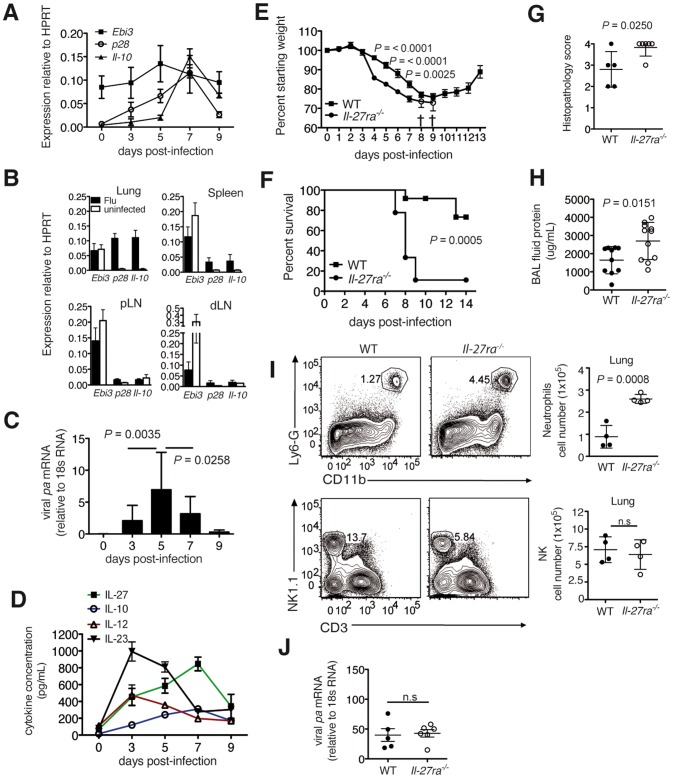
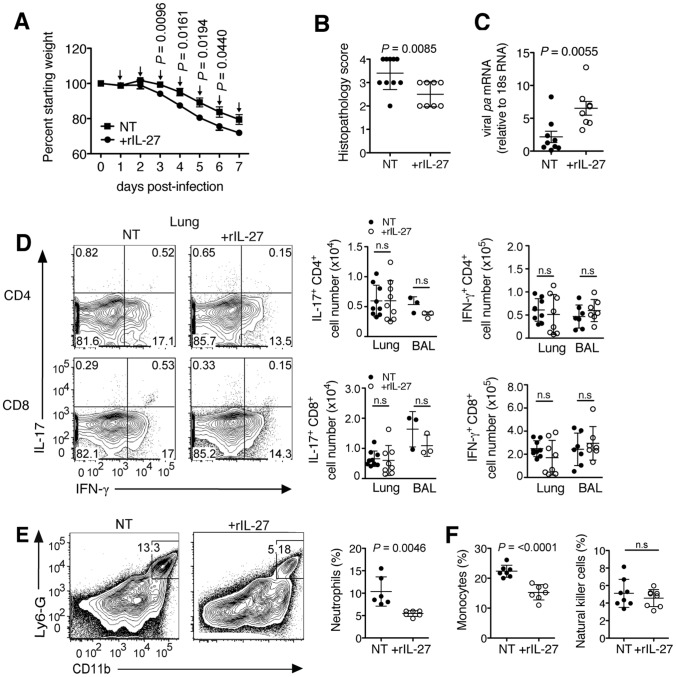
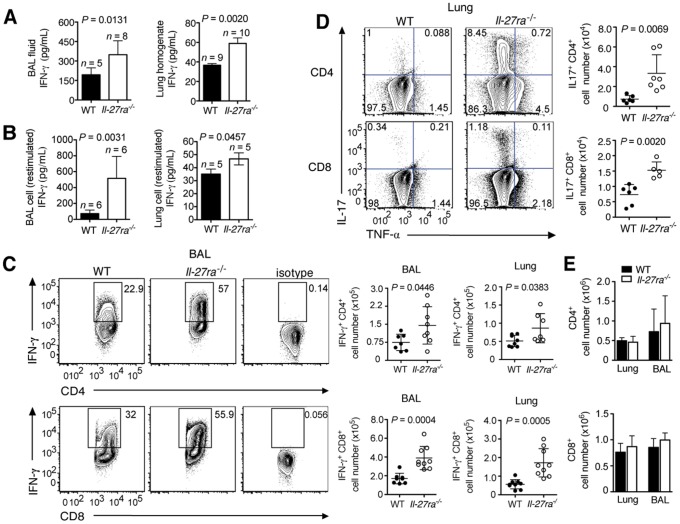
Infection with influenza virus can result in massive pulmonary infiltration and potentially fatal immunopathology. Understanding the endogenous mechanisms that control immunopathology could provide a key to novel adjunct therapies for this disease. Here we show that the cytokine IL-27 plays a crucial role in protection from exaggerated inflammation during influenza virus infection. Using Il-27ra-/- mice, IL-27 was found to limit immunopathology, neutrophil accumulation, and dampened TH1 or TH17 responses via IL-10-dependent and -independent pathways. Accordingly, the absence of IL-27 signals resulted in a more severe disease course and in diminished survival without impacting viral loads. Consistent with the delayed expression of endogenous Il-27p28 during influenza, systemic treatment with recombinant IL-27 starting at the peak of virus load resulted in a major amelioration of lung pathology, strongly reduced leukocyte infiltration and improved survival without affecting viral clearance. In contrast, early application of IL-27 impaired virus clearance and worsened disease. These findings demonstrate the importance of IL-27 for the physiological control of immunopathology and the potential value of well-timed IL-27 application to treat life-threatening inflammation during lung infection.
感染流感病毒可导致大量肺部浸润,并可能引发致命的免疫病理反应。了解控制免疫病理反应的内源性机制可能为这种疾病的新型辅助治疗提供关键。在此,我们表明细胞因子IL-27在流感病毒感染期间防止过度炎症反应中起着至关重要的作用。利用Il-27ra-/-小鼠,发现IL-27通过依赖IL-10和不依赖IL-10的途径限制免疫病理反应、中性粒细胞积聚,并抑制TH1或TH17反应。因此,缺乏IL-27信号导致疾病进程更严重,生存率降低,而不影响病毒载量。与流感期间内源性Il-27p28的延迟表达一致,在病毒载量达到峰值时开始用重组IL-27进行全身治疗,可使肺部病理状况得到显著改善,白细胞浸润大幅减少,生存率提高,且不影响病毒清除。相反,早期应用IL-27会损害病毒清除并加重疾病。这些发现证明了IL-27对免疫病理反应生理控制的重要性,以及适时应用IL-27治疗肺部感染期间危及生命的炎症的潜在价值。