Zieliński Piotr, Dudek Katarzyna, Stuglik Michał Tadeusz, Liana Marcin, Babik Wiesław
Institute of Environmental Sciences, Jagiellonian University, Kraków, Poland.
Department of Comparative Anatomy, Institute of Zoology, Jagiellonian University, Krakow, Poland.
PLoS One. 2014 May 12;9(5):e97431. doi: 10.1371/journal.pone.0097431. eCollection 2014.
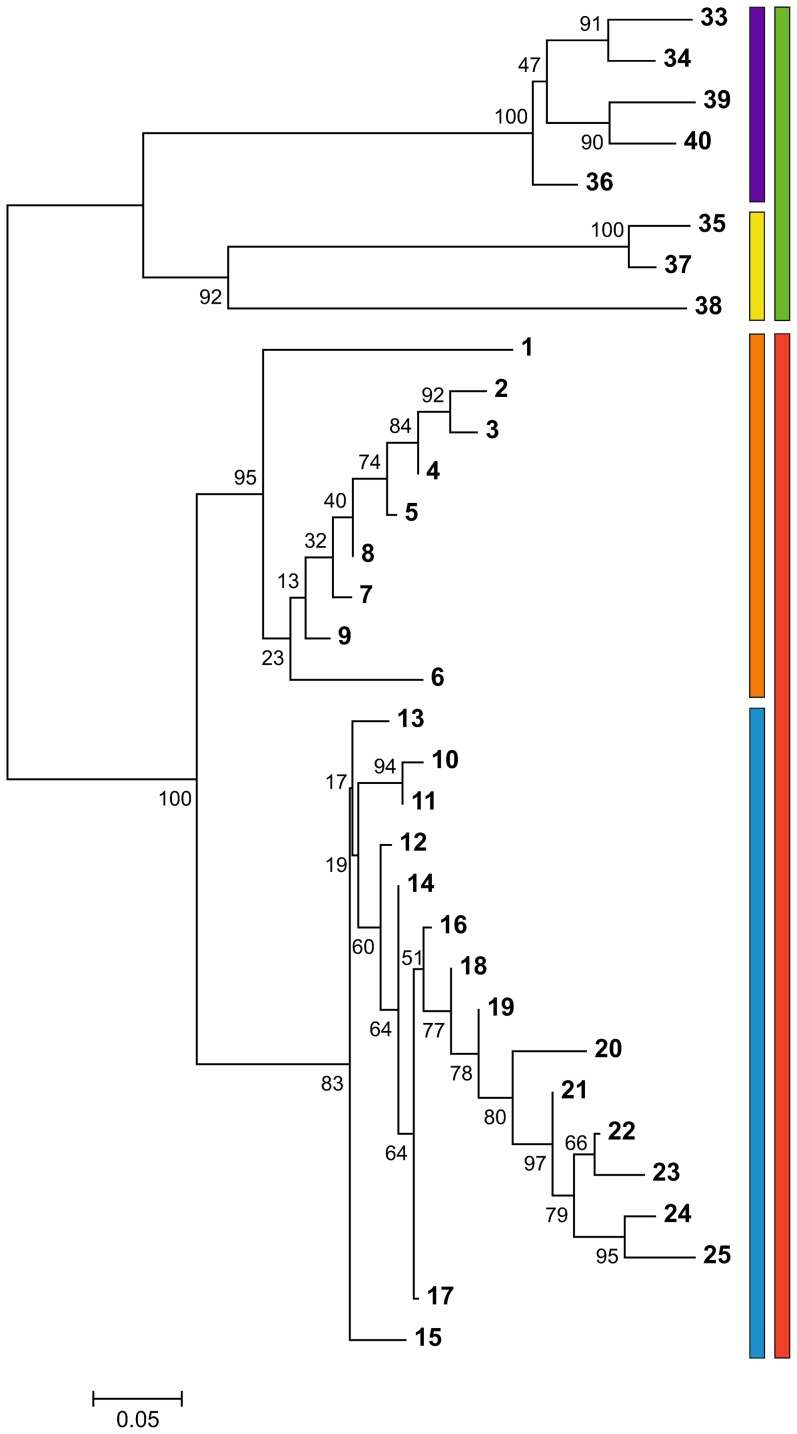
Genetic variation within species is commonly structured in a hierarchical manner which may result from superimposition of processes acting at different spatial and temporal scales. In organisms of limited dispersal ability, signatures of past subdivision are detectable for a long time. Studies of contemporary genetic structure in such taxa inform about the history of isolation, range changes and local admixture resulting from geographically restricted hybridization with related species. Here we use a set of 139 transcriptome-derived, unlinked nuclear single nucleotide polymorphisms (SNP) to assess the genetic structure of the Carpathian newt (Lissotriton montandoni, Lm) and introgression from its congener, the smooth newt (L. vulgaris, Lv). Two substantially differentiated groups of Lm populations likely originated from separate refugia, both located in the Eastern Carpathians. The colonization of the present range in north-western and south-western directions was accompanied by a modest loss of variation; admixture between the two groups has occurred in the middle of the Eastern Carpathians. Local, apparently recent introgression of Lv alleles into several Lm populations was detected, demonstrating increased power for admixture detection in comparison to a previous study based on a limited number of microsatellite markers. The level of introgression was higher in Lm populations classified as admixed than in syntopic populations. We discuss the possible causes and propose further tests to distinguish between alternatives. Several outlier loci were identified in tests of interspecific differentiation, suggesting genomic heterogeneity of gene flow between species.
物种内的遗传变异通常以分层的方式构建,这可能是由在不同空间和时间尺度上起作用的过程叠加造成的。在扩散能力有限的生物中,过去种群细分的特征可以在很长时间内被检测到。对这类分类群当代遗传结构的研究有助于了解隔离的历史、范围变化以及与相关物种地理上受限杂交导致的局部混合情况。在这里,我们使用一组139个转录组衍生的、不连锁的核单核苷酸多态性(SNP)来评估喀尔巴阡蝾螈(Lissotriton montandoni,Lm)的遗传结构以及其同属物种光滑蝾螈(L. vulgaris,Lv)的基因渗入情况。Lm种群的两个明显分化的群体可能起源于位于东喀尔巴阡山脉的两个不同避难所。向西北和西南方向当前分布范围的殖民化伴随着适度的变异损失;两组之间的混合发生在东喀尔巴阡山脉中部。检测到Lv等位基因向几个Lm种群的局部、明显近期的基因渗入,这表明与之前基于有限数量微卫星标记的研究相比,混合检测能力有所提高。分类为混合的Lm种群中的基因渗入水平高于同域分布种群。我们讨论了可能的原因,并提出了进一步的测试以区分不同的可能性。在种间分化测试中鉴定出了几个异常位点,表明物种间基因流的基因组异质性。