Tang Liang, Peng Silong, Bi Yiming, Shan Peng, Hu Xiyuan
Institute of Automation, Chinese Academy of Sciences, Beijing, China; Network Information Center, Harbin University of Science and Technology, Harbin, China.
Institute of Automation, Chinese Academy of Sciences, Beijing, China.
PLoS One. 2014 May 12;9(5):e96944. doi: 10.1371/journal.pone.0096944. eCollection 2014.
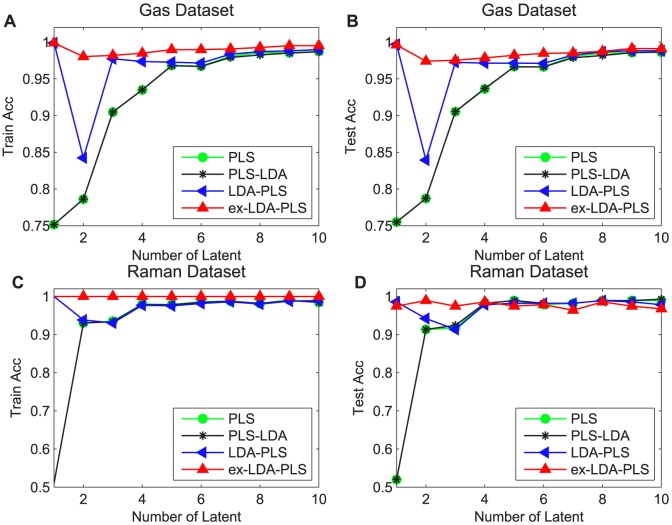
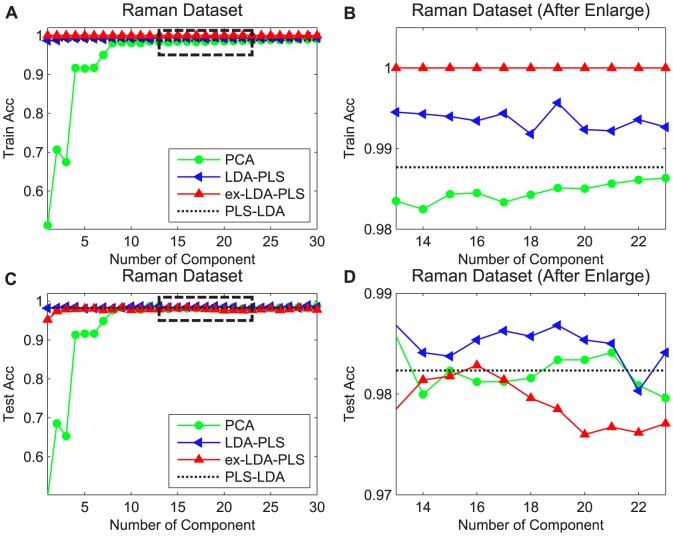
Linear discriminant analysis (LDA) is a classical statistical approach for dimensionality reduction and classification. In many cases, the projection direction of the classical and extended LDA methods is not considered optimal for special applications. Herein we combine the Partial Least Squares (PLS) method with LDA algorithm, and then propose two improved methods, named LDA-PLS and ex-LDA-PLS, respectively. The LDA-PLS amends the projection direction of LDA by using the information of PLS, while ex-LDA-PLS is an extension of LDA-PLS by combining the result of LDA-PLS and LDA, making the result closer to the optimal direction by an adjusting parameter. Comparative studies are provided between the proposed methods and other traditional dimension reduction methods such as Principal component analysis (PCA), LDA and PLS-LDA on two data sets. Experimental results show that the proposed method can achieve better classification performance.
线性判别分析(LDA)是一种用于降维和分类的经典统计方法。在许多情况下,经典LDA方法和扩展LDA方法的投影方向对于特殊应用而言并非最优。在此,我们将偏最小二乘法(PLS)与LDA算法相结合,进而分别提出了两种改进方法,即LDA - PLS和扩展LDA - PLS。LDA - PLS利用PLS的信息修正LDA的投影方向,而扩展LDA - PLS是LDA - PLS的扩展,它将LDA - PLS和LDA的结果相结合,并通过一个调整参数使结果更接近最优方向。在两个数据集上,对所提出的方法与其他传统降维方法(如主成分分析(PCA)、LDA和PLS - LDA)进行了比较研究。实验结果表明,所提出的方法能够实现更好的分类性能。