Elliott Victoria A, Rychahou Piotr, Zaytseva Yekaterina Y, Evers B Mark
Markey Cancer Center, University of Kentucky, Lexington, Kentucky, United States of America.
Markey Cancer Center, University of Kentucky, Lexington, Kentucky, United States of America; Department of Surgery, University of Kentucky, Lexington, Kentucky, United States of America.
PLoS One. 2014 May 13;9(5):e97432. doi: 10.1371/journal.pone.0097432. eCollection 2014.
Liver metastasis is the most common cause of death in patients with colorectal cancer. Despite extensive research into the biology of cancer progression, the molecular mechanisms that drive colorectal cancer metastasis are not well characterized.
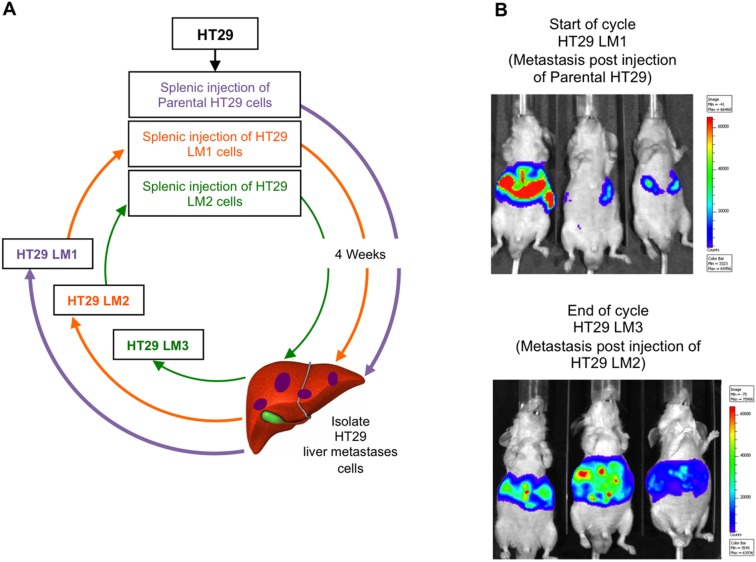
HT29 LM1, HT29 LM2, HT29 LM3 cell lines were derived from the human colorectal cancer cell line HT29 following multiple rounds of in vivo selection in immunodeficient mice.
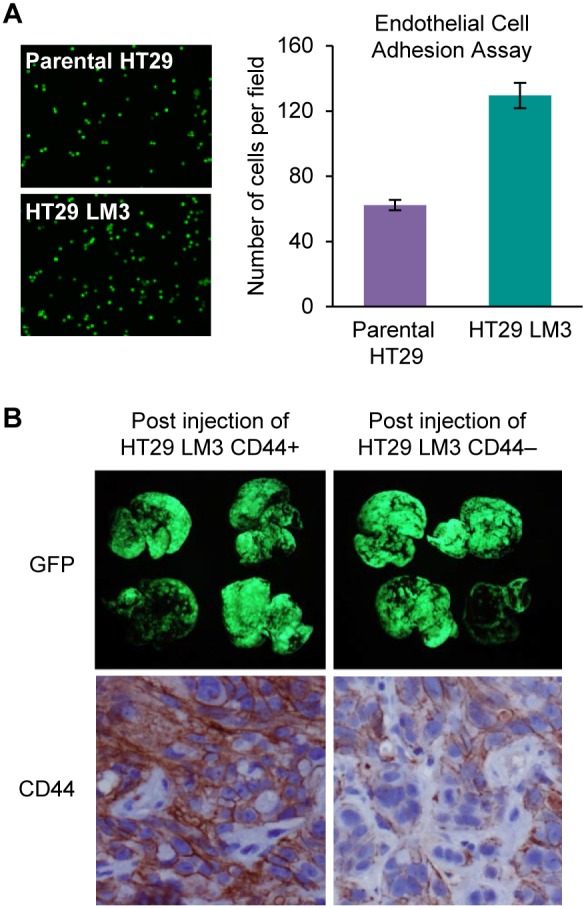
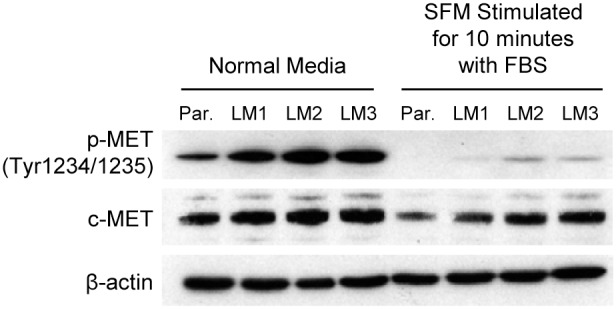
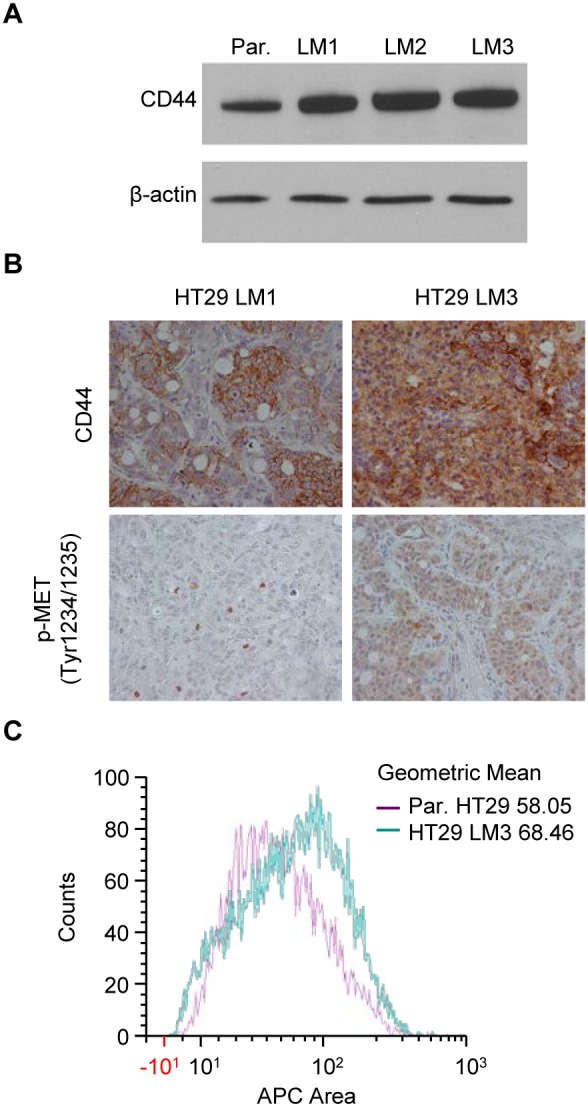
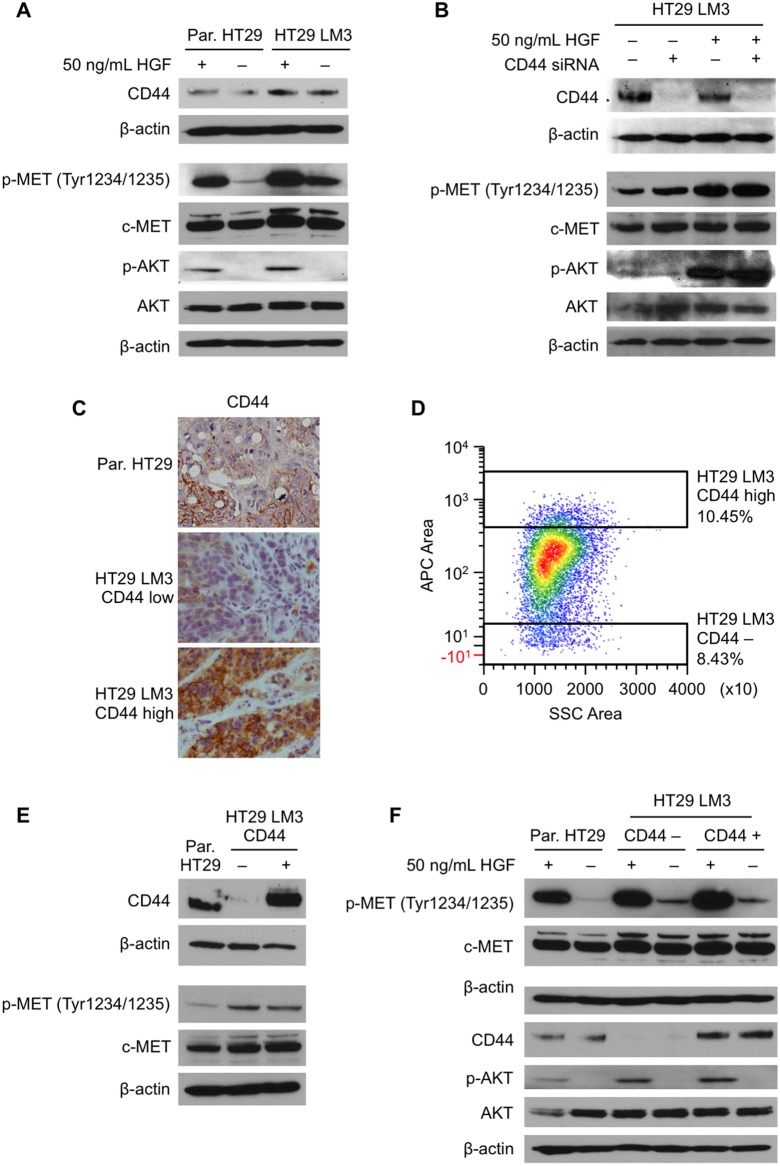
CD44 expression, a transmembrane glycoprotein involved in cell-cell and cell-matrix adhesions, and cancer cells adhesion to endothelial cells was increased in all in vivo selected cell lines, with maximum CD44 expression and cancer cells adhesion to endothelial cells in the highly metastatic HT29 LM3 cell line. Activation of c-Met upon hepatocyte growth factor (HGF) stimulation in the in vivo selected cell lines is CD44 independent. In vitro separation of CD44 high and low expression cells from HT29 LM3 cell line with FACS sorting confirmed that c-Met activation is CD44 independent upon hepatocyte growth factor stimulation. Furthermore, in vivo evaluation of CD44 low and high expressing HT29 LM3 cells demonstrated no difference in liver metastasis penetrance.
Taken together, our findings indicate that the aggressive metastatic phenotype of in vivo selected cell lines is associated with overexpression of CD44 and activation of c-MET. We demonstrate that c-Met activation is CD44 independent upon hepatocyte growth factor stimulation and confirm that CD44 expression in HT29 LM3 cell line is not responsible for the increase in metastatic penetrance in HT29 LM3 cell line.
肝转移是结直肠癌患者最常见的死亡原因。尽管对癌症进展生物学进行了广泛研究,但驱动结直肠癌转移的分子机制仍未得到充分表征。
HT29 LM1、HT29 LM2、HT29 LM3细胞系是在免疫缺陷小鼠体内经过多轮筛选后,从人结直肠癌细胞系HT29衍生而来。
在所有体内筛选的细胞系中,参与细胞 - 细胞和细胞 - 基质黏附的跨膜糖蛋白CD44的表达以及癌细胞与内皮细胞的黏附均增加,在高转移性HT29 LM3细胞系中CD44表达和癌细胞与内皮细胞的黏附达到最高。体内筛选的细胞系在肝细胞生长因子(HGF)刺激下c-Met的激活不依赖于CD44。用荧光激活细胞分选术(FACS)从HT29 LM3细胞系中体外分离CD44高表达和低表达细胞,证实肝细胞生长因子刺激后c-Met的激活不依赖于CD44。此外,对CD44低表达和高表达的HT29 LM3细胞进行体内评估,结果显示肝转移发生率没有差异。
综上所述,我们的研究结果表明,体内筛选的细胞系的侵袭性转移表型与CD44的过表达和c-MET的激活有关。我们证明,在肝细胞生长因子刺激下c-Met的激活不依赖于CD44,并证实HT29 LM3细胞系中CD44的表达与HT29 LM3细胞系转移发生率的增加无关。