Am J Psychiatry. 2014 Aug;171(8):844-53. doi: 10.1176/appi.ajp.2014.13040502.
Military deployment can have profound effects on physical and mental health. Few studies have examined whether interventions prior to deployment can improve mechanisms underlying resilience. Mindfulness-based techniques have been shown to aid recovery from stress and may affect brain-behavior relationships prior to deployment. The authors examined the effect of mindfulness training on resilience mechanisms in active-duty Marines preparing for deployment.
Eight Marine infantry platoons (N=281) were randomly selected. Four platoons were assigned to receive mindfulness training (N=147) and four were assigned to a training-as-usual control condition (N=134). Platoons were assessed at baseline, 8 weeks after baseline, and during and after a stressful combat training session approximately 9 weeks after baseline. The mindfulness training condition was delivered in the form of 8 weeks of Mindfulness-Based Mind Fitness Training (MMFT), a program comprising 20 hours of classroom instruction plus daily homework exercises. MMFT emphasizes interoceptive awareness, attentional control, and tolerance of present-moment experiences. The main outcome measures were heart rate, breathing rate, plasma neuropeptide Y concentration, score on the Response to Stressful Experiences Scale, and brain activation as measured by functional MRI.
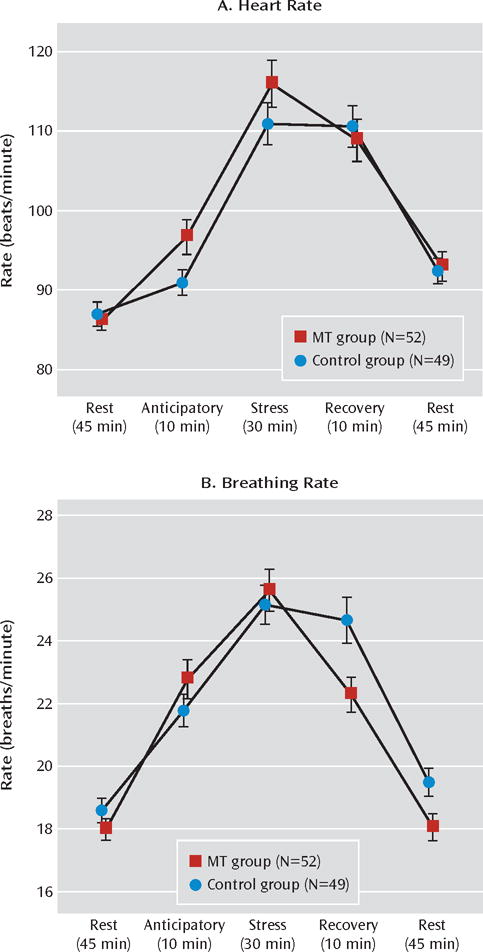
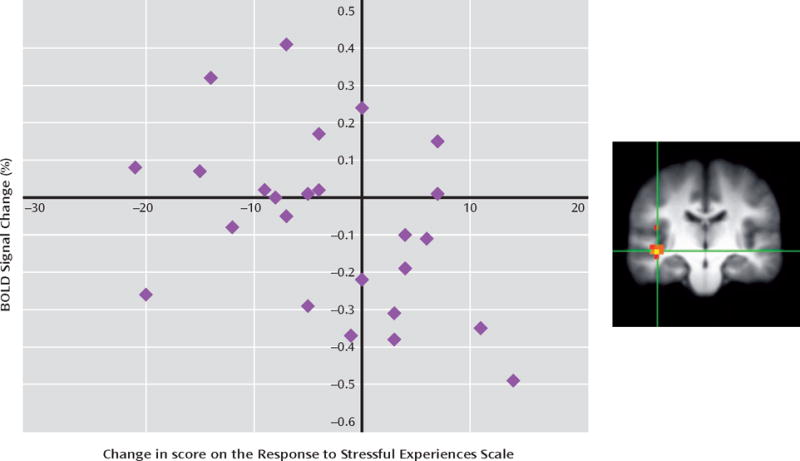
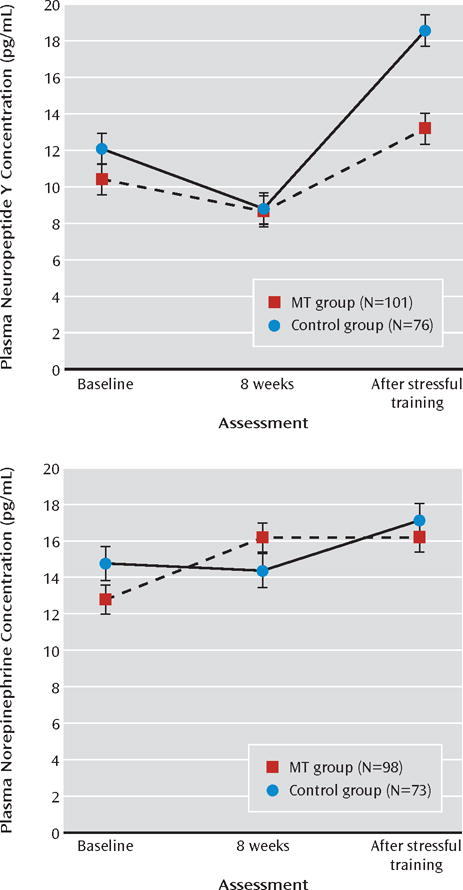
Marines who received MMFT showed greater reactivity (heart rate [d=0.43]) and enhanced recovery (heart rate [d=0.67], breathing rate [d=0.93]) after stressful training; lower plasma neuropeptide Y concentration after stressful training (d=0.38); and attenuated blood-oxygen-level-dependent signal in the right insula and anterior cingulate.
The results show that mechanisms related to stress recovery can be modified in healthy individuals prior to stress exposure, with important implications for evidence-based mental health research and treatment.
军事部署可能对身心健康产生深远影响。很少有研究探讨部署前的干预措施是否可以改善适应力的潜在机制。基于正念的技术已被证明有助于从压力中恢复,并且可能会影响部署前的大脑-行为关系。作者研究了正念训练对准备部署的现役海军陆战队员适应力机制的影响。
随机选择了 8 个海军陆战队步兵排(N=281)。将其中 4 个排分配到接受正念训练组(N=147),将另外 4 个排分配到常规训练对照组(N=134)。在基线、基线后 8 周以及大约基线后 9 周进行紧张的战斗训练期间和之后对排进行评估。正念训练条件以 8 周的正念为基础的心理健身训练(MMFT)的形式提供,该计划包括 20 小时的课堂教学和每日家庭作业练习。MMFT 强调内感受意识、注意力控制和对当下体验的容忍度。主要的测量指标包括心率、呼吸频率、血浆神经肽 Y 浓度、应激体验反应量表的得分以及功能磁共振成像测量的大脑激活。
接受 MMFT 的海军陆战队员在紧张训练后表现出更大的反应性(心率[d=0.43])和更好的恢复性(心率[d=0.67],呼吸频率[d=0.93]);紧张训练后血浆神经肽 Y 浓度较低(d=0.38);右侧脑岛和前扣带的血氧水平依赖性信号减弱。
研究结果表明,在暴露于压力之前,可以在健康个体中改变与压力恢复相关的机制,这对基于证据的心理健康研究和治疗具有重要意义。