Sparta Dennis R, Smithuis Jim, Stamatakis Alice M, Jennings Joshua H, Kantak Pranish A, Ung Randall L, Stuber Garret D
Departments of Psychiatry and Cell Biology and Physiology, UNC Neuroscience Center, University of North Carolina at Chapel Hill Chapel Hill, NC, USA ; Bowles Center for Alcohol Studies, University of North Carolina at Chapel Hill Chapel Hill, NC, USA.
Departments of Psychiatry and Cell Biology and Physiology, UNC Neuroscience Center, University of North Carolina at Chapel Hill Chapel Hill, NC, USA.
Front Behav Neurosci. 2014 May 6;8:129. doi: 10.3389/fnbeh.2014.00129. eCollection 2014.
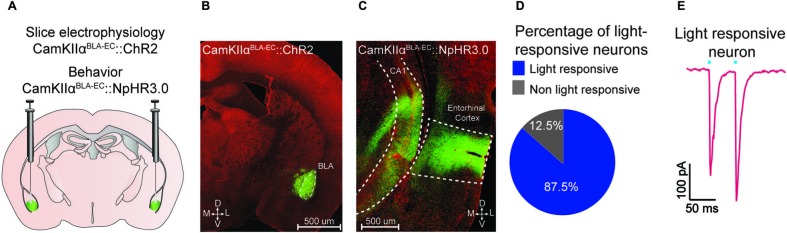
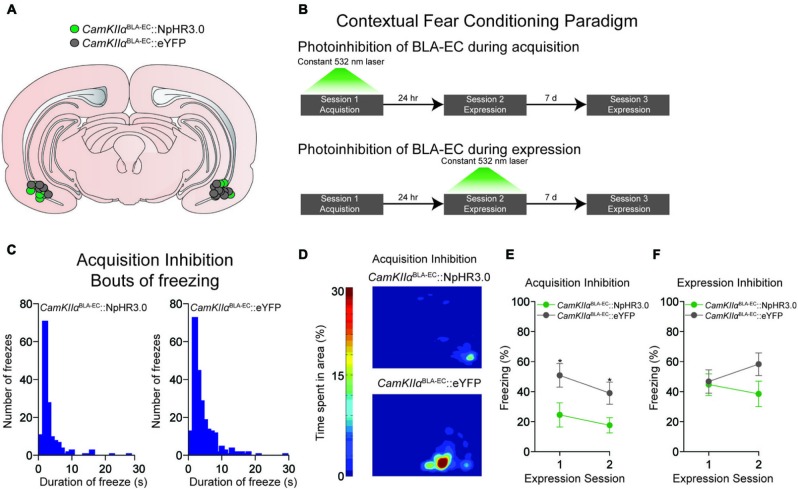
The development of excessive fear and/or stress responses to environmental cues such as contexts associated with a traumatic event is a hallmark of post-traumatic stress disorder (PTSD). The basolateral amygdala (BLA) has been implicated as a key structure mediating contextual fear conditioning. In addition, the hippocampus has an integral role in the encoding and processing of contexts associated with strong, salient stimuli such as fear. Given that both the BLA and hippocampus play an important role in the regulation of contextual fear conditioning, examining the functional connectivity between these two structures may elucidate a role for this pathway in the development of PTSD. Here, we used optogenetic strategies to demonstrate that the BLA sends a strong glutamatergic projection to the hippocampal formation through the entorhinal cortex (EC). Next, we photoinhibited glutamatergic fibers from the BLA terminating in the EC during the acquisition or expression of contextual fear conditioning. In mice that received optical inhibition of the BLA-to-EC pathway during the acquisition session, we observed a significant decrease in freezing behavior in a context re-exposure session. In contrast, we observed no differences in freezing behavior in mice that were only photoinhibited during the context re-exposure session. These data demonstrate an important role for the BLA-to-EC glutamatergic pathway in the acquisition of contextual fear conditioning.
对与创伤性事件相关的环境线索(如情境)产生过度恐惧和/或应激反应是创伤后应激障碍(PTSD)的一个标志。基底外侧杏仁核(BLA)被认为是介导情境恐惧条件反射的关键结构。此外,海马体在编码和处理与强烈、显著刺激(如恐惧)相关的情境方面具有不可或缺的作用。鉴于BLA和海马体在调节情境恐惧条件反射中都发挥着重要作用,研究这两个结构之间的功能连接可能有助于阐明该通路在PTSD发展中的作用。在这里,我们使用光遗传学策略证明,BLA通过内嗅皮质(EC)向海马结构发送强烈的谷氨酸能投射。接下来,我们在情境恐惧条件反射的习得或表达过程中,用光抑制终止于EC的来自BLA的谷氨酸能纤维。在习得阶段接受BLA到EC通路光抑制的小鼠中,我们在情境重新暴露实验中观察到僵住行为显著减少。相比之下,我们在仅在情境重新暴露实验中接受光抑制的小鼠中未观察到僵住行为的差异。这些数据证明了BLA到EC的谷氨酸能通路在情境恐惧条件反射习得中的重要作用。