Department of Psychology, University of York York, UK.
Front Hum Neurosci. 2014 May 6;8:264. doi: 10.3389/fnhum.2014.00264. eCollection 2014.
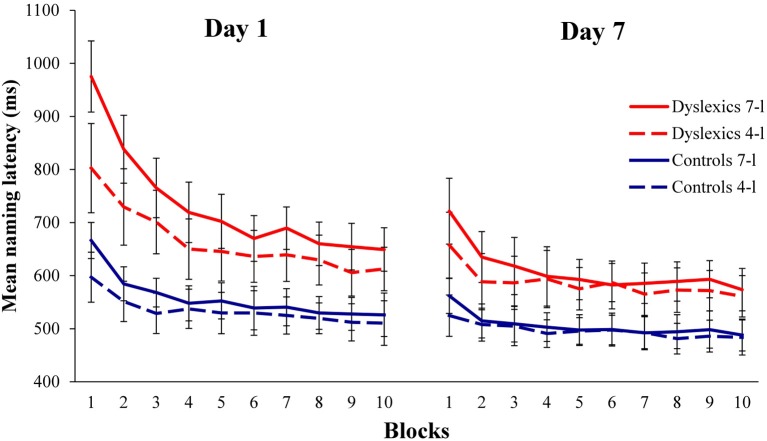
We investigated word learning in university and college students with a diagnosis of dyslexia and in typically-reading controls. Participants read aloud short (4-letter) and longer (7-letter) nonwords as quickly as possible. The nonwords were repeated across 10 blocks, using a different random order in each block. Participants returned 7 days later and repeated the experiment. Accuracy was high in both groups. The dyslexics were substantially slower than the controls at reading the nonwords throughout the experiment. They also showed a larger length effect, indicating less effective decoding skills. Learning was demonstrated by faster reading of the nonwords across repeated presentations and by a reduction in the difference in reading speeds between shorter and longer nonwords. The dyslexics required more presentations of the nonwords before the length effect became non-significant, only showing convergence in reaction times between shorter and longer items in the second testing session where controls achieved convergence part-way through the first session. Participants also completed a psychological test battery assessing reading and spelling, vocabulary, phonological awareness, working memory, nonverbal ability and motor speed. The dyslexics performed at a similar level to the controls on nonverbal ability but significantly less well on all the other measures. Regression analyses found that decoding ability, measured as the speed of reading aloud nonwords when they were presented for the first time, was predicted by a composite of word reading and spelling scores ("literacy"). Word learning was assessed in terms of the improvement in naming speeds over 10 blocks of training. Learning was predicted by vocabulary and working memory scores, but not by literacy, phonological awareness, nonverbal ability or motor speed. The results show that young dyslexic adults have problems both in pronouncing novel words and in learning new written words.
我们调查了有阅读障碍诊断的大学生和大学生的单词学习情况,并与典型阅读的对照组进行了比较。参与者尽可能快地大声朗读短(4 个字母)和长(7 个字母)的非单词。在每个块中使用不同的随机顺序重复 10 次块,参与者在 7 天后返回并重复实验。两组的准确率都很高。在整个实验过程中,阅读障碍者阅读非单词的速度明显慢于对照组。他们还表现出较大的长度效应,表明解码技能较差。通过重复呈现非单词的速度更快来证明学习效果,并通过减少短非单词和长非单词之间的阅读速度差异来证明。阅读障碍者需要更多次呈现非单词,直到长度效应变得不显著,只有在第二次测试中,阅读障碍者的反应时间在短和长项目之间趋同,而对照组在第一次测试的中途就达到了趋同。参与者还完成了一套心理测试,评估阅读和拼写、词汇、语音意识、工作记忆、非言语能力和运动速度。阅读障碍者在非言语能力方面与对照组表现相当,但在所有其他测试中表现明显较差。回归分析发现,首次呈现非单词时的阅读速度(作为解码能力的衡量标准)可以通过阅读和拼写分数的综合来预测(“读写能力”)。单词学习是根据 10 个训练块中命名速度的提高来评估的。学习由词汇和工作记忆分数预测,但不受读写能力、语音意识、非言语能力或运动速度的影响。结果表明,年轻的阅读障碍成年人在发音新单词和学习新的书面单词方面都存在问题。