Division of Infectious Diseases, Cincinnati Children's Hospital Medical Center, Cincinnati, OH 45229; Medical Scientist Training Program, University of Cincinnati College of Medicine, Cincinnati, OH 45229; and.
Division of Infectious Diseases, Cincinnati Children's Hospital Medical Center, Cincinnati, OH 45229;
J Immunol. 2014 Jun 1;192(11):4949-56. doi: 10.4049/jimmunol.1400498.
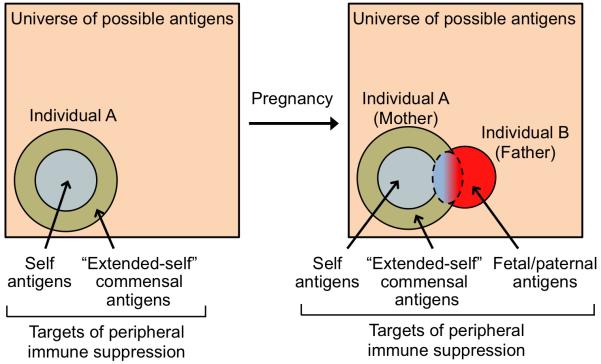
The immunological alterations required for successful pregnancy in eutherian placental mammals have remained a scientific enigma since the discovery of MHC haplotype diversity and unique immune signatures among individuals. Within the past 10 years, accumulating data suggest that immune-suppressive regulatory T cells (Tregs) confer essential protective benefits in sustaining tolerance to the semiallogeneic fetus during pregnancy, along with their more established roles in maintaining tolerance to self and "extended self" commensal Ags that averts autoimmunity. Reciprocally, many human pregnancy complications stemming from inadequacies in fetal tolerance have been associated with defects in maternal Tregs. Thus, further elucidating the immunological shifts during pregnancy not only have direct translational implications for improving perinatal health, they have enormous potential for unveiling new clues about how Tregs work in other biological contexts. In this article, epidemiological data in human pregnancy and complementary animal studies implicating a pivotal protective role for maternal Tregs are summarized.
自从 MHC 单倍型多样性和个体之间独特的免疫特征被发现以来,真兽类胎盘哺乳动物中成功妊娠所需的免疫改变仍然是一个科学谜团。在过去的 10 年中,越来越多的数据表明,免疫抑制性调节性 T 细胞(Tregs)在维持妊娠期间对半同种异体胎儿的耐受方面提供了重要的保护益处,同时它们在维持对自身和“扩展自身”共生抗原的耐受方面也具有更确定的作用,从而避免了自身免疫。相反,许多源于胎儿耐受不足的人类妊娠并发症与母体 Tregs 的缺陷有关。因此,进一步阐明妊娠期间的免疫学变化不仅对改善围产期健康具有直接的转化意义,而且对于揭示 Tregs 在其他生物学背景下的工作方式具有巨大的潜力。在本文中,总结了人类妊娠中的流行病学数据和补充动物研究,这些研究表明母体 Tregs 具有关键的保护作用。