Bioforsk - Norwegian Institute for Agricultural and Environmental Research, Svanvik, Norway.
Department of Biology, University of Oulu, Oulu, Finland.
PLoS One. 2014 May 19;9(5):e97558. doi: 10.1371/journal.pone.0097558. eCollection 2014.
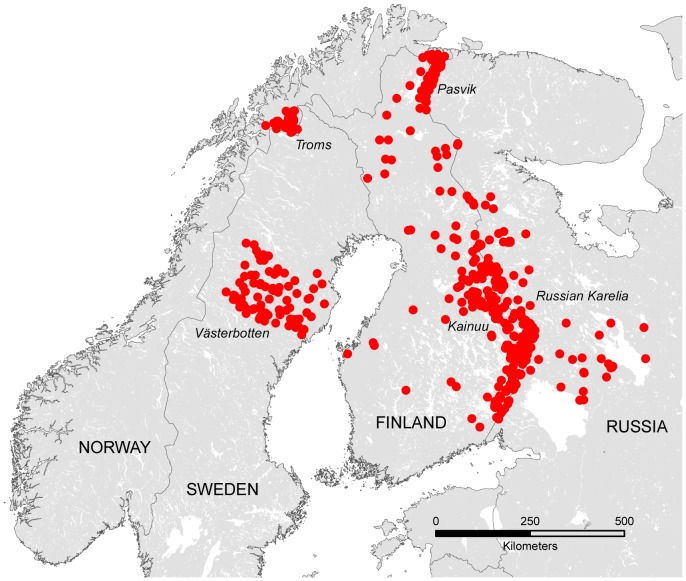
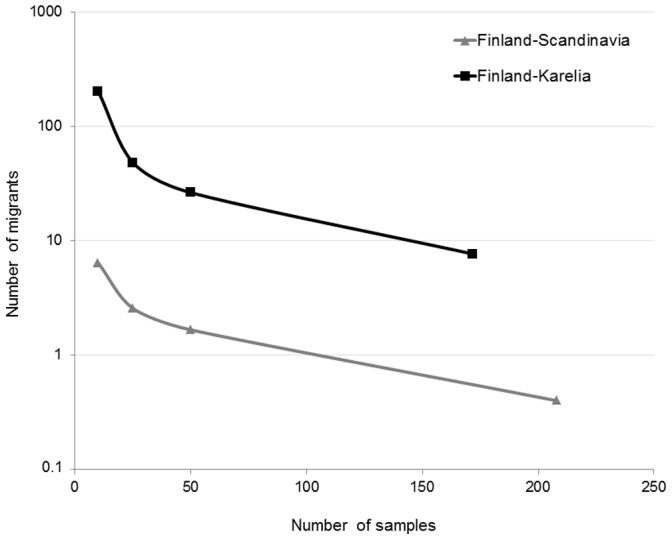
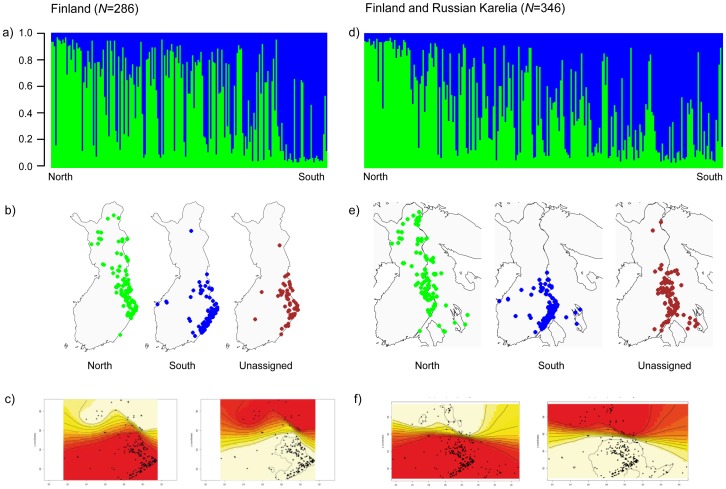
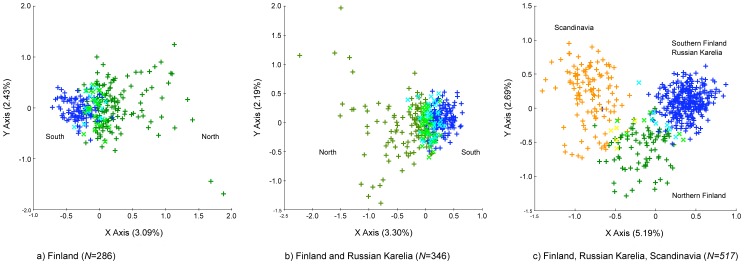
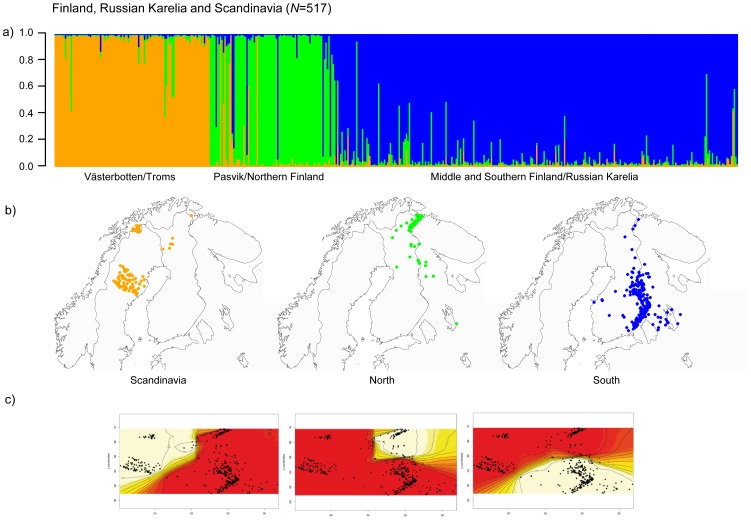
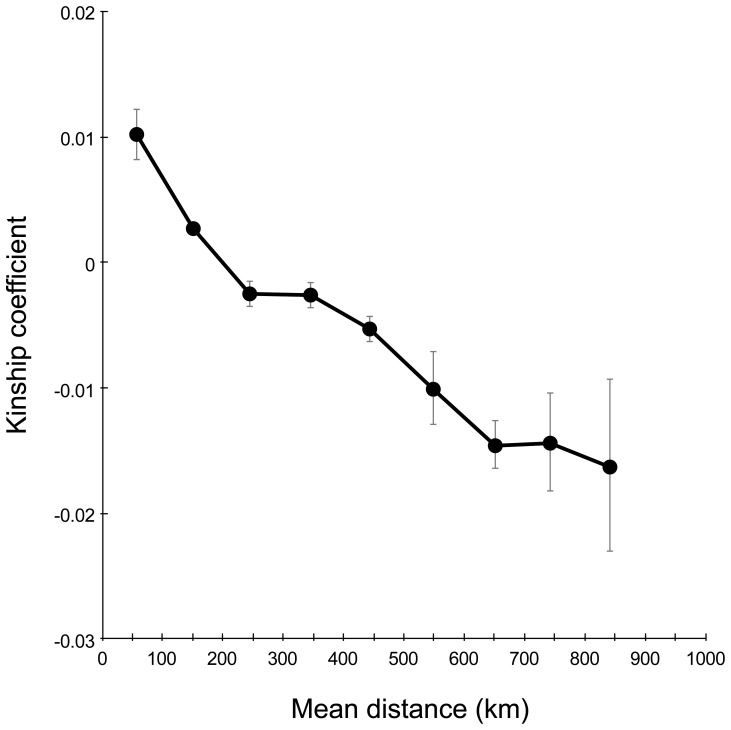
Large carnivores were persecuted to near extinction during the last centuries, but have now recovered in some countries. It has been proposed earlier that the recovery of the Northern European brown bear is supported by migration from Russia. We tested this hypothesis by obtaining for the first time continuous sampling of the whole Finnish bear population, which is located centrally between the Russian and Scandinavian bear populations. The Finnish population is assumed to experience high gene flow from Russian Karelia. If so, no or a low degree of genetic differentiation between Finnish and Russian bears could be expected. We have genotyped bears extensively from all over Finland using 12 validated microsatellite markers and compared their genetic composition to bears from Russian Karelia, Sweden, and Norway. Our fine masked investigation identified two overlapping genetic clusters structured by isolation-by-distance in Finland (pairwise FST = 0.025). One cluster included Russian bears, and migration analyses showed a high number of migrants from Russia into Finland, providing evidence of eastern gene flow as an important driver during recovery. In comparison, both clusters excluded bears from Sweden and Norway, and we found no migrants from Finland in either country, indicating that eastern gene flow was probably not important for the population recovery in Scandinavia. Our analyses on different spatial scales suggest a continuous bear population in Finland and Russian Karelia, separated from Scandinavia.
在过去的几个世纪里,大型食肉动物遭到迫害,几近灭绝,但现在在一些国家已经恢复。有人提出,北欧棕熊的恢复是由从俄罗斯迁徙而来的种群支持的。为了验证这一假设,我们首次对整个芬兰熊种群进行了连续采样,该种群位于俄罗斯和斯堪的纳维亚熊种群的中心。芬兰种群被认为与俄罗斯卡累利阿地区有着高度的基因流动。如果是这样,那么芬兰和俄罗斯熊之间可能没有或只有低程度的遗传分化。我们使用 12 个经过验证的微卫星标记对芬兰各地的熊进行了广泛的基因分型,并将其遗传组成与来自俄罗斯卡累利阿、瑞典和挪威的熊进行了比较。我们精心设计的调查在芬兰确定了两个由隔离距离决定的重叠遗传聚类(成对 FST = 0.025)。一个聚类包括俄罗斯的熊,迁徙分析显示有大量的俄罗斯熊迁移到芬兰,这表明东部的基因流动是恢复过程中的一个重要驱动因素。相比之下,两个聚类都排除了来自瑞典和挪威的熊,而且我们在两国都没有发现来自芬兰的移民,这表明东部的基因流动可能对斯堪的纳维亚的种群恢复并不重要。我们在不同空间尺度上的分析表明,芬兰和俄罗斯卡累利阿的熊种群是连续的,与斯堪的纳维亚分开。