Department of Metabolic Medicine, Graduate School of Medicine, Osaka University, Suita.
Amagasaki City Office, Amagasaki, Hyogo.
J Diabetes Investig. 2011 Jun 5;2(3):218-24. doi: 10.1111/j.2040-1124.2010.00080.x.
Aims/Introduction: The aim of the present study was to determine the predictors of deterioration of glucose tolerance in individuals with normal glucose tolerance (NGT) and abdominal obesity, and whether a lifestyle intervention to reduce visceral fat is effective in these individuals.
The study subjects were 251 individuals who had abdominal obesity with certain risk factors (hypertension, high fasting plasma glucose (FPG), elevated hemoglobin A1c (HbA1c), dyslipidemia and hyperuricemia) and underwent oral glucose tolerance test (OGTT) in 2004 and 2005.
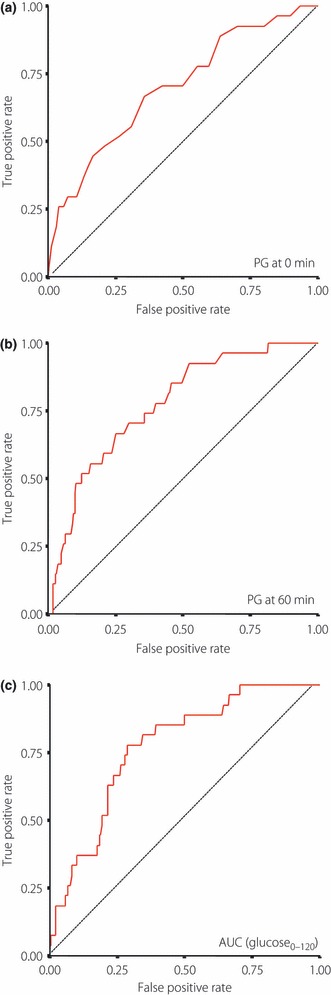
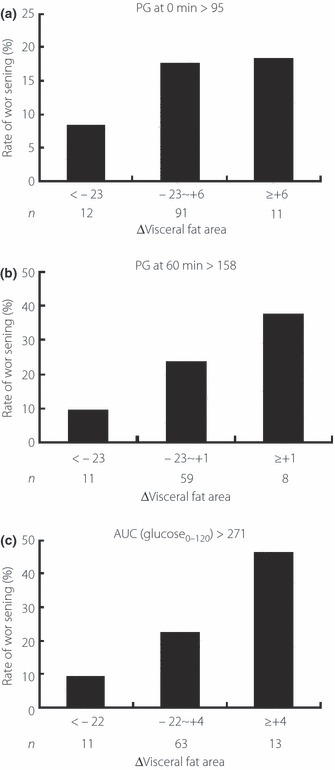
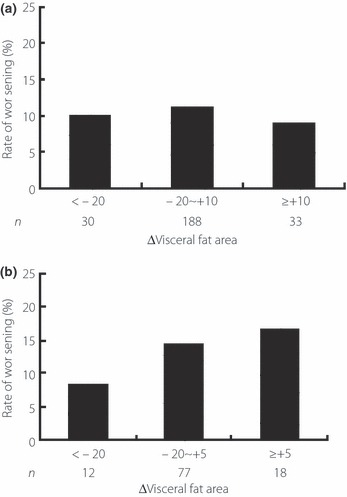
Using the area under the receiver operating characteristic curve, we found that PG at 0 min, 60 min, and area under the curve (AUC) of glucose from 0 to 120 min (AUC [glucose0-120]) in OGTT were significant predictors of deterioration of glucose tolerance, with optimal cut-off values of 95 mg/dL, 158 mg/dL and 271 mg h/dL, respectively. Although the rate of deterioration of glucose tolerance didn't decrease with reductions in visceral fat area (VFA) over the 1-year period in subjects with NGT, the rate tended to decrease with reductions in VFA in high-risk NGT subjects (PG at 0 min > 95 or at 60 min > 158, or AUC [glucose0-120] > 271).
These results suggest that reduction of visceral fat over 1 year might not be beneficial in all subjects with NGT, but is beneficial in high-risk NGT. We propose that individuals with values of the aforementioned predictors higher than the cut-off levels, even those with NGT, should receive a lifestyle intervention program aimed at reducing visceral fat to prevent deterioration of glucose tolerance. (J Diabetes Invest, doi: 10.1111/j.2040-1124.2010.00080.x, 2011).
目的/引言:本研究旨在确定糖耐量正常(NGT)合并腹型肥胖者糖代谢恶化的预测因素,以及减少内脏脂肪的生活方式干预在这些患者中的有效性。
研究对象为 2004 年和 2005 年有一定危险因素(高血压、空腹血糖升高(FPG)、糖化血红蛋白升高(HbA1c)、血脂异常和高尿酸血症)且行口服葡萄糖耐量试验(OGTT)的腹型肥胖者 251 例。
使用受试者工作特征曲线下面积,我们发现 OGTT 中 0 分钟时的血糖(PG)、60 分钟时的 PG 和 0 至 120 分钟时的血糖曲线下面积(AUC)[葡萄糖 0-120]是糖代谢恶化的显著预测因素,其最佳截断值分别为 95mg/dL、158mg/dL 和 271mg·h/dL。尽管在 NGT 患者中,1 年内内脏脂肪面积(VFA)减少与糖代谢恶化率无相关性,但在高危 NGT 患者中,VFA 减少与糖代谢恶化率呈负相关(0 分钟时 PG>95 或 60 分钟时 PG>158,或 AUC[葡萄糖 0-120]>271)。
这些结果提示,1 年内内脏脂肪减少可能对所有 NGT 患者均无益,但对高危 NGT 患者有益。我们建议,即使是那些糖耐量正常的患者,只要其上述预测因素值高于截断值,也应接受旨在减少内脏脂肪的生活方式干预,以预防糖代谢恶化。(J Diabetes Invest, doi: 10.1111/j.2040-1124.2010.00080.x, 2011)。