Oboti Livio, Peretto Paolo
Children's National Health System, Center for Neuroscience Research Washington, DC, USA.
Department of Life Sciences and Systems Biology, Neuroscience Institute Cavalieri Ottolenghi, University of Torino Orbassano, Italy.
Front Neurosci. 2014 May 9;8:102. doi: 10.3389/fnins.2014.00102. eCollection 2014.
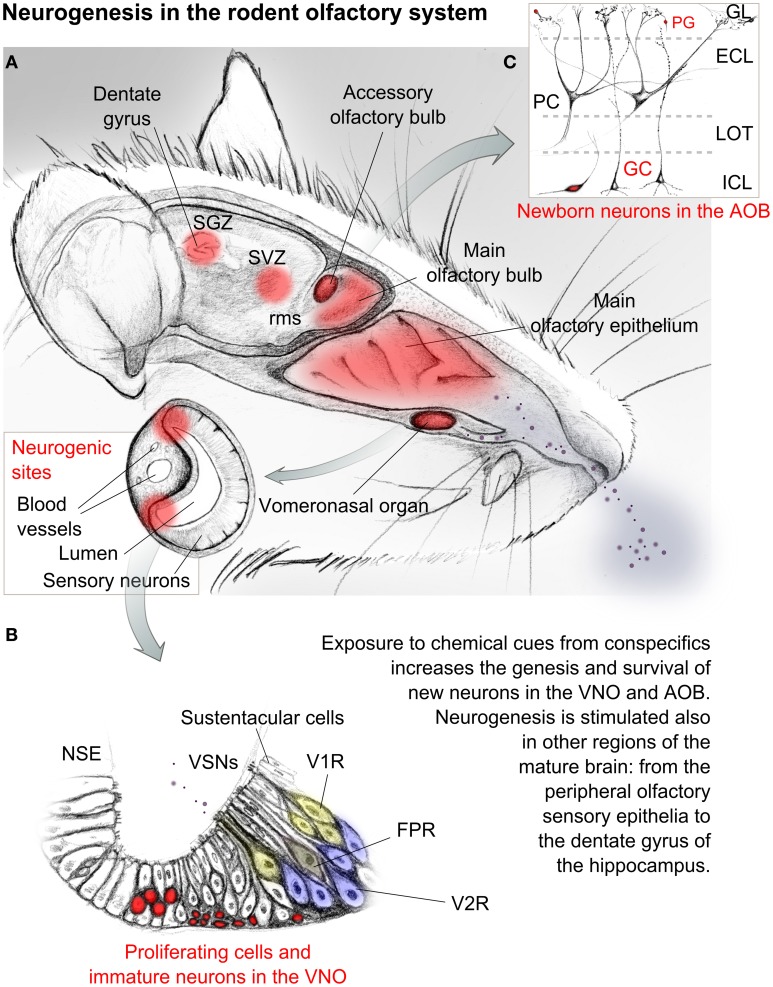
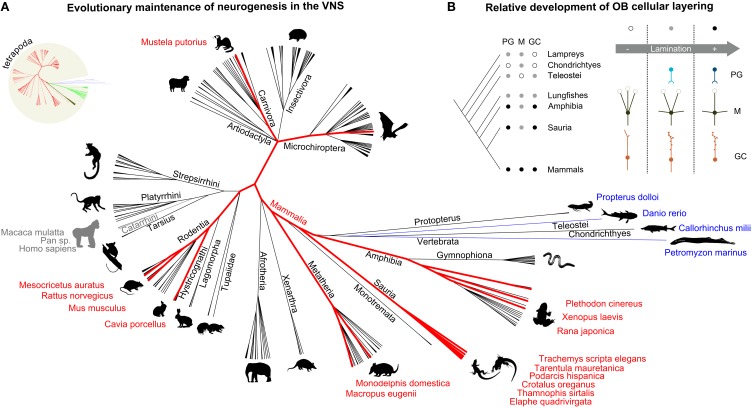
So far most studies on adult neurogenesis aimed to unravel mechanisms and molecules regulating the integration of newly generated neurons in the mature brain parenchyma. The exceedingly abundant amount of results that followed, rather than being beneficial in the perspective of brain repair, provided a clear evidence that adult neurogenesis constitutes a necessary feature to the correct functioning of the hosting brain regions. In particular, the rodent olfactory system represents a privileged model to study how neuronal plasticity and neurogenesis interact with sensory functions. Until recently, the vomeronasal system (VNS) has been commonly described as being specialized in the detection of innate chemosignals. Accordingly, its circuitry has been considered necessarily stable, if not hard-wired, in order to allow stereotyped behavioral responses. However, both first and second order projections of the rodent VNS continuously change their synaptic connectivity due to ongoing postnatal and adult neurogenesis. How the functional integrity of a neuronal circuit is maintained while newborn neurons are continuously added-or lost-is a fundamental question for both basic and applied neuroscience. The VNS is proposed as an alternative model to answer such question. Hereby the underlying motivations will be reviewed.
到目前为止,大多数关于成体神经发生的研究旨在揭示调节新生成神经元融入成熟脑实质的机制和分子。随后大量的研究结果,从脑修复的角度来看,并没有带来益处,反而清楚地证明了成体神经发生是宿主脑区正常功能所必需的特征。特别是,啮齿动物的嗅觉系统是研究神经元可塑性和神经发生如何与感觉功能相互作用的一个特殊模型。直到最近,犁鼻器系统(VNS)通常被描述为专门用于检测先天化学信号。因此,其神经回路被认为必然是稳定的,即使不是固定连接的,以便产生刻板的行为反应。然而,由于出生后和成年期持续的神经发生,啮齿动物VNS的一级和二级投射不断改变其突触连接。在不断有新生神经元加入或丢失的情况下,神经回路的功能完整性是如何维持的,这是基础神经科学和应用神经科学的一个基本问题。VNS被提议作为回答这个问题的一个替代模型。在此将对其潜在动机进行综述。