Department of Psychology, Peking University Beijing, China ; Department of Psychological and Brain Sciences, Johns Hopkins University Baltimore, MD, USA.
Department of Psychology, Peking University Beijing, China ; Department of Human Sciences, College of Education and Human Ecology, Ohio State University Columbus, OH, USA.
Front Hum Neurosci. 2014 May 7;8:282. doi: 10.3389/fnhum.2014.00282. eCollection 2014.
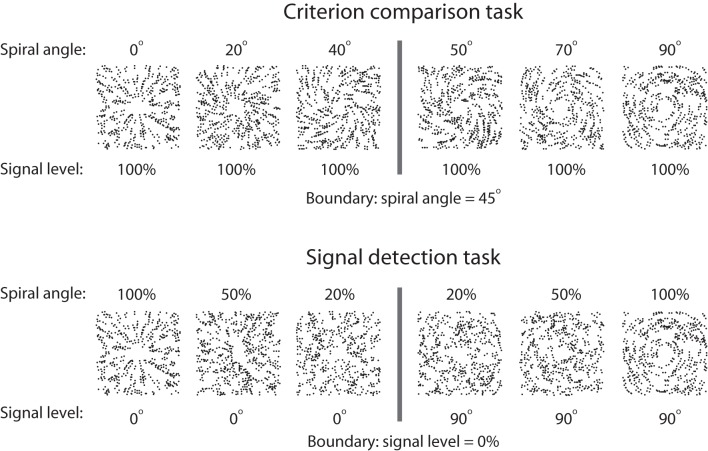
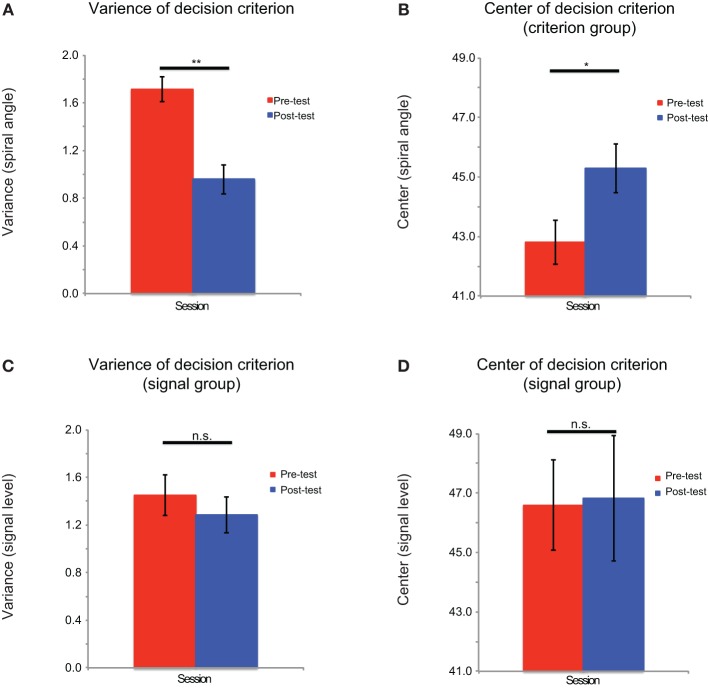
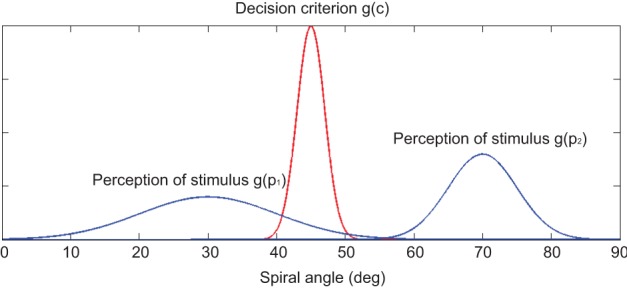
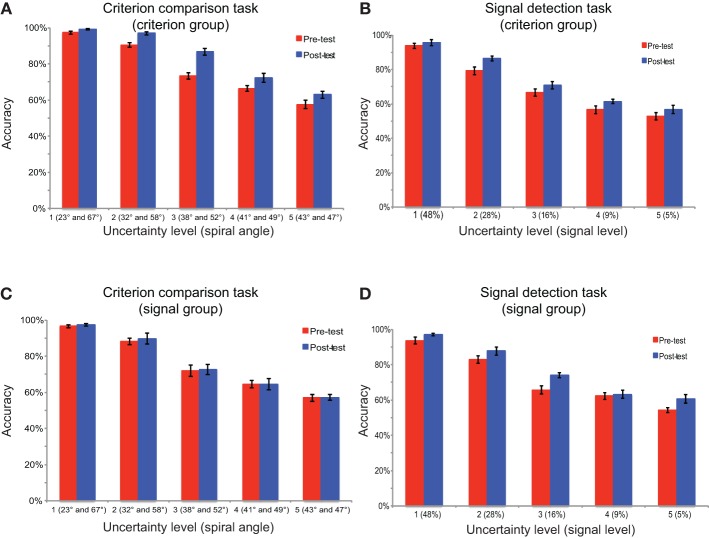
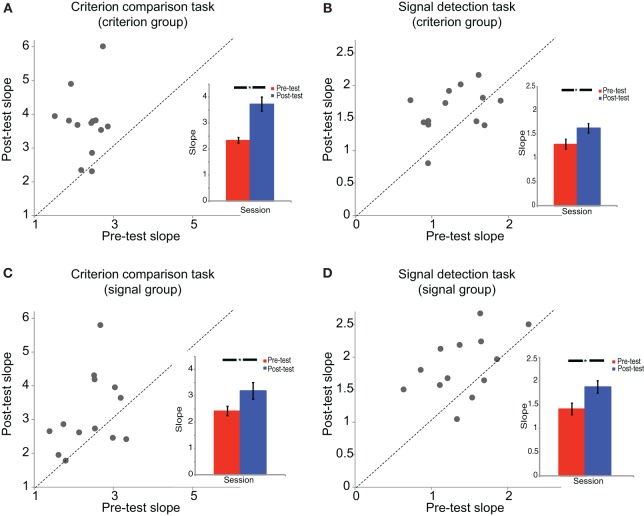
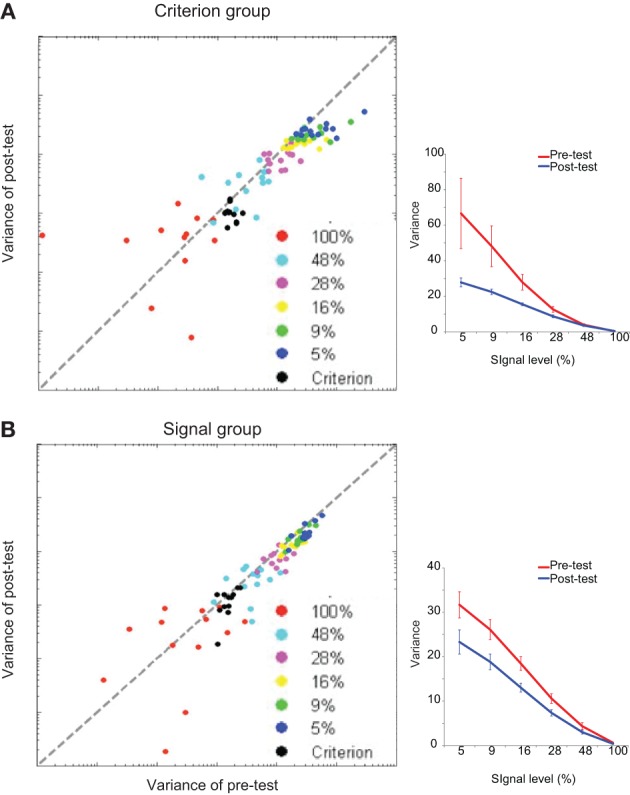
Perceptual decision-making in which decisions are reached primarily from extracting and evaluating sensory information requires close interactions between the sensory system and decision-related networks in the brain. Uncertainty pervades every aspect of this process and can be considered related to either the stimulus signal or decision criterion. Here, we investigated the learning-induced reduction of both the signal and criterion uncertainty in two perceptual decision tasks based on two Glass pattern stimulus sets. This was achieved by manipulating spiral angle and signal level of radial and concentric Glass patterns. The behavioral results showed that the participants trained with a task based on criterion comparison improved their categorization accuracy for both tasks, whereas the participants who were trained on a task based on signal detection improved their categorization accuracy only on their trained task. We fitted the behavioral data with a computational model that can dissociate the contribution of the signal and criterion uncertainties. The modeling results indicated that the participants who were trained on the criterion comparison task reduced both the criterion and signal uncertainty. By contrast, the participants who were trained on the signal detection task only reduced their signal uncertainty after training. Our results suggest that the signal uncertainty can be resolved by training participants to extract signals from noisy environments and to discriminate between clear signals, which are evidenced by reduced perception variance after both training procedures. Conversely, the criterion uncertainty can only be resolved by the training of fine discrimination. These findings demonstrate that uncertainty in perceptual decision-making can be reduced with training but that the reduction of different types of uncertainty is task-dependent.
在主要通过提取和评估感官信息来做出决策的感知决策中,决策需要大脑中的感官系统和与决策相关的网络之间的紧密交互。不确定性贯穿于这个过程的各个方面,可以被认为与刺激信号或决策标准有关。在这里,我们研究了两种基于两个 Glass 图案刺激集的感知决策任务中,信号和标准不确定性的学习诱导减少。这是通过操纵放射状和同心 Glass 图案的螺旋角和信号水平来实现的。行为结果表明,基于标准比较的任务训练的参与者提高了他们对两个任务的分类准确性,而基于信号检测的任务训练的参与者仅提高了他们在训练任务上的分类准确性。我们用一个可以区分信号和标准不确定性贡献的计算模型来拟合行为数据。建模结果表明,基于标准比较任务训练的参与者降低了标准和信号不确定性。相比之下,在信号检测任务中训练的参与者在训练后仅降低了信号不确定性。我们的结果表明,信号不确定性可以通过训练参与者从噪声环境中提取信号并区分清晰信号来解决,这在两种训练程序后感知方差减小中得到了证明。相反,标准不确定性只能通过精细的区分训练来解决。这些发现表明,感知决策中的不确定性可以通过训练来降低,但不同类型的不确定性的降低是任务相关的。