Linnerbauer Stefanie, Behrends Uta, Adhikary Dinesh, Witter Klaus, Bornkamm Georg W, Mautner Josef
Clinical Cooperation Group Pediatric Tumor Immunology, Children's Hospital, Technische Universität München, Munich, Germany; Helmholtz Zentrum München, Munich, Germany; German Centre for Infection Research (DZIF), Munich, Germany.
Clinical Cooperation Group Pediatric Tumor Immunology, Children's Hospital, Technische Universität München, Munich, Germany; Helmholtz Zentrum München, Munich, Germany.
PLoS Pathog. 2014 May 22;10(5):e1004068. doi: 10.1371/journal.ppat.1004068. eCollection 2014 May.
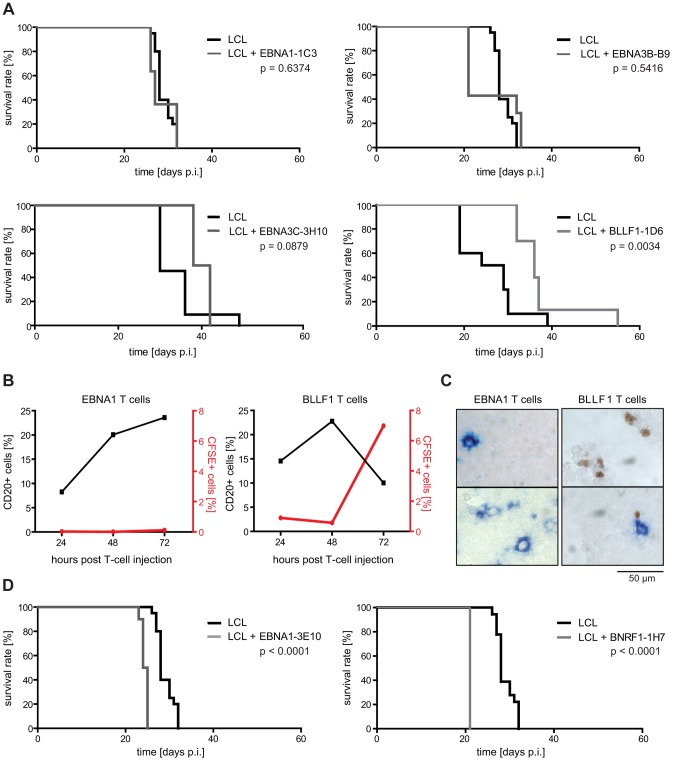
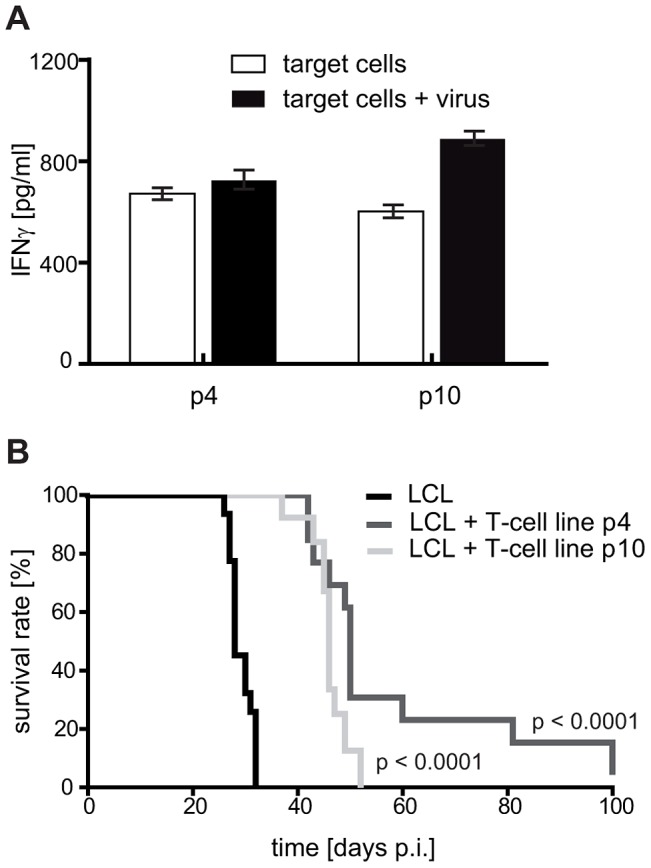
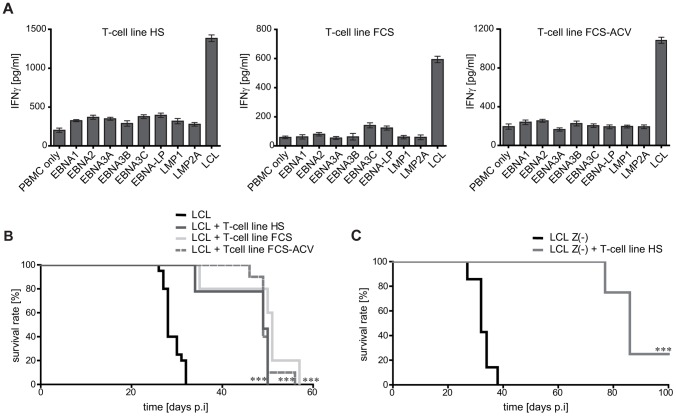
Polyclonal Epstein-Barr virus (EBV)-infected B cell line (lymphoblastoid cell lines; LCL)-stimulated T-cell preparations have been successfully used to treat EBV-positive post-transplant lymphoproliferative disorders (PTLD) in transplant recipients, but function and specificity of the CD4+ component are still poorly defined. Here, we assessed the tumor-protective potential of different CD4+ T-cell specificities in a PTLD-SCID mouse model. Injection of different virus-specific CD4+ T-cell clones showed that single specificities were capable of prolonging mouse survival and that the degree of tumor protection directly correlated with recognition of target cells in vitro. Surprisingly, some CD4+ T-cell clones promoted tumor development, suggesting that besides antigen recognition, still elusive functional differences exist among virus-specific T cells. Of several EBV-specific CD4+ T-cell clones tested, those directed against virion antigens proved most tumor-protective. However, enriching these specificities in LCL-stimulated preparations conferred no additional survival benefit. Instead, CD4+ T cells specific for unknown, probably self-antigens were identified as principal antitumoral effectors in LCL-stimulated T-cell lines. These results indicate that virion and still unidentified cellular antigens are crucial targets of the CD4+ T-cell response in this preclinical PTLD-model and that enriching the corresponding T-cell specificities in therapeutic preparations may enhance their clinical efficacy. Moreover, the expression in several EBV-negative B-cell lymphoma cell lines implies that these putative autoantigen(s) might also qualify as targets for T-cell-based immunotherapy of virus-negative B cell malignancies.
多克隆爱泼斯坦-巴尔病毒(EBV)感染的B细胞系(淋巴母细胞系;LCL)刺激的T细胞制剂已成功用于治疗移植受者中EBV阳性的移植后淋巴细胞增生性疾病(PTLD),但CD4+组分的功能和特异性仍不清楚。在此,我们在PTLD-SCID小鼠模型中评估了不同CD4+T细胞特异性的肿瘤保护潜力。注射不同病毒特异性的CD4+T细胞克隆表明,单一特异性能够延长小鼠存活时间,且肿瘤保护程度与体外对靶细胞的识别直接相关。令人惊讶的是,一些CD4+T细胞克隆促进了肿瘤发展,这表明除了抗原识别外,病毒特异性T细胞之间仍存在难以捉摸的功能差异。在测试的几种EBV特异性CD4+T细胞克隆中,那些针对病毒粒子抗原的克隆显示出最强的肿瘤保护作用。然而,在LCL刺激的制剂中富集这些特异性并未带来额外的生存益处。相反,对未知的、可能是自身抗原具有特异性的CD4+T细胞被确定为LCL刺激的T细胞系中的主要抗肿瘤效应细胞。这些结果表明,在这个临床前PTLD模型中,病毒粒子和仍未确定的细胞抗原是CD4+T细胞反应的关键靶点,在治疗制剂中富集相应的T细胞特异性可能会提高其临床疗效。此外,在几种EBV阴性B细胞淋巴瘤细胞系中的表达表明,这些假定的自身抗原也可能成为病毒阴性B细胞恶性肿瘤基于T细胞免疫治疗的靶点。