Dominguez Gaelle, Faucher Pierre, Henkous Nadia, Krazem Ali, Piérard Christophe, Béracochéa Daniel
INSERM U-930, Université François Rabelais, Parc Grandmont Tours, France.
Institut de Neurosciences Cognitives et Intégratives d'Aquitaine, CNRS UMR 5287, Nouvelle Université de Bordeaux Talence, France.
Front Behav Neurosci. 2014 May 15;8:166. doi: 10.3389/fnbeh.2014.00166. eCollection 2014.
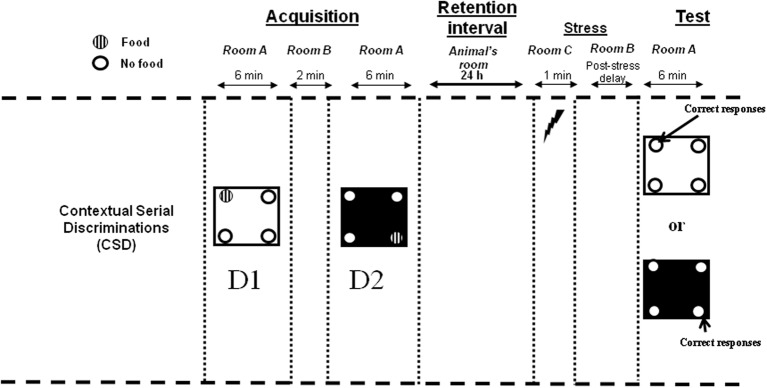
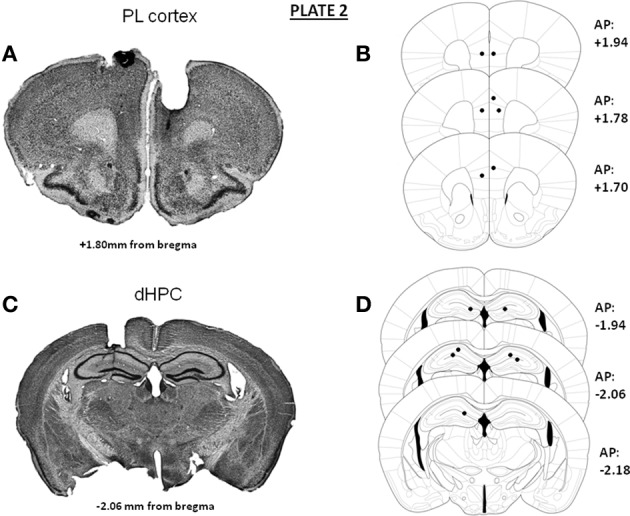
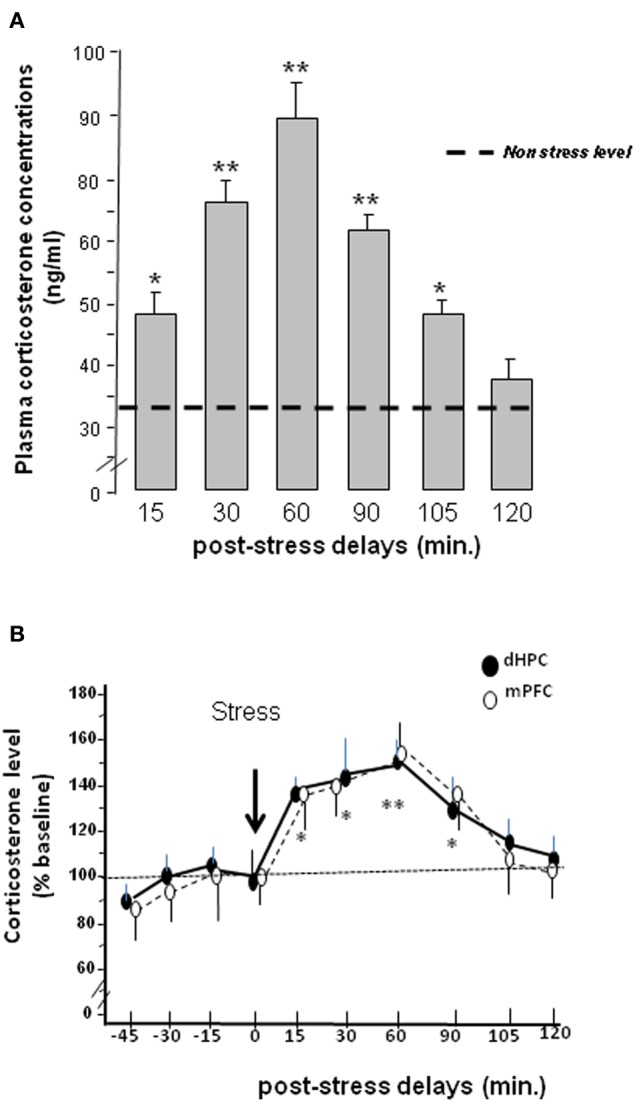
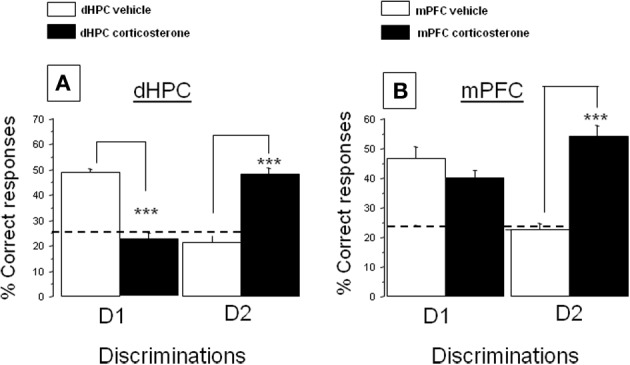
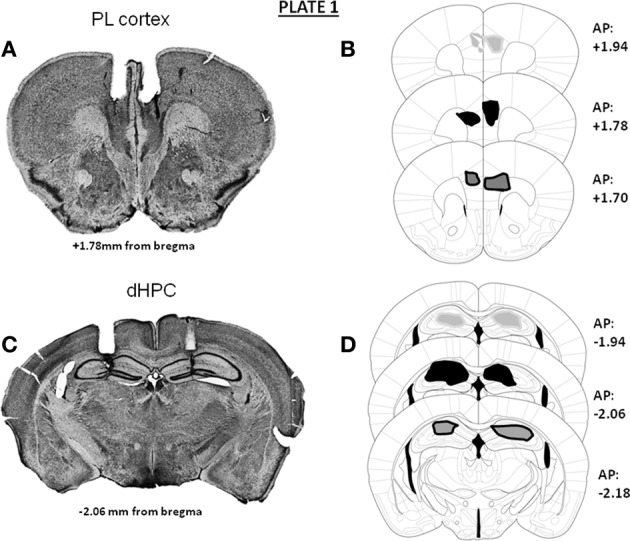
Most of the deleterious effects of stress on memory retrieval are due to a dysfunction of the hippocampo-prefrontal cortex interplay. The role of the stress-induced regional corticosterone increase in such dysfunction remains however unclear, since there is no published study as yet dedicated to measuring corticosterone concentrations simultaneously in both the prefrontal cortex (mPFC) and the hippocampus (dHPC) in relation with memory impairments. To that aim, we first showed in Experiment 1 that an acute stress (3 electric footschocks; 0.9 mA each) delivered before memory testing reversed the memory retrieval pattern (MRP) in a serial discrimination task in which mice learned two successive discriminations. More precisely, whereas non-stressed animals remembered accurately the first learned discrimination and not the second one, stressed mice remembered more accurately the second discrimination but not the first one. We demonstrated that local inactivation of dHPC or mPFC with the anesthetic lidocaine recruited the dHPC activity in non-stress conditions whereas the stress-induced MRP inversion recruited the mPFC activity. In a second experiment, we showed that acute stress induced a very similar time-course evolution of corticosterone rises within both the mPFC and dHPC. In a 3rd experiment, we found however that in situ injections of corticosterone either within the mPFC or the dHPC before memory testing favored the emergence of the mPFC-dependent MRP but blocked the emergence of the dHPC-dependent one. Overall, our study evidences that the simultaneous increase of corticosterone after stress in both areas induces a shift from dHPC (non-stress condition) to mPFC-dependent MRP and that corticosterone is critically involved in mediating the deleterious effects of stress on cognitive functions involving the mPFC-HPC interplay.
应激对记忆提取的大多数有害影响归因于海马体-前额叶皮质相互作用的功能障碍。然而,应激诱导的局部皮质酮增加在这种功能障碍中的作用仍不明确,因为目前尚无专门研究同时测量前额叶皮质(内侧前额叶皮质,mPFC)和海马体(背侧海马体,dHPC)中皮质酮浓度与记忆损伤之间关系的报道。为此,我们在实验1中首先表明,在记忆测试前施加急性应激(3次电击足底;每次0.9 mA)会逆转小鼠在连续辨别任务中的记忆提取模式(MRP),该任务中,小鼠学习了两个连续的辨别。更确切地说,未受应激的动物能准确记住第一次学习的辨别而记不住第二次,而受应激的小鼠能更准确地记住第二次辨别但记不住第一次。我们证明,用麻醉剂利多卡因局部灭活dHPC或mPFC会在非应激条件下募集dHPC活性,而应激诱导的MRP反转则会募集mPFC活性。在第二个实验中,我们表明急性应激在mPFC和dHPC中诱导了非常相似的皮质酮升高时间进程演变。然而,在第三个实验中,我们发现,在记忆测试前于mPFC或dHPC内原位注射皮质酮有利于mPFC依赖性MRP的出现,但会阻止dHPC依赖性MRP的出现。总体而言,我们的研究证明,应激后两个区域皮质酮的同时增加会导致从dHPC(非应激条件)依赖性MRP向mPFC依赖性MRP的转变,并且皮质酮在介导应激对涉及mPFC-HPC相互作用的认知功能的有害影响中起关键作用。