Key Laboratory of the Ministry of Agriculture for Nuclear Agricultural Sciences, Institute of Nuclear Agricultural Sciences, Zhejiang University Hangzhou, China ; Department of Plant and Environmental Sciences, Faculty of Sciences, University of Copenhagen Frederiksberg, Denmark.
Department of Plant and Environmental Sciences, Faculty of Sciences, University of Copenhagen Frederiksberg, Denmark.
Front Plant Sci. 2014 May 15;5:197. doi: 10.3389/fpls.2014.00197. eCollection 2014.
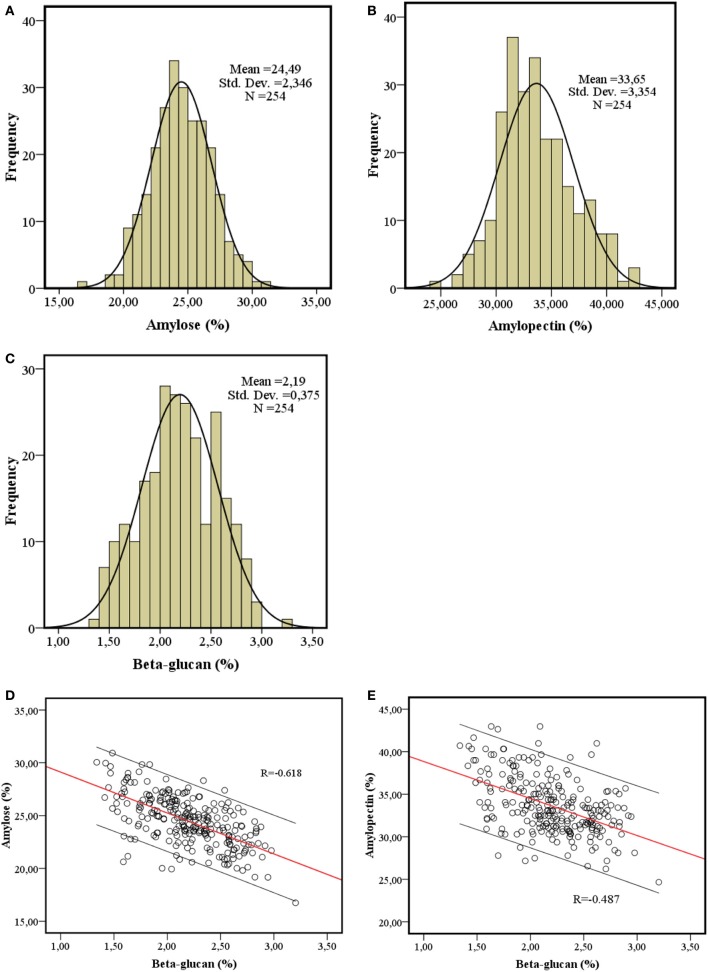
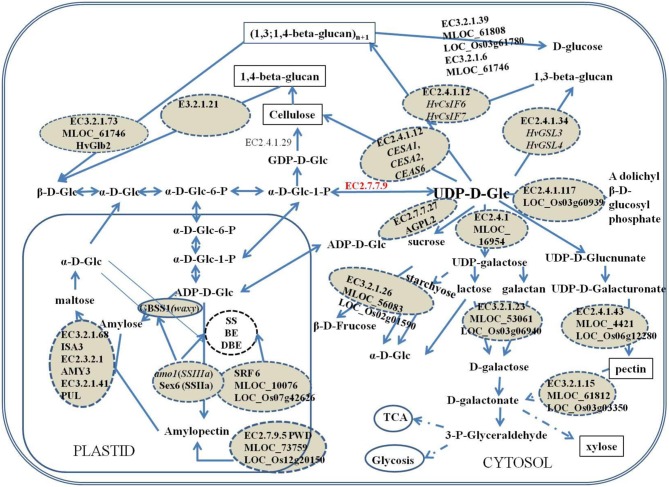
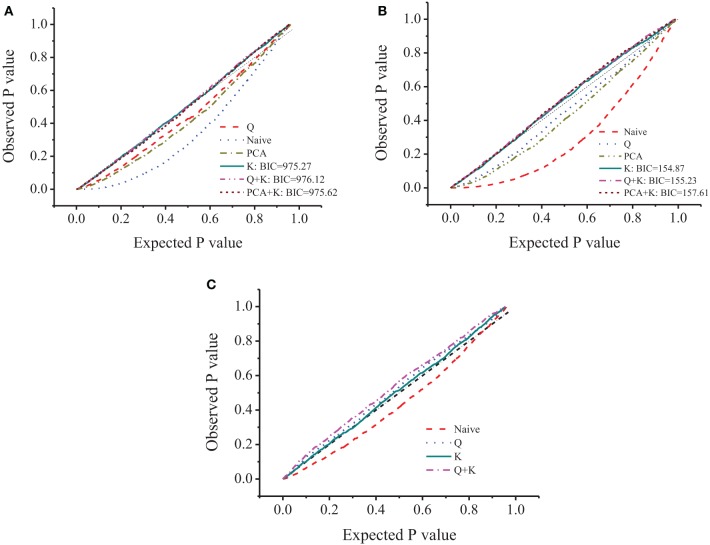
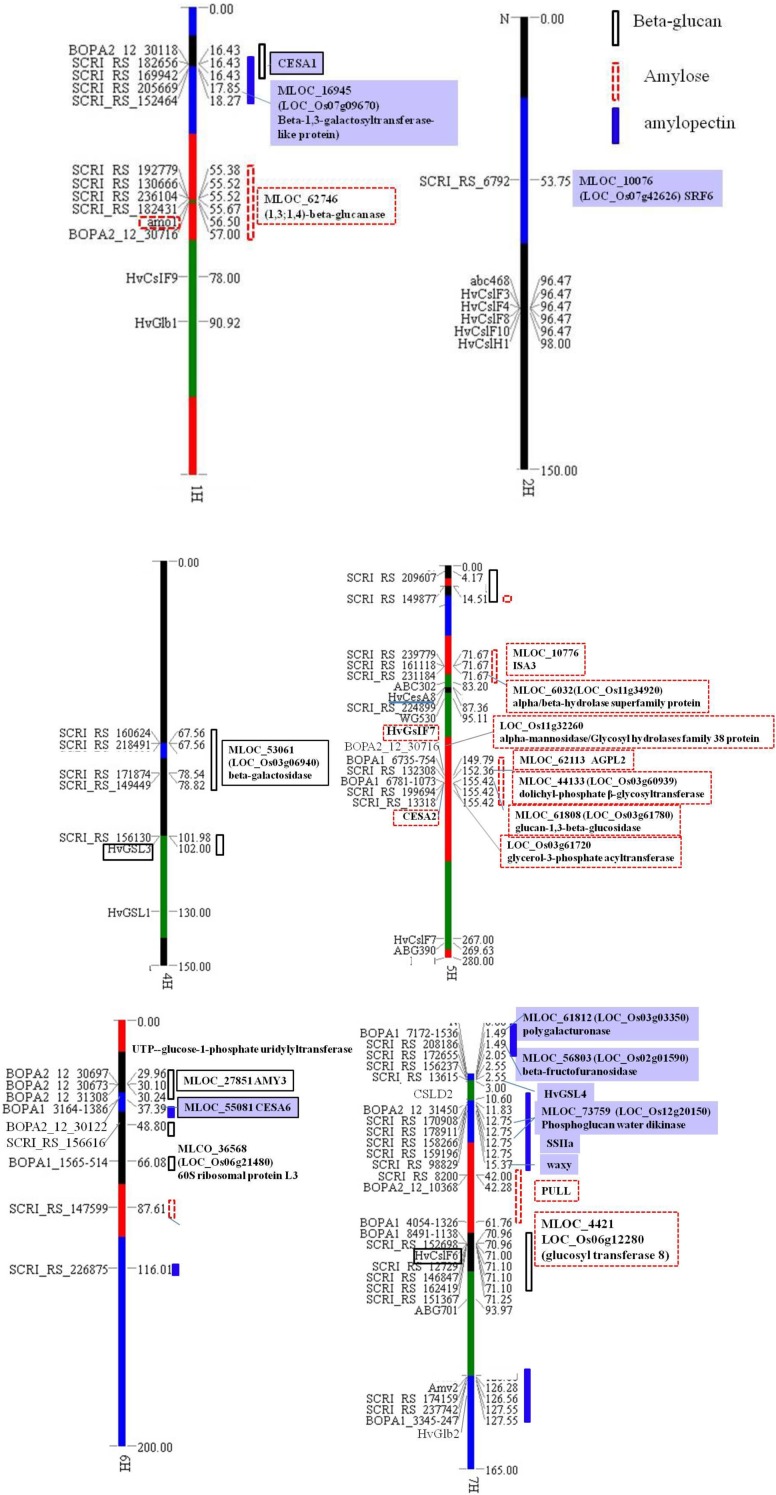
Genome-wide association studies (GWAS) for amylose, amylopectin and β-glucan concentration in a collection of 254 European spring barley varieties allowed to identify 20, 17, and 21 single nucleotide polymorphic (SNP) markers, respectively, associated with these important grain quality traits. Negative correlations between the content of amylose and β-glucan (R = -0.62, P < 0.01) and amylopectin and β-glucan (R = -0.487, P < 0.01) were found in this large collection of spring barley varieties. Besides HvCslF6, amo1 and AGPL2, sex6, and waxy were identified among the major genes responsible for β-glucan, amylose and amylopectin content, respectively. Several minor genes like HvGSL4, HvGSL3, and HvCesA6, PWD were also detected by GWAS for the first time. Furthermore, the gene encoding β-fructofuranosidase, located on the short arm of chromosome 7H at 1.49 cM, and SRF6, encoding "leucine-rich repeat receptor kinase protein" on chromosome 2 H, are proposed to be new candidate genes for amylopectin formation in barley endosperm. Several of the associated SNPs on chromosome 1, 5, 6, and 7H mapped to overlapping regions containing QTLs and genes controlling the three grain constituents. In particular chromosomes 5 and 7H carry many QTLs controlling barley grain quality. Amylose, amylopectin and β-glucan were interacted among each other through a metabolic network connected by UDP showing pleiotropic effects. Taken together, these results showed that cereal quality traits related each other and regulated through an interaction network, the identified major genes and genetic regions for amylose, amylopectin and β-glucan is a helpful for further research on carbohydrates and barley breeding.
在一个包含 254 个欧洲春大麦品种的集合中进行的直链淀粉、支链淀粉和 β-葡聚糖浓度的全基因组关联研究(GWAS),分别鉴定出与这些重要谷物品质性状相关的 20、17 和 21 个单核苷酸多态性(SNP)标记。在这个大型春大麦品种集合中,发现直链淀粉和 β-葡聚糖(R = -0.62,P < 0.01)以及支链淀粉和 β-葡聚糖(R = -0.487,P < 0.01)之间存在负相关。除了 HvCslF6、amo1 和 AGPL2 之外,sex6 和 waxy 也被鉴定为负责 β-葡聚糖、直链淀粉和支链淀粉含量的主要基因之一。通过 GWAS,还首次检测到几个次要基因,如 HvGSL4、HvGSL3 和 HvCesA6、PWD。此外,位于 7H 染色体短臂上 1.49cM 处编码 β-果糖呋喃糖苷酶的基因和位于 2H 染色体上编码“富含亮氨酸重复受体激酶蛋白”的 SRF6 被提议为大麦胚乳中支链淀粉形成的新候选基因。染色体 1、5、6 和 7H 上的一些相关 SNP 映射到包含控制三种谷物成分的 QTL 和基因的重叠区域。特别是染色体 5 和 7H 携带许多控制大麦谷物品质的 QTL。直链淀粉、支链淀粉和 β-葡聚糖通过由 UDP 连接的代谢网络相互作用,表现出多效性。总的来说,这些结果表明,与谷物品质性状相互作用并通过相互作用网络调节,鉴定出的与直链淀粉、支链淀粉和 β-葡聚糖相关的主要基因和遗传区域,有助于进一步研究碳水化合物和大麦育种。