Kartoglu Umit, Milstien Julie
Department of Essential Medicines and Health Products, World Health Organization, 20 Avenue Appia, 27 Geneva 1211, Switzerland.
Expert Rev Vaccines. 2014 Jul;13(7):843-54. doi: 10.1586/14760584.2014.923761. Epub 2014 May 28.
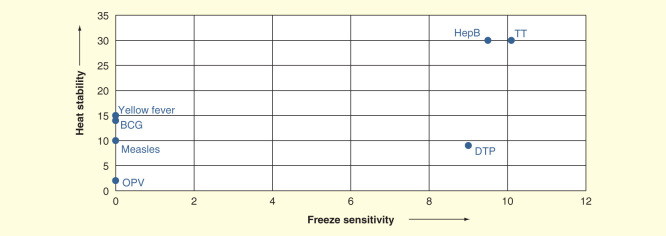
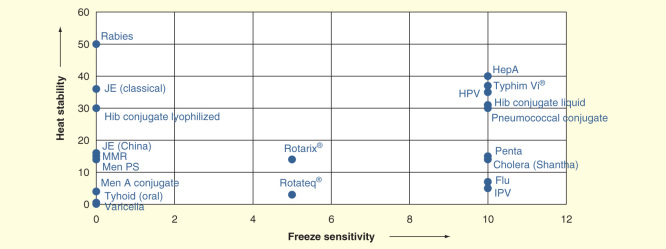
The Expanded Program on Immunization was designed 40 years ago for two types of vaccines: those that are heat stable but freeze sensitive and those that are stable to freezing but heat labile. A cold chain was developed for transport and storage of such vaccines and established in all countries, despite limited access to resources and electricity in the poorest areas. However, cold chain problems occur in all countries. Recent changes to vaccines and vaccine handling include development and introduction of new vaccines with a wide range of characteristics, improvement of heat stability of several basic vaccines, observation of vaccine freezing as a real threat, development of regulatory pathways for both vaccine development and the supply chain, and emergence of new temperature monitoring devices that can pinpoint and avoid problems. With such tools, public health groups have now encouraged development of vaccines labeled for use in flexible cold chains and these tools should be considered for future systems.
扩大免疫规划于40年前设计用于两类疫苗:一类是热稳定但对冷冻敏感的疫苗,另一类是对冷冻稳定但热不稳定的疫苗。为此开发了一个冷链用于此类疫苗的运输和储存,并在所有国家建立起来,尽管最贫困地区资源和电力供应有限。然而,冷链问题在所有国家都会出现。疫苗及疫苗处理方面的近期变化包括开发和引入具有多种特性的新疫苗、提高几种基本疫苗的热稳定性、认识到疫苗冷冻是一个切实存在的威胁、建立疫苗研发和供应链的监管途径以及出现能够精准定位并避免问题的新型温度监测设备。有了这些工具,公共卫生组织如今鼓励开发标明可在灵活冷链中使用的疫苗,未来的系统应考虑采用这些工具。