Pearcey Gregory E P, Power Kevin E, Button Duane C
School of Human Kinetics and Recreation, Memorial University of Newfoundland, St. John's, NL, Canada.
School of Human Kinetics and Recreation, Memorial University of Newfoundland, St. John's, NL, Canada; Faculty of Medicine, Memorial University of Newfoundland, St. John's, NL, Canada.
PLoS One. 2014 May 29;9(5):e98468. doi: 10.1371/journal.pone.0098468. eCollection 2014.
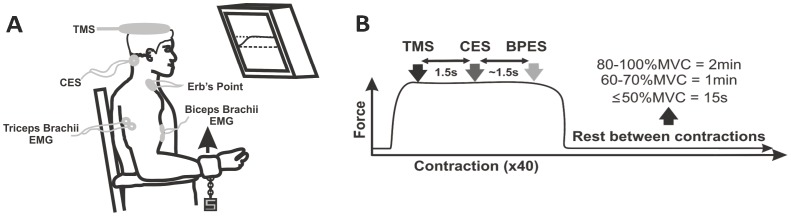
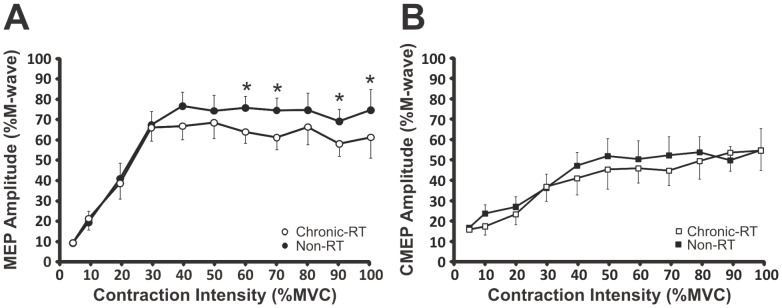
Motor evoked potentials (MEP) and cervicomedullary evoked potentials (CMEP) may help determine the corticospinal adaptations underlying chronic resistance training-induced increases in voluntary force production. The purpose of the study was to determine the effect of chronic resistance training on corticospinal excitability (CE) of the biceps brachii during elbow flexion contractions at various intensities and the CNS site (i.e. supraspinal or spinal) predominantly responsible for any training-induced differences in CE. Fifteen male subjects were divided into two groups: 1) chronic resistance-trained (RT), (n = 8) and 2) non-RT, (n = 7). Each group performed four sets of ∼5 s elbow flexion contractions of the dominant arm at 10 target forces (from 10%-100% MVC). During each contraction, subjects received 1) transcranial magnetic stimulation, 2) transmastoid electrical stimulation and 3) brachial plexus electrical stimulation, to determine MEP, CMEP and compound muscle action potential (Mmax) amplitudes, respectively, of the biceps brachii. All MEP and CMEP amplitudes were normalized to Mmax. MEP amplitudes were similar in both groups up to 50% MVC, however, beyond 50% MVC, MEP amplitudes were lower in the chronic RT group (p<0.05). CMEP amplitudes recorded from 10-100% MVC were similar for both groups. The ratio of MEP amplitude/absolute force and CMEP amplitude/absolute force were reduced (p<0.012) at all contraction intensities from 10-100% MVC in the chronic-RT compared to the non-RT group. In conclusion, chronic resistance training alters supraspinal and spinal excitability. However, adaptations in the spinal cord (i.e. motoneurone) seem to have a greater influence on the altered CE.
运动诱发电位(MEP)和颈髓诱发电位(CMEP)可能有助于确定慢性抗阻训练引起的随意力产生增加背后的皮质脊髓适应性。本研究的目的是确定慢性抗阻训练对肱二头肌在不同强度的肘关节屈曲收缩过程中皮质脊髓兴奋性(CE)的影响,以及主要负责训练引起的CE差异的中枢神经系统部位(即脊髓上或脊髓)。15名男性受试者被分为两组:1)慢性抗阻训练组(RT),(n = 8)和2)非抗阻训练组,(n = 7)。每组在10个目标力(从10% - 100%最大自主收缩力[MVC])下对优势臂进行四组约5秒的肘关节屈曲收缩。在每次收缩期间,受试者分别接受1)经颅磁刺激、2)经乳突电刺激和3)臂丛电刺激,以确定肱二头肌的MEP、CMEP和复合肌肉动作电位(Mmax)幅度。所有MEP和CMEP幅度均以Mmax进行标准化。两组在达到50%MVC之前MEP幅度相似,然而,超过50%MVC后,慢性RT组的MEP幅度较低(p<0.05)。两组在10% - 100%MVC记录的CMEP幅度相似。与非RT组相比,慢性RT组在10% - 100%MVC的所有收缩强度下,MEP幅度/绝对力和CMEP幅度/绝对力的比值均降低(p<0.012)。总之,慢性抗阻训练会改变脊髓上和脊髓的兴奋性。然而,脊髓(即运动神经元)的适应性似乎对CE的改变有更大影响。