Department of Environmental Studies, Elon University, Elon, NC 27244, USA
Department of Environmental Studies, Elon University, Elon, NC 27244, USA.
AoB Plants. 2014 Mar 28;6:plu014. doi: 10.1093/aobpla/plu014.
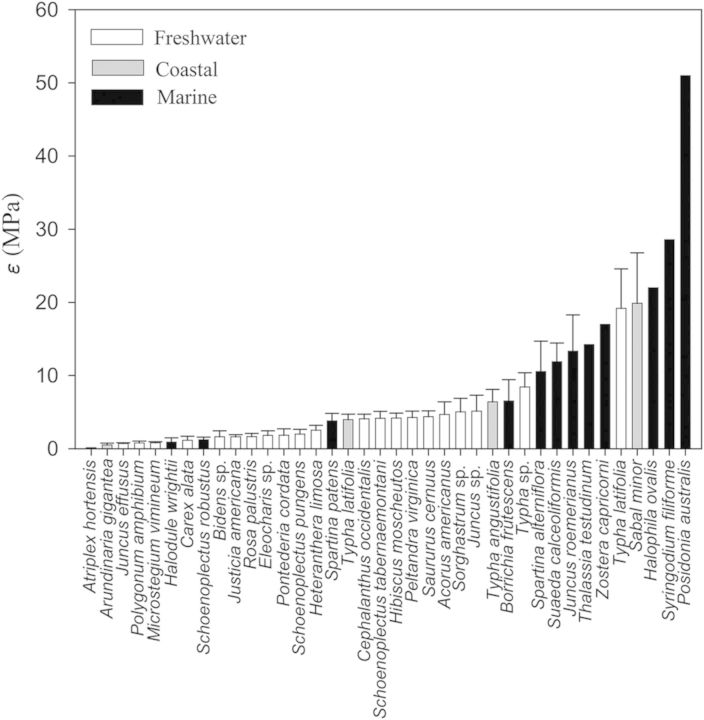
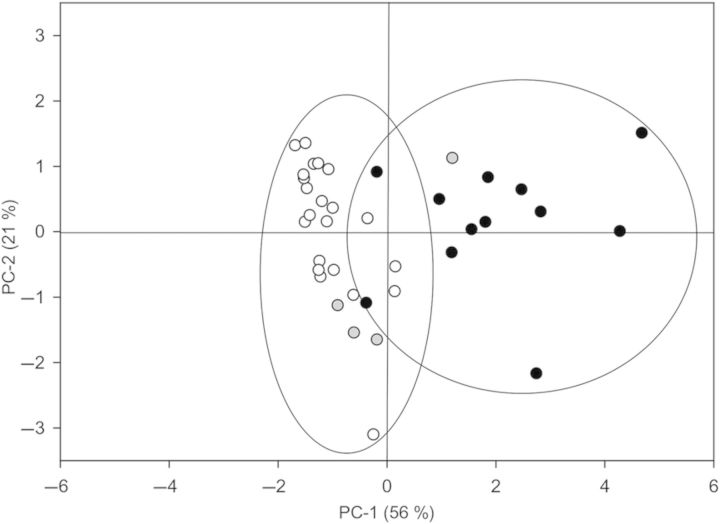
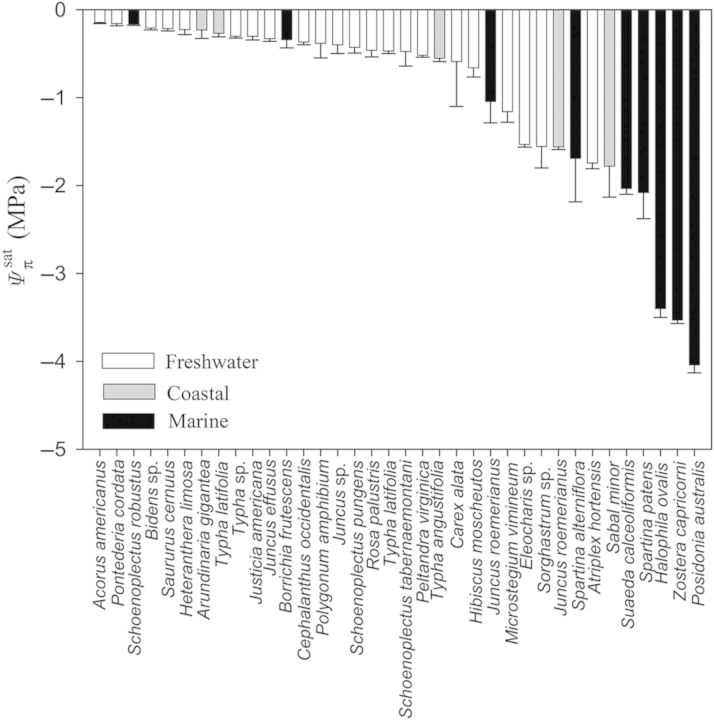
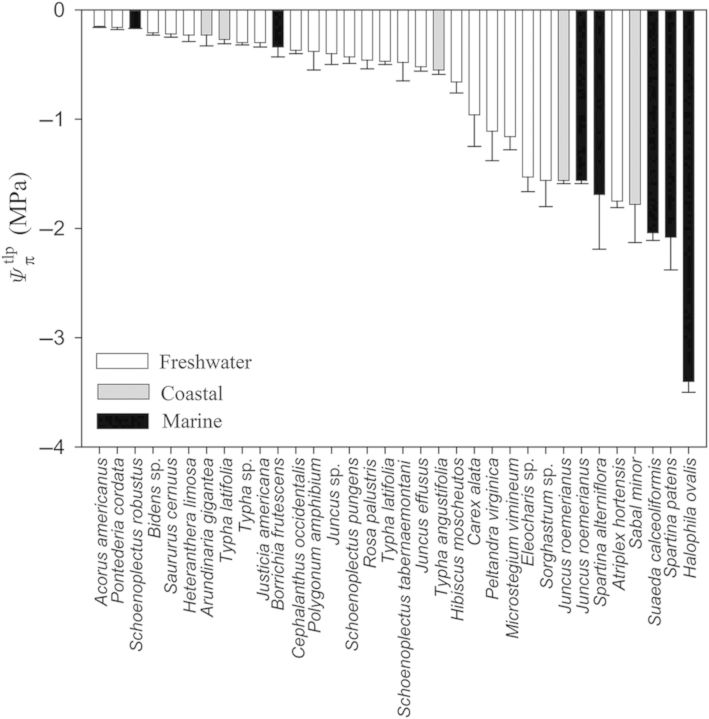
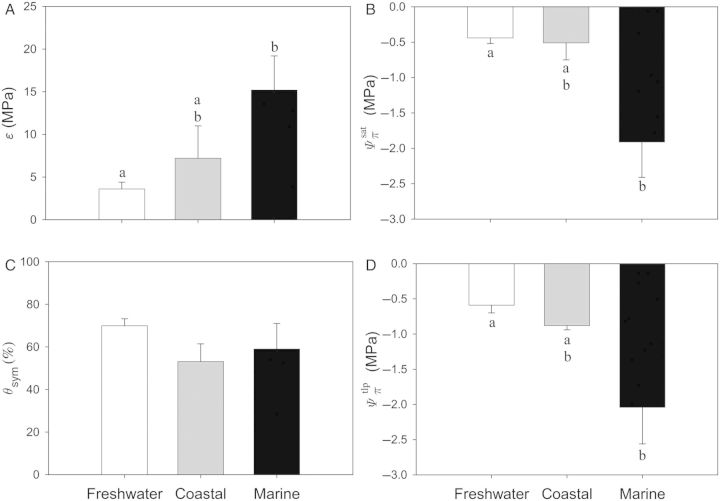
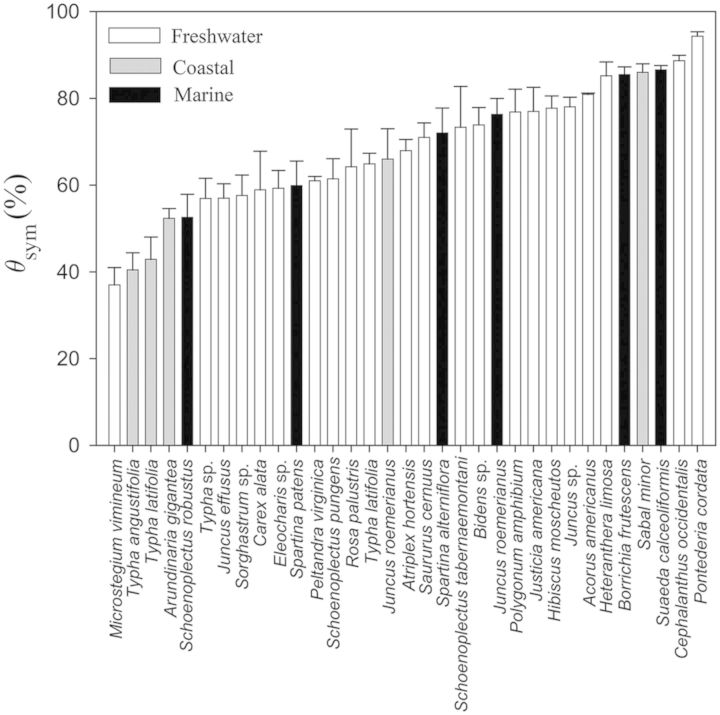
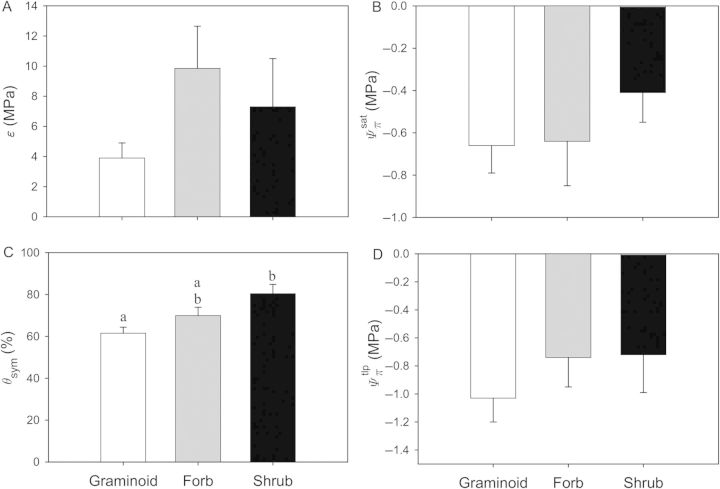
Bulk modulus of elasticity (ɛ), depicting the flexibility of plant tissues, is recognized as an important component in maintaining internal water balance. Elevated ɛ and comparatively low osmotic potential (Ψπ) may work in concert to effectively maintain vital cellular water content. This concept, termed the 'cell water conservation hypothesis', may foster tolerance for lower soil-water potentials in plants while minimizing cell dehydration and shrinkage. Therefore, the accumulation of solutes in marine plants, causing decreases in Ψπ, play an important role in plant-water relations and likely works with higher ɛ to achieve favourable cell volumes. While it is generally held that plants residing in marine systems have higher leaf tissue ɛ, to our knowledge no study has specifically addressed this notion in aquatic and wetland plants residing in marine and freshwater systems. Therefore, we compared ɛ and Ψπ in leaf tissues of 38 freshwater, coastal and marine plant species using data collected in our laboratory, with additional values from the literature. Overall, 8 of the 10 highest ɛ values were observed in marine plants, and 20 of the lowest 25 ɛ values were recorded in freshwater plants. As expected, marine plants often had lower Ψπ, wherein the majority of marine plants were below -1.0 MPa and the majority of freshwater plants were above -1.0 MPa. While there were no differences among habitat type and symplastic water content (θsym), we did observe higher θsym in shrubs when compared with graminoids, and believe that the comparatively low θsym observed in aquatic grasses may be attributed to their tendency to develop aerenchyma that hold apoplastic water. These results, with few exceptions, support the premise that leaf tissues of plants acclimated to marine environments tend to have higher ɛ and lower Ψπ, and agree with the general tenets of the cell water conservation hypothesis.
弹性模量(ɛ)表示植物组织的柔韧性,被认为是维持内部水分平衡的重要组成部分。升高的ɛ和相对较低的渗透势(Ψπ)可能协同作用,有效地维持重要的细胞含水量。这一概念被称为“细胞水分保护假说”,它可以促进植物在较低土壤水势下的耐受性,同时最大限度地减少细胞脱水和收缩。因此,海洋植物中溶质的积累导致 Ψπ降低,在植物水分关系中起着重要作用,并且可能与较高的 ɛ一起实现有利的细胞体积。虽然普遍认为生活在海洋系统中的植物具有较高的叶片组织 ɛ,但据我们所知,没有研究专门针对生活在海洋和淡水系统中的水生和湿地植物的这一概念。因此,我们使用实验室收集的数据以及文献中的其他值,比较了 38 种淡水、沿海和海洋植物物种的叶片组织中的 ɛ 和 Ψπ。总的来说,在海洋植物中观察到了 8 个最高 ɛ 值中的 10 个,而在淡水植物中记录了 25 个最低 ɛ 值中的 20 个。正如预期的那样,海洋植物通常具有较低的 Ψπ,其中大多数海洋植物低于-1.0 MPa,而大多数淡水植物高于-1.0 MPa。虽然生境类型和共质体含水量(θsym)之间没有差异,但我们确实观察到与禾本科植物相比,灌木具有较高的 θsym,并且认为水生草本植物中观察到的相对较低的 θsym 可能归因于它们倾向于形成含有质外体水的通气组织。这些结果除了少数例外,支持了这样一个前提,即适应海洋环境的植物的叶片组织往往具有较高的 ɛ 和较低的 Ψπ,并且与细胞水分保护假说的一般原则一致。