Centre of Research Excellence for Chronic Respiratory Disease and Lung Aging, School of Medicine, University of Tasmania, Hobart, TAS, Australia.
Faculty of Education, University of Tasmania, Hobart, TAS, Australia.
Int J Chron Obstruct Pulmon Dis. 2014 May 19;9:513-23. doi: 10.2147/COPD.S58478. eCollection 2014.
Both exercise and self-management are advocated in pulmonary rehabilitation for people with chronic obstructive pulmonary disease (COPD). The widely used 6-week, group-based Chronic Disease Self-Management Program (CDSMP) increases self-reported exercise, despite supervised exercise not being a program component. This has been little explored in COPD. Whether adding supervised exercise to the CDSMP would add benefit is unknown. We investigated the CDSMP in COPD, with and without a formal supervised exercise component, to address this question.
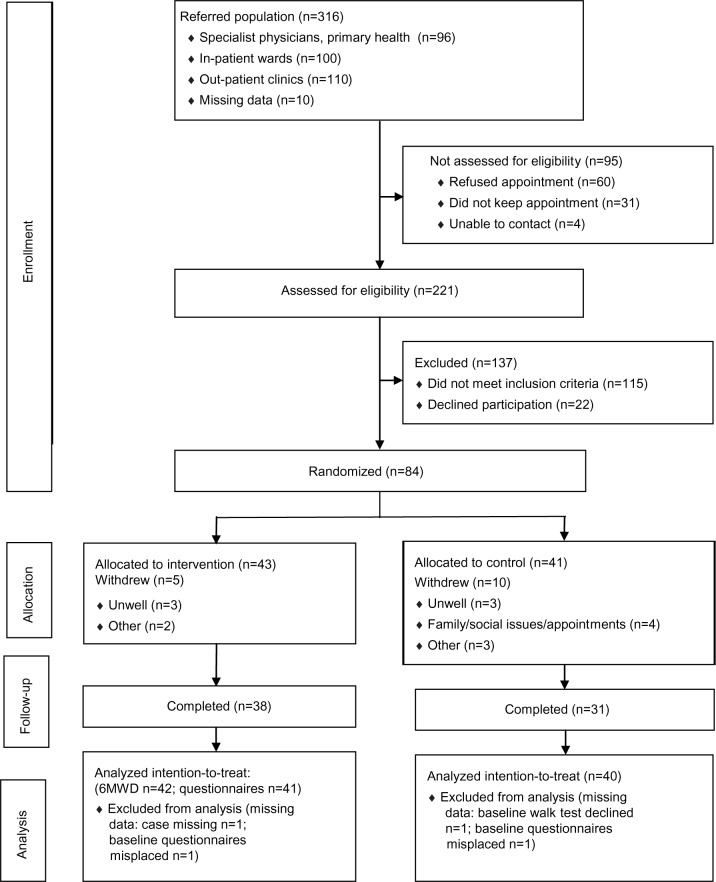
Adult outpatients with COPD were randomized to the CDSMP with or without one hour of weekly supervised exercise over 6 weeks. The primary outcome measure was 6-minute walk test distance (6MWD). Secondary outcomes included self-reported exercise, exercise stage of change, exercise self-efficacy, breathlessness, quality of life, and self-management behaviors. Within- and between-group differences were analyzed on an intention-to-treat basis.
Of 84 subjects recruited, 15 withdrew. 6MWD increased similarly in both groups: CDSMP-plus-exercise (intervention group) by 18.6±46.2 m; CDSMP-alone (control group) by 20.0±46.2 m. There was no significant difference for any secondary outcome.
The CDSMP produced à small statistically significant increase in 6MWD. The addition of a single supervised exercise session did not further increase exercise capacity. Our findings confirm the efficacy of a behaviorally based intervention in COPD, but this would seem to be less than expected from conventional exercise-based pulmonary rehabilitation, raising the question of how, if at all, the small gains observed in this study may be augmented.
运动和自我管理都被提倡用于慢性阻塞性肺疾病(COPD)患者的肺康复。广泛使用的 6 周、基于小组的慢性疾病自我管理计划(CDSMP)增加了自我报告的运动,尽管监督运动不是该计划的组成部分。这在 COPD 中很少被探讨。在 CDSMP 中加入监督运动是否会带来额外的益处尚不清楚。我们调查了 COPD 患者的 CDSMP,包括有无一个小时的每周监督运动,共 6 周。主要观察指标是 6 分钟步行测试距离(6MWD)。次要观察指标包括自我报告的运动、运动阶段的变化、运动自我效能、呼吸困难、生活质量和自我管理行为。基于意向治疗进行了组内和组间差异分析。
成年 COPD 门诊患者被随机分配到 CDSMP 加或不加每周一小时的监督运动,共 6 周。主要观察指标是 6 分钟步行测试距离(6MWD)。次要观察指标包括自我报告的运动、运动阶段的变化、运动自我效能、呼吸困难、生活质量和自我管理行为。基于意向治疗进行了组内和组间差异分析。
在招募的 84 名患者中,有 15 名退出。两组的 6MWD 增加相似:CDSMP 加运动(干预组)增加了 18.6±46.2m;CDSMP 单独组(对照组)增加了 20.0±46.2m。任何次要结果都没有显著差异。
CDSMP 使 6MWD 有一个小的统计学显著增加。增加一次监督运动并没有进一步增加运动能力。我们的研究结果证实了基于行为的干预在 COPD 中的有效性,但这似乎低于传统基于运动的肺康复的预期,这就提出了一个问题,即无论如何,在这项研究中观察到的微小收益如何增加。