Adam-Poupart Ariane, Brand Allan, Fournier Michel, Jerrett Michael, Smargiassi Audrey
Department of Environmental and Occupational Health, Faculty of Public Health, Université de Montréal, Montréal, Québec, Canada.
Environ Health Perspect. 2014 Sep;122(9):970-6. doi: 10.1289/ehp.1306566. Epub 2014 May 30.
Ambient air ozone (O3) is a pulmonary irritant that has been associated with respiratory health effects including increased lung inflammation and permeability, airway hyperreactivity, respiratory symptoms, and decreased lung function. Estimation of O3 exposure is a complex task because the pollutant exhibits complex spatiotemporal patterns. To refine the quality of exposure estimation, various spatiotemporal methods have been developed worldwide.
We sought to compare the accuracy of three spatiotemporal models to predict summer ground-level O3 in Quebec, Canada.
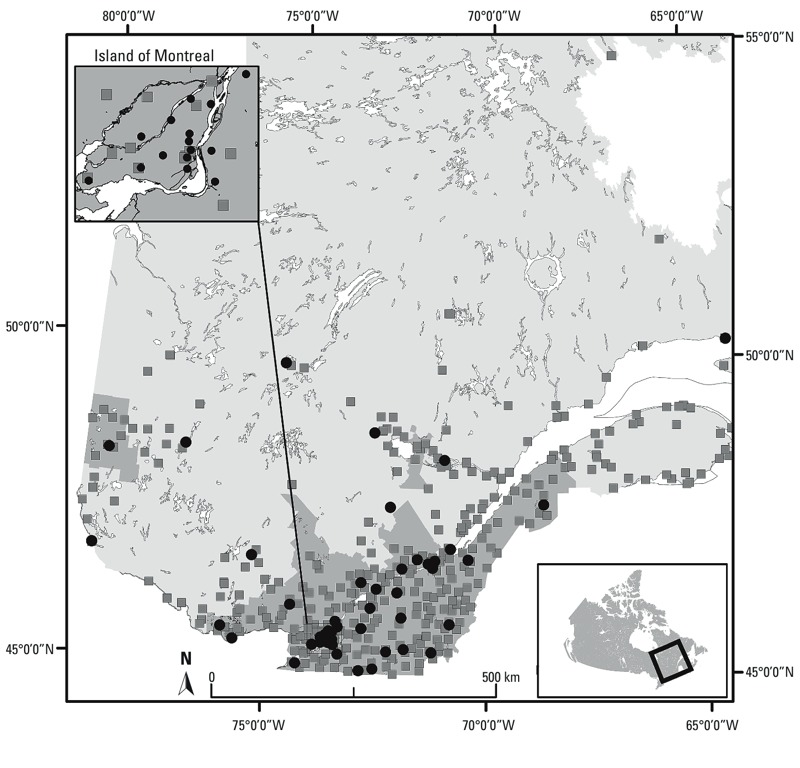
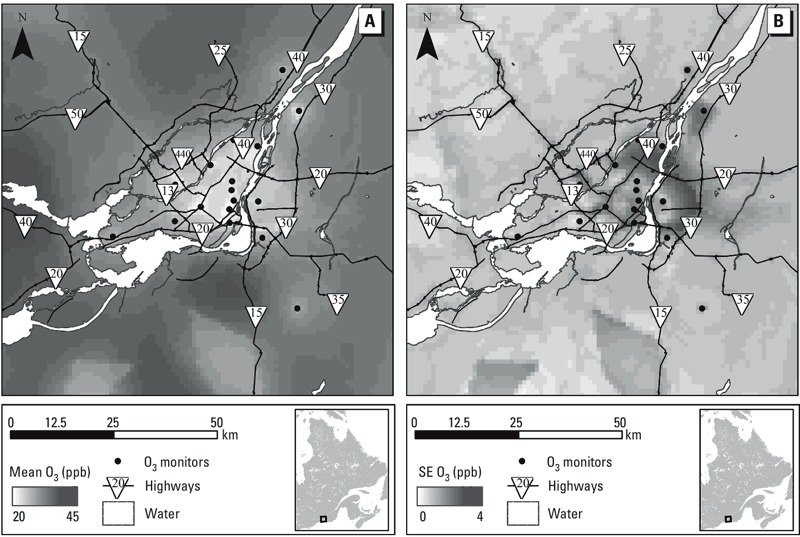
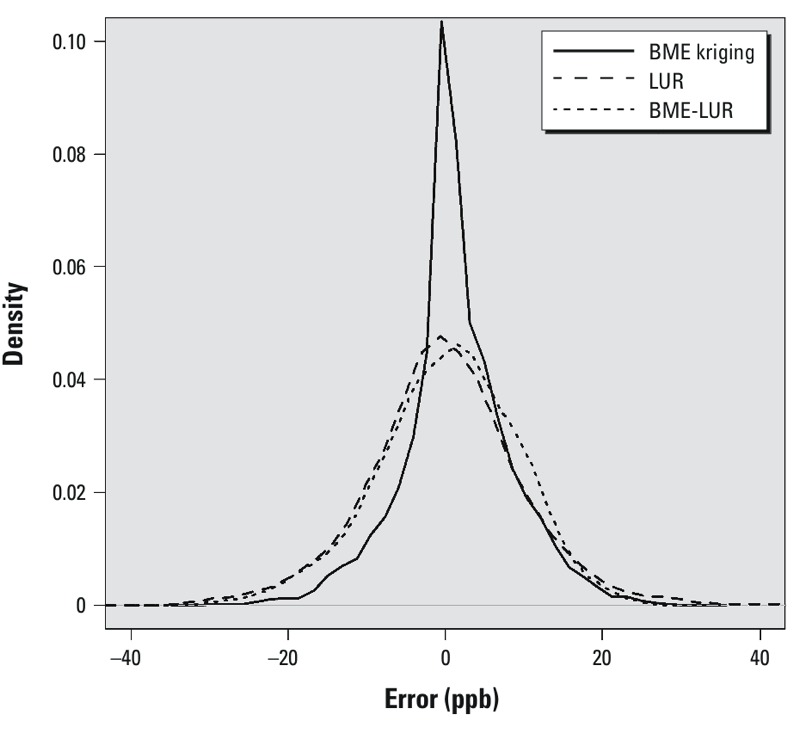
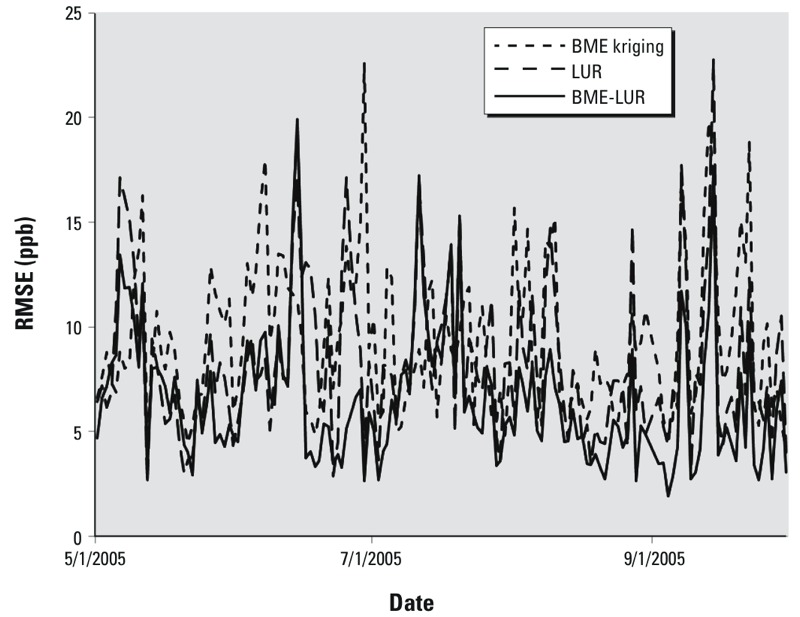
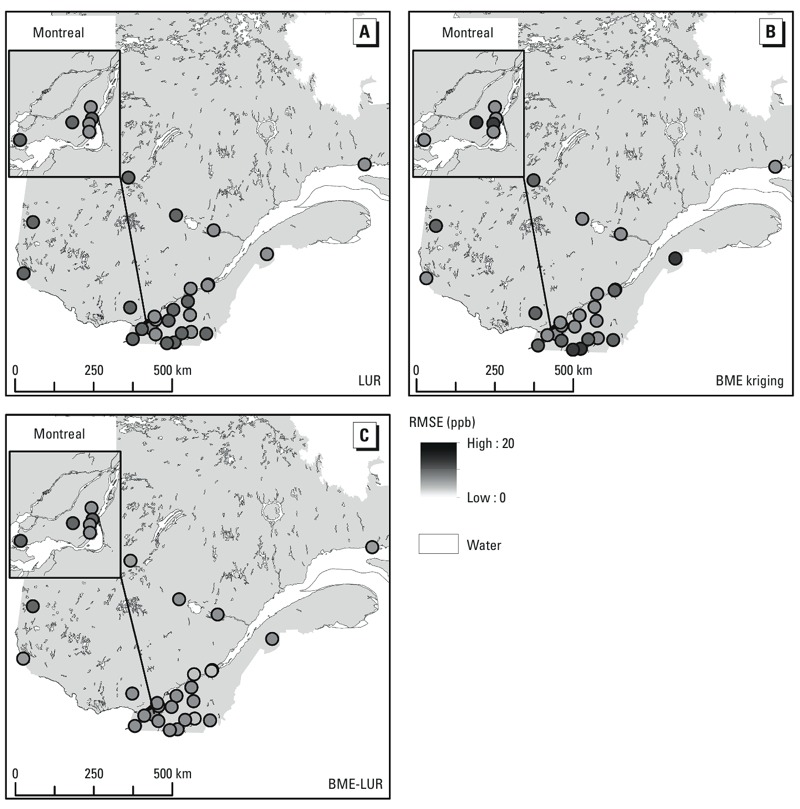
We developed a land-use mixed-effects regression (LUR) model based on readily available data (air quality and meteorological monitoring data, road networks information, latitude), a Bayesian maximum entropy (BME) model incorporating both O3 monitoring station data and the land-use mixed model outputs (BME-LUR), and a kriging method model based only on available O3 monitoring station data (BME kriging). We performed leave-one-station-out cross-validation and visually assessed the predictive capability of each model by examining the mean temporal and spatial distributions of the average estimated errors.
The BME-LUR was the best predictive model (R2 = 0.653) with the lowest root mean-square error (RMSE ;7.06 ppb), followed by the LUR model (R2 = 0.466, RMSE = 8.747) and the BME kriging model (R2 = 0.414, RMSE = 9.164).
Our findings suggest that errors of estimation in the interpolation of O3 concentrations with BME can be greatly reduced by incorporating outputs from a LUR model developed with readily available data.
环境空气中的臭氧(O₃)是一种肺部刺激物,与多种呼吸系统健康影响相关,包括肺部炎症和通透性增加、气道高反应性、呼吸道症状以及肺功能下降。由于该污染物呈现复杂的时空模式,因此估算臭氧暴露是一项复杂的任务。为了提高暴露估算的质量,全球已开发出各种时空方法。
我们试图比较三种时空模型预测加拿大魁北克夏季地面臭氧水平的准确性。
我们基于现成数据(空气质量和气象监测数据、道路网络信息、纬度)开发了一个土地利用混合效应回归(LUR)模型,一个结合臭氧监测站数据和土地利用混合模型输出的贝叶斯最大熵(BME)模型(BME-LUR),以及一个仅基于现有臭氧监测站数据的克里金方法模型(BME克里金)。我们进行了留一法交叉验证,并通过检查平均估计误差的平均时间和空间分布直观地评估了每个模型的预测能力。
BME-LUR是最佳预测模型(R² = 0.653),均方根误差最低(RMSE;7.06 ppb),其次是LUR模型(R² = 0.466,RMSE = 8.747)和BME克里金模型(R² = 0.414,RMSE = 9.164)。
我们的研究结果表明,通过纳入利用现成数据开发的LUR模型的输出,可以大大减少使用BME插值臭氧浓度时的估计误差。